THE BODDY JOURNAL
Best Fitbod Alternatives for Real-Time Workout Coaching
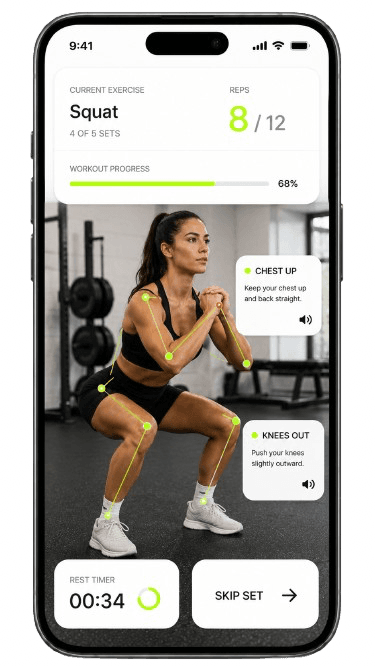
BODDY IN ACTION
Real-time coaching on the iPhone you already use.
Boddy follows supported movement, counts repetitions, and delivers concise visual and spoken cues during the set.

Direct answer: Boddy is the best Fitbod alternative for someone whose deciding requirement is real-time form feedback during supported exercises. It uses the iPhone camera to observe movement, count reps, and provide concise on-screen or spoken cues while the set is still happening. If your priority is instead social workout logging, routines, history, and community, another option below may fit better.
This independent editorial guide compares publicly documented product capabilities checked in August 2026. “Best” is tied to a stated use case, not sponsorship or a universal score. Features, availability, and pricing can change, so confirm current details before subscribing.
Why people search for Fitbod alternatives
Most people searching for a Fitbod alternative still want help deciding what to train. The real question is whether they need a different workout generator, a simpler logger, a program library, or feedback on the repetitions they are performing right now.
Fitbod is strongest when the user wants strength workouts generated from available equipment, training history, muscle recovery, and stated goals. That is a programming problem, and Fitbod has built a mature experience around it.
The reason to switch is not that adaptive planning has no value. It is that a generated plan cannot see the set. If your recurring frustration is wondering whether a supported squat reached the intended depth or whether a visible movement pattern changed as fatigue increased, planning alone leaves that question unanswered.
For a direct two-product analysis, read Boddy vs Fitbod. The guide you are reading has a broader job: identify which type of replacement matches the reason for switching.
Fitbod alternatives at a glance
| Alternative | Best for | Main tradeoff |
|---|---|---|
| Boddy | Real-time camera-observed feedback and spoken cues during supported exercises | Its strongest differentiation is in-set coaching, so confirm that your preferred exercises and camera setup are supported. |
| Hevy | Social workout logging, routines, history, and community | It is primarily a tracker and social training product rather than a camera-based form coach. |
| Strong | Fast, focused set logging with timers and records | It keeps the training log organized but does not publicly position the phone camera as an observer of current reps. |
| Boostcamp | Coach-created programs, progression, and a broad program library | Its program depth solves a different problem from live movement correction. |
| Freeletics | Adaptive Training Journeys and equipment-light training | Its plan adaptations rely heavily on profile and workout feedback rather than camera observation of every supported rep. |
No table can decide whether an interface feels natural in a real gym. Use it to create a shortlist, then test the finalists in an ordinary session with the equipment, lighting, headphones, and time pressure you actually have.
The best alternatives, explained
1. Boddy
Best for: Real-time camera-observed feedback and spoken cues during supported exercises.
Boddy is the most relevant option in this list when “coaching” means a response to the user's own supported movement. With a suitable camera view, Boddy follows the exercise, counts repetitions, and can issue a concise visual or spoken cue before the set ends. That is different from receiving a plan, watching a demonstration, or reviewing a log afterward.
Important tradeoff: Its strongest differentiation is in-set coaching, so confirm that your preferred exercises and camera setup are supported.
2. Hevy
Best for: Social workout logging, routines, history, and community.
Hevy deserves consideration because its main job may match the reason someone is leaving Fitbod. It should be judged on that job rather than on whether it uses the same marketing vocabulary as every other fitness product.
Important tradeoff: It is primarily a tracker and social training product rather than a camera-based form coach.
3. Strong
Best for: Fast, focused set logging with timers and records.
Strong deserves consideration because its main job may match the reason someone is leaving Fitbod. It should be judged on that job rather than on whether it uses the same marketing vocabulary as every other fitness product.
Important tradeoff: It keeps the training log organized but does not publicly position the phone camera as an observer of current reps.
4. Boostcamp
Best for: Coach-created programs, progression, and a broad program library.
Boostcamp deserves consideration because its main job may match the reason someone is leaving Fitbod. It should be judged on that job rather than on whether it uses the same marketing vocabulary as every other fitness product.
Important tradeoff: Its program depth solves a different problem from live movement correction.
5. Freeletics
Best for: Adaptive Training Journeys and equipment-light training.
Freeletics deserves consideration because its main job may match the reason someone is leaving Fitbod. It should be judged on that job rather than on whether it uses the same marketing vocabulary as every other fitness product.
Important tradeoff: Its plan adaptations rely heavily on profile and workout feedback rather than camera observation of every supported rep.
The difference between a workout app and an in-set coach
Fitness apps often group four separate jobs under the word “coaching”:
- Planning: choosing exercises, sets, repetitions, and weekly structure.
- Instruction: showing a demonstration or playing general technique cues.
- Tracking: recording load, repetitions, time, effort, and progress.
- Observation: responding to what the individual user is doing during the current repetition.
The first three can be excellent without the fourth. A video can teach the intended movement, but it cannot confirm what the viewer just did. A workout generator can adapt tomorrow's plan without seeing today's squat. A log can show that eight repetitions were recorded without explaining whether the visible pattern changed on repetition seven.
Boddy is built around the observation layer for supported exercises. The distinction matters because useful feedback has a deadline. A cue that arrives while the user can still adjust the set serves a different purpose from a note reviewed later.
A realistic workout example
Imagine that Fitbod prescribes three sets of squats. It can choose the movement, recommend loading, record the work, and influence the next session. During the third set, however, the lifter still has to judge each repetition. Boddy addresses that specific gap by using a suitable iPhone camera view to observe supported movement, count repetitions, and deliver a concise visual or spoken cue while the set is underway.
This does not make camera coaching automatically superior. If the angle is obstructed, lighting is poor, the entire body is not visible, or the exercise is unsupported, the app should not pretend to know more than it can see. A trustworthy experience communicates those limits.
Should you replace Fitbod or use both?
Using two apps can make sense when their responsibilities are clear. Keep Fitbod if it already solves your planning, content, or record-keeping need well. Use Boddy for supported sets where immediate feedback is valuable. Avoid maintaining two competing sources of truth for weights, repetitions, and progression; fragmented records make future decisions harder.
Replace Fitbod completely only when the alternative covers the parts you use every week. A feature list is less important than the recurring workflow: opening the session, finding the exercise, setting up the phone, receiving understandable cues, logging the result, and returning to the next workout.
How to switch without losing training momentum
Before leaving Fitbod, export or record the routines, exercise history, and recent working weights that matter to you. Rebuild only the next training week in the replacement app, not an entire historical archive. Run the new workflow for three representative sessions and compare interruption, coaching usefulness, and logging effort before cancelling anything.
Use this three-session test:
- Session one: learn the interface and ignore novelty.
- Session two: test the exercises and conditions you use most often.
- Session three: compare whether the feedback changed a decision or merely added noise.
Keep the app that removes your most expensive recurring uncertainty. That might be “What should I train?”, “What did I lift?”, “How do I stay accountable?”, or “What is happening during this rep?” Those are different product requirements.
Questions to ask before choosing
Does the app react to me or play general guidance?
Look for a clear explanation of the input. Camera-based feedback should depend on a visible movement signal. Prerecorded audio, timers, heart-rate zones, and demonstration videos can all be useful, but they should not be described as personalized form correction unless they respond to the user's execution.
Is the feedback available during the set?
“AI coaching” may refer to plan generation, a chatbot, a post-workout summary, or live analysis. Check when the output arrives. For technique-focused users, timing is often more important than the number of generated recommendations.
Can I test it with my normal setup?
Test camera distance, orientation, exercise support, headphones, and gym traffic. The best app in theory is not the best app if the setup is too disruptive to use consistently.
Safety and scope
Boddy provides non-medical training guidance for supported movements. It cannot diagnose pain, injury, or mobility restrictions, verify that a load is safe, or replace a qualified professional who can assess the full situation. Stop if a movement causes pain, use an appropriate environment, and seek qualified help when symptoms or technique concerns require it.
Bottom line
Choose Fitbod when its central strength still matches your main need. Choose another specialist when logging, programming, classes, or community is the real reason for switching. Choose Boddy when the decisive feature is a camera-observed coaching loop that can turn a visible supported repetition into an immediate visual or spoken cue.
Sources checked in August 2026
- Fitbod: How Fitbod creates workouts — https://help.fitbod.me/hc/en-us/sections/360001078993-Understanding-Fitbod-How-It-Works
- Fitbod features and integrations — https://help.fitbod.me/hc/en-us/categories/1500000286421-Features-and-Integrations
- Hevy official feature catalog — https://www.hevyapp.com/features/
- Strong official product page — https://www.strong.app/
- Boostcamp official feature catalog — https://www.boostcamp.app/features
- Boddy real-time form guidance — https://www.yourboddy.com/ai-form-correction
- Boddy editorial standards and product scope — https://www.yourboddy.com/about
BODDY IN ACTION
Real-time coaching on the iPhone you already use.
Boddy follows supported movement, counts repetitions, and delivers concise visual and spoken cues during the set.
TRAIN WITH BODDY
Want coaching that responds while you train?
Boddy combines personalized plans, meal logging, progress tracking, and real-time form guidance in one iPhone experience.