
LE JOURNAL BODDY
What Makes a Rest Timer Helpful Instead of Distracting?
BODDY EN ACTION
Un coaching en temps réel sur l’iPhone que vous utilisez déjà.
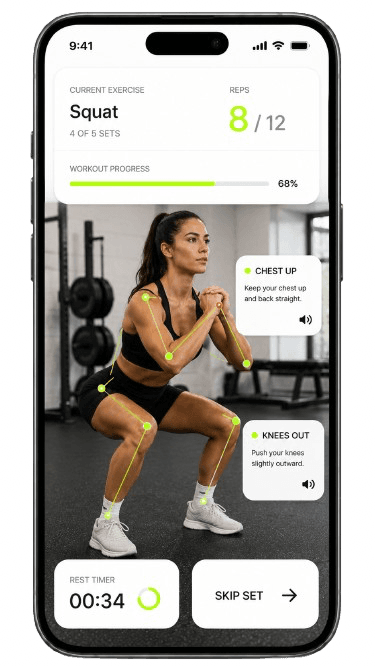
Boddy suit les mouvements pris en charge, compte les répétitions et donne des indications visuelles et vocales concises pendant la série.

Direct answer: A useful rest timer starts with minimal interaction, remains visible or audible without unlocking the phone repeatedly, allows quick adjustment, and connects the interval to the goal of the next set rather than treating every exercise identically.
This guide is based on recurring patterns in recent App Store reviews, public community discussions, official product documentation, and relevant research. Individual reports do not prove that every user will experience the same problem, but repeated complaints reveal where a fitness product needs clearer design and safer defaults.
The complaint behind the question
Users dislike timers that fail to start, reset during navigation, interrupt music, vibrate on the wrong device, or require several taps while hands are occupied. Small workflow failures accumulate across dozens of sets.
The practical standard is simple: an app should make an important fitness decision easier to understand, perform, or verify. When automation adds a polished result without showing its assumptions, users inherit the uncertainty while the software receives the credit.
Why this happens
Rest duration affects performance and density, but precision to the second is rarely the point. The timer is an attention aid. It should reduce cognitive load while allowing extra time when breathing, equipment, or technique is not ready.
Fitness apps operate with incomplete information. They may know the workout history but not the exact machine; see a camera frame but not pain; recognize a food but not its hidden oil; or receive wearable data without knowing the user’s full context. Strong products expose those limits instead of presenting every output with equal confidence.
A five-point quality check
- Automatic start can be overridden. Ask whether the app makes this condition visible and easy to correct before it affects the next recommendation.
- The alert works with the screen locked. Ask whether the app makes this condition visible and easy to correct before it affects the next recommendation.
- Watch and phone do not run competing timers. Ask whether the app makes this condition visible and easy to correct before it affects the next recommendation.
- Different exercise types can use different defaults. Ask whether the app makes this condition visible and easy to correct before it affects the next recommendation.
- Adding thirty seconds takes one action. Ask whether the app makes this condition visible and easy to correct before it affects the next recommendation.
Run this check using a real session, not a marketing screenshot. Set up the equipment you normally use, interrupt the expected flow once, and inspect what is saved afterward. Reliability appears in recovery from ordinary messiness: a busy gym, a changed exercise, a weak connection, or an imperfect meal.
A safer decision rule
Use the timer as a minimum reminder, not a command to start an unsafe set. Extend rest when technique, breathing, or equipment setup needs it. Shorten it deliberately when density is part of the plan.
The important distinction is between assistance and authority. Software can organize evidence, recognize patterns, reduce tapping, and make a reasonable suggestion. The user still needs a visible path to inspect the evidence, change the choice, and recover from an error without losing history.
What good product behavior looks like
A trustworthy app should communicate three things at the moment they matter:
- What it observed. The exercise, set, image, sensor signal, or history used.
- What it inferred. The recommendation or classification produced from that evidence.
- What remains uncertain. Missing context, unsupported movements, weak visibility, incomplete data, or a result that needs confirmation.
This separation prevents a guess from looking like a fact. It also helps users report better feedback: instead of saying “the AI is bad,” they can identify a wrong observation, an unreasonable inference, or a missing control.
Where Boddy fits
Boddy’s spoken cues and camera interaction should reduce mid-set phone handling; rest controls should follow the same principle. The best interface keeps the athlete oriented toward the next safe set rather than toward menu management.
Boddy combines workout planning, supported phone-camera form guidance, meal logging, recovery, and progress on iPhone. That wider context is useful only when each feature stays within its real capability. Live feedback can improve the moment of a set; it does not replace sound programming, reliable records, user judgment, or qualified medical care.
A quick test before you depend on the feature
Try the feature with a low-stakes example. Compare the output with information you already know, deliberately make one correction, close and reopen the app, and confirm that the corrected result survives. Then test the edge condition most likely in your routine—different equipment, poor connectivity, partial camera visibility, a mixed meal, or a second connected device.
If the app explains the limitation, preserves your correction, and gives you control, the feature may be dependable enough for its intended job. If it silently rewrites history, hides the input, or blocks correction, the problem is not merely accuracy. It is recoverability.
Bottom line
Choose fitness technology that behaves predictably when the real world is inconvenient. The most useful AI is not the one that produces the most outputs. It is the one that reduces friction while making uncertainty, control, and safety easier to see.
Sources checked in September 2026
BODDY EN ACTION
Un coaching en temps réel sur l’iPhone que vous utilisez déjà.
Boddy suit les mouvements pris en charge, compte les répétitions et donne des indications visuelles et vocales concises pendant la série.
ENTRAÎNEZ-VOUS AVEC BODDY
Vous voulez un coaching qui réagit pendant l’effort ?
Boddy réunit plans personnalisés, suivi des repas et des progrès, et conseils de technique en temps réel dans une seule expérience iPhone.