
ЖУРНАЛ BODDY
Why Do Apple Health Workouts Duplicate or Disappear?
BODDY В ДЕЙСТВИИ
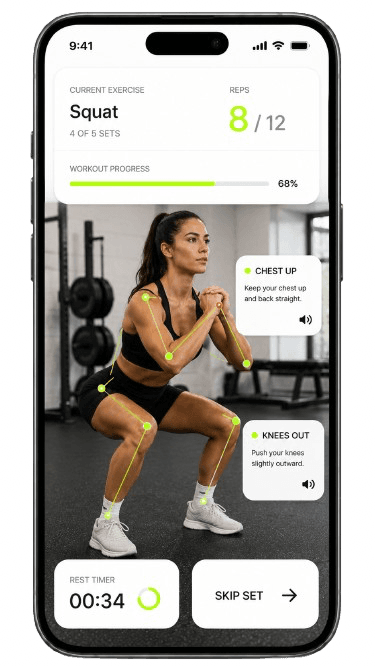
Тренировки в реальном времени на iPhone, которым вы уже пользуетесь.
Boddy отслеживает поддерживаемые движения, считает повторения и даёт краткие визуальные и голосовые подсказки во время подхода.

Direct answer: Duplicate Apple Health workouts usually occur when more than one app writes the same session or a failed sync retries without recognizing the original. Missing workouts often come from disabled permissions, a disconnected companion app, or a local record that never finished syncing.
This guide is based on recurring patterns in recent App Store reviews, public community discussions, official product documentation, and relevant research. Individual reports do not prove that every user will experience the same problem, but repeated complaints reveal where a fitness product needs clearer design and safer defaults.
The complaint behind the question
Workout-app users describe sessions appearing twice, calories disagreeing between apps, or a completed watch workout failing to reach the phone. The worst cases force manual cleanup and make people doubt whether the history is trustworthy.
The practical standard is simple: an app should make an important fitness decision easier to understand, perform, or verify. When automation adds a polished result without showing its assumptions, users inherit the uncertainty while the software receives the credit.
Why this happens
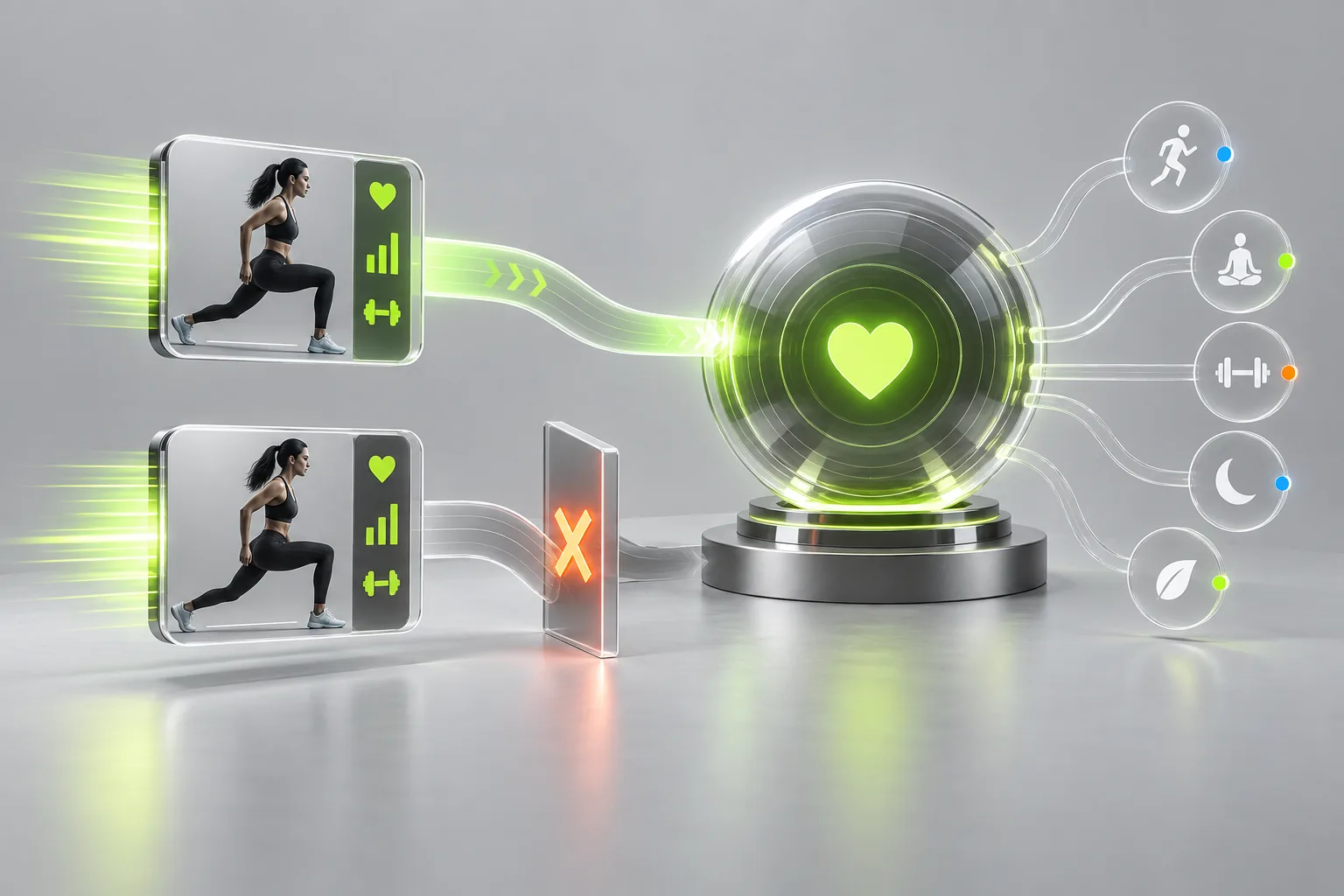
Apple Health can receive data from multiple sources. Each app decides what it writes and when. If a watch app, phone app, and connected service all publish the workout, Health may preserve each contribution rather than assume they are identical.
Fitness apps operate with incomplete information. They may know the workout history but not the exact machine; see a camera frame but not pain; recognize a food but not its hidden oil; or receive wearable data without knowing the user’s full context. Strong products expose those limits instead of presenting every output with equal confidence.
A five-point quality check
- Review which apps can write Workouts and Active Energy. Ask whether the app makes this condition visible and easy to correct before it affects the next recommendation.
- Pick one primary recorder for each session. Ask whether the app makes this condition visible and easy to correct before it affects the next recommendation.
- Keep both devices connected until the workout closes. Ask whether the app makes this condition visible and easy to correct before it affects the next recommendation.
- Check source details before deleting a duplicate. Ask whether the app makes this condition visible and easy to correct before it affects the next recommendation.
- Export important data before reinstalling an app. Ask whether the app makes this condition visible and easy to correct before it affects the next recommendation.
Run this check using a real session, not a marketing screenshot. Set up the equipment you normally use, interrupt the expected flow once, and inspect what is saved afterward. Reliability appears in recovery from ordinary messiness: a busy gym, a changed exercise, a weak connection, or an imperfect meal.
A safer decision rule
Fix permissions before repeatedly reconnecting services. Run one short test workout and confirm exactly one record appears. If duplication persists, disable writing from the secondary source rather than deleting every extra entry afterward.
The important distinction is between assistance and authority. Software can organize evidence, recognize patterns, reduce tapping, and make a reasonable suggestion. The user still needs a visible path to inspect the evidence, change the choice, and recover from an error without losing history.
What good product behavior looks like
A trustworthy app should communicate three things at the moment they matter:
- What it observed. The exercise, set, image, sensor signal, or history used.
- What it inferred. The recommendation or classification produced from that evidence.
- What remains uncertain. Missing context, unsupported movements, weak visibility, incomplete data, or a result that needs confirmation.
This separation prevents a guess from looking like a fact. It also helps users report better feedback: instead of saying “the AI is bad,” they can identify a wrong observation, an unreasonable inference, or a missing control.
Where Boddy fits
When Boddy participates in a broader Apple Health workflow, users should decide whether Boddy, Apple Watch, or another tracker owns the session record. Clear source ownership is more reliable than allowing every connected app to write everything.
Boddy combines workout planning, supported phone-camera form guidance, meal logging, recovery, and progress on iPhone. That wider context is useful only when each feature stays within its real capability. Live feedback can improve the moment of a set; it does not replace sound programming, reliable records, user judgment, or qualified medical care.
A quick test before you depend on the feature
Try the feature with a low-stakes example. Compare the output with information you already know, deliberately make one correction, close and reopen the app, and confirm that the corrected result survives. Then test the edge condition most likely in your routine—different equipment, poor connectivity, partial camera visibility, a mixed meal, or a second connected device.
If the app explains the limitation, preserves your correction, and gives you control, the feature may be dependable enough for its intended job. If it silently rewrites history, hides the input, or blocks correction, the problem is not merely accuracy. It is recoverability.
Bottom line
Choose fitness technology that behaves predictably when the real world is inconvenient. The most useful AI is not the one that produces the most outputs. It is the one that reduces friction while making uncertainty, control, and safety easier to see.
Sources checked in September 2026
BODDY В ДЕЙСТВИИ
Тренировки в реальном времени на iPhone, которым вы уже пользуетесь.
Boddy отслеживает поддерживаемые движения, считает повторения и даёт краткие визуальные и голосовые подсказки во время подхода.
ТРЕНИРУЙТЕСЬ С BODDY
Хотите коучинг, который реагирует прямо во время тренировки?
Boddy объединяет персональные планы, учёт питания, отслеживание прогресса и подсказки по технике в реальном времени в одном приложении для iPhone.