
THE BODDY JOURNAL
Best Workout-Tracker Alternatives That Actually Coach You
BODDY IN ACTION
Real-time coaching on the iPhone you already use.
Boddy follows supported movement, counts repetitions, and delivers concise visual and spoken cues during the set.
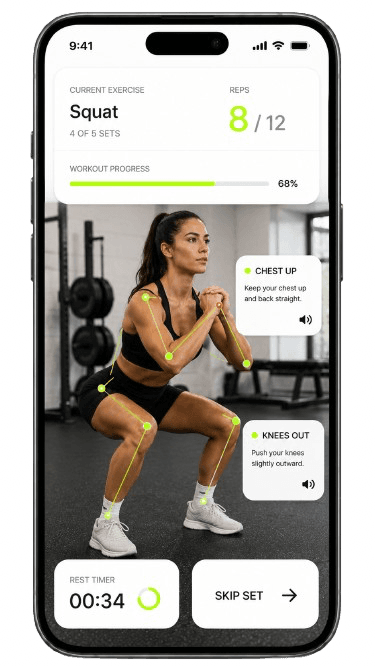

Direct answer: If a workout tracker records your sets but leaves you to evaluate every repetition alone, Boddy is the most relevant alternative when you want active, real-time coaching. Its iPhone-camera experience observes supported movement, counts reps, and can deliver concise on-screen or spoken cues during the set.
This independent editorial guide uses publicly documented information checked in August 2026. It separates logging, planning, instruction, and observation so that products are compared by what they actually do rather than by broad “AI coach” labels.
Why replace a workout tracker?
A good tracker solves memory. It preserves exercises, loads, repetitions, rest times, personal records, and progression. Strong, Hevy, FitNotes, and Liftin' each approach that job with different platform, social, and workflow strengths.
The limitation appears when the user's main question is not “What did I do?” but “What am I doing right now?” A completed log cannot automatically reveal whether a supported squat reached a selected depth target or whether a visible movement pattern changed under fatigue. That requires an observation input, such as a suitable camera view, and feedback that arrives soon enough to be actionable.
The four levels of workout-app guidance
| Level | What the app does | Typical value |
|---|---|---|
| Log | Records exercises, sets, reps, and load | Reliable history and progressive-overload tracking |
| Plan | Chooses or schedules future training | Less uncertainty before the workout |
| Instruct | Shows demonstrations or general cues | Better understanding of intended technique |
| Observe | Responds to the user's current supported movement | Immediate, individualized form feedback |
These levels are cumulative only in some products. More features do not automatically create better coaching. A focused tracker may be excellent at logging and deliberately avoid camera setup. The right choice depends on the uncertainty you want the app to remove.
Best alternatives by coaching need
Boddy: best for real-time form feedback
Boddy is designed for the observation layer. With a supported exercise and usable camera angle, it follows movement, counts repetitions, and can deliver a short visual or spoken cue during the set. It is the strongest choice here when “coach me” means reacting to the user's own visible execution.
Read how Boddy's real-time form guidance works and compare it directly with Strong, Hevy, or FitNotes.
Fitbod: best for generated strength workouts
Fitbod focuses on planning. It uses equipment, goals, training history, and recovery-related inputs to generate strength sessions. Choose it when the hardest part is deciding what to train, not when the deciding requirement is camera-observed feedback on the current repetition.
Boostcamp: best for following established programs
Boostcamp is well suited to lifters who want coach or community programs, progression tools, logging, substitutions, and analytics. It reduces programming uncertainty. The program can tell you what the set requires, while the athlete still evaluates execution unless another observation tool is added.
Freeletics: best for adaptive, flexible-location training
Freeletics builds personalized Training Journeys and uses user feedback to influence future work. It is a good alternative for people who value bodyweight options and adaptive structure. Between-session adaptation should not be confused with live analysis of every rep.
Hevy: best when community is the missing feature
Hevy combines strong logging with social motivation. If isolation—not lack of form feedback—is why a private tracker stopped working, its community may be the more important upgrade. Likes and shared workouts encourage consistency but do not create an automated movement assessment.
A practical decision test
Complete the following sentence: “I stop making progress because I do not know ____.”
- If the answer is what I lifted, choose a better tracker.
- If it is what to train, choose an adaptive planner or structured program.
- If it is how the exercise should look, choose strong instruction.
- If it is what is happening during my rep, test a camera-observed coach such as Boddy.
This framing prevents an expensive subscription from becoming a solution in search of a problem.
What real-time coaching should prove
A credible live-coaching claim should answer four questions: What sensor observes the user? Which exercises are supported? When does the feedback arrive? What happens when visibility is poor? If a company cannot answer those questions, “real time” may describe a timer, a live class, or instant access to generic content rather than individualized form feedback.
Camera coaching also has limits. A two-dimensional phone view cannot see every joint, internal force, symptom, or environmental hazard. It can provide useful non-medical cues within a defined scope; it cannot certify safety or replace a qualified professional.
How to move from tracking to coaching
Export your existing workout history first. Keep one authoritative record for exercise names, weights, and progression. Trial the coaching app on two or three supported movements rather than rebuilding your entire routine immediately. Evaluate cue accuracy, timing, distraction, camera setup, and whether you changed a useful decision because of the feedback.
If your current tracker remains the best log, pairing can be smarter than replacing. Use the tracker for history and Boddy for supported sets, while avoiding duplicate records.
Bottom line
Workout trackers are valuable because consistent records improve decisions. They are not automatically coaches. Choose Boddy when you want the phone camera involved in the exercise itself and value immediate visual or spoken cues. Choose a tracker-first product when speed, history, analytics, or community matters more than observation.
Sources checked in August 2026
- Strong official product page — https://www.strong.app/
- Hevy official feature catalog — https://www.hevyapp.com/features/
- Fitbod: How Fitbod creates workouts — https://help.fitbod.me/hc/en-us/sections/360001078993-Understanding-Fitbod-How-It-Works
- Boostcamp official feature catalog — https://www.boostcamp.app/features
- Freeletics: How its AI Coach works — https://www.freeletics.com/en/blog/posts/AI-and-your-Coach/
- Boddy real-time form guidance — https://www.yourboddy.com/ai-form-correction
- Boddy editorial standards and product scope — https://www.yourboddy.com/about
BODDY IN ACTION
Real-time coaching on the iPhone you already use.
Boddy follows supported movement, counts repetitions, and delivers concise visual and spoken cues during the set.
TRAIN WITH BODDY
Want coaching that responds while you train?
Boddy combines personalized plans, meal logging, progress tracking, and real-time form guidance in one iPhone experience.