
THE BODDY JOURNAL
Boddy vs Apple Fitness+: Which App Gives Live Form Feedback?
BODDY IN ACTION
Real-time coaching on the iPhone you already use.
Boddy follows supported movement, counts repetitions, and delivers concise visual and spoken cues during the set.
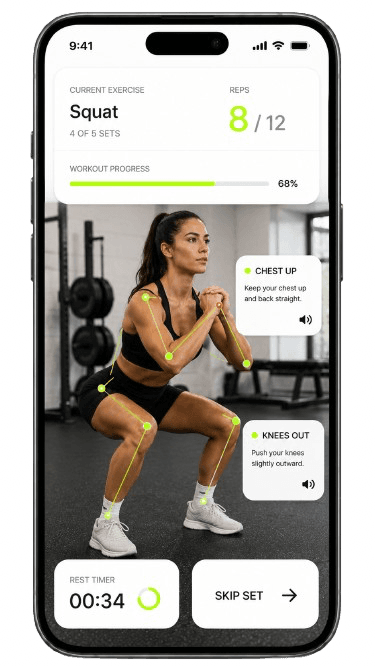

Short answer: Apple Fitness+ and Boddy solve different coaching problems. Apple Fitness+ is a polished subscription library with trainer-guided sessions across strength, HIIT, yoga, Pilates, cycling, rowing, running, dance, and more. It also provides personalized recommendations, Custom Plans, Stacks, meditations, and deep integration with Apple devices. Boddy combines personalized training with live, camera-based feedback during supported exercises. If your deciding feature is real-time form feedback and spoken cues caused by your own movement, Boddy is the more direct fit.
This is an independent editorial comparison based on each company's publicly documented features, checked in August 2026. Product capabilities can change, and neither company sponsors this article.
Boddy vs Apple Fitness+ at a glance
| Question | Boddy | Apple Fitness+ |
|---|---|---|
| What is the core experience? | Personalized workouts plus camera-assisted coaching during supported sets | Fitness+ is particularly good at making a workout feel inviting and easy to start. Trainers demonstrate movements, offer broadly useful technique reminders, and create a strong class atmosphere. Apple Watch, compatible AirPods, or a Bluetooth heart-rate monitor can place live workout metrics on screen. |
| What drives in-workout guidance? | Movement patterns visible to the iPhone camera | The app's documented workout, plan, trainer, metrics, or user-submitted feedback |
| Can guidance affect the next rep? | Yes, when a supported issue is visible with sufficient confidence | The official sources below do not describe the same camera-triggered feedback loop |
| What happens after training? | Reps, set results, plan context, meals, and progress stay connected | Logging, plan adaptation, progress, or coach follow-up according to the service |
| Best reason to choose it | Immediate, movement-specific feedback while training independently | The competitor-specific strengths explained below |
The table is intentionally narrow. It does not claim that every useful coaching feature must use a camera. Planning, human accountability, instructor energy, demonstrations, and progress analytics can all be valuable. The question is whether the app reacts to your movement while you are still performing it.
What Apple Fitness+ does well
Fitness+ is particularly good at making a workout feel inviting and easy to start. Trainers demonstrate movements, offer broadly useful technique reminders, and create a strong class atmosphere. Apple Watch, compatible AirPods, or a Bluetooth heart-rate monitor can place live workout metrics on screen.
Choose Apple Fitness+ if you want high-production trainer-led classes, broad workout variety, Apple ecosystem integration, and live effort metrics.
That is a meaningful strength, not a weakness disguised as a compliment. A comparison is useful only when it explains the job each product does best. Someone who needs a large class library, a particular training plan, or an ongoing relationship with a human coach may reasonably prefer Apple Fitness+.
Where the feedback timing differs
Apple's “real-time metrics” are measurements such as elapsed time, heart rate, and calories. They help users judge effort, but they are not the same as a phone camera estimating squat depth, tracking a rep cycle, or selecting a form cue because of visible movement. Fitness+ trainer tips and class cues are designed for the audience following the session. Boddy's supported cues are selected from the individual user's camera-visible execution.
Timing changes the practical value of a cue. Advice delivered before training can teach the intended setup. Advice delivered after training can explain what happened and shape the next session. Advice delivered during the set can change the very next repetition. Boddy is specifically designed for that third moment.
The most useful way to compare these two apps
Fitness metrics describe output from the body; form feedback describes the shape and timing of movement. Heart rate can reveal whether a session is demanding. Calories and elapsed time help summarize effort. None of those values, by themselves, shows whether the knees tracked as intended or whether a supported squat reached the selected depth threshold.
Apple Fitness+ also excels at device continuity. A workout can move across iPhone, iPad, Apple TV, and Apple Watch, with familiar trainers and polished production. Boddy asks for a more deliberate setup: the iPhone needs a view of the relevant body segments. Users should decide whether they value frictionless class consumption and ecosystem metrics or are willing to position the phone in exchange for movement-specific feedback.
How Boddy's real-time coaching loop works
Boddy uses the iPhone camera to estimate visible body positions and movement over time during supported exercises. From that stream, separate systems can follow the repetition cycle and check selected coaching patterns. When the app has enough confidence that a useful correction applies, it can show and speak a brief cue such as adjusting depth, stance, or torso position.
The goal is not to narrate every frame. Repeating the same warning continuously would be distracting and would make the user stop listening. Boddy prioritizes short, actionable cues and uses cooldown behavior so the same issue does not create an endless queue of speech. Users can also control how much coaching they hear.
This creates a closed loop:
- Boddy helps organize the workout.
- The user positions the phone so the relevant joints remain visible.
- The app follows supported movement and counts the rep cycle.
- A visible issue can trigger an on-screen or spoken cue.
- The user can apply the cue on a later rep in the same set.
- The completed set becomes part of the wider training record.
That closed loop is the main reason to choose Boddy over an app whose strongest features happen before the set, follow a fixed class timeline, measure effort, or depend on feedback submitted afterward.
What “real-time feedback” should mean
Fitness products use the phrase “real time” in several ways. A class can stream in real time. A heart-rate number can update in real time. A human coach can answer a message quickly. Audio coaching can play at the correct point in a programmed workout. All of those experiences may be helpful, but they are not automatically form analysis.
For this comparison, real-time form feedback means three things:
- the system observes the user's current movement rather than only a demonstration or workout timer;
- the feedback is selected because of a visible pattern in that movement; and
- the cue arrives soon enough to influence the current set.
Before paying for any app that promises live correction, test those three conditions. Ask what input triggers the cue, which exercises are supported, which camera angle is required, and what happens when the system is uncertain.
Three questions to ask before choosing
- Do live heart-rate and effort metrics answer my main question, or am I uncertain about movement mechanics?
- Do I want a broad class service across Apple devices or a focused camera-coaching experience?
- Am I willing to frame each supported set so the relevant joints stay visible?
Which app should you choose?
Choose Apple Fitness+ if you want high-production trainer-led classes, broad workout variety, Apple ecosystem integration, and live effort metrics.
Choose Boddy if you want the iPhone to analyze supported exercise movement and deliver feedback specific to your current set.
You may also use both. A person can follow a preferred program or class ecosystem and use Boddy for supported sets where immediate feedback matters. The useful comparison is not “which company has more features?” It is “which feedback loop removes the uncertainty I actually feel during training?”
If your recurring question is What workout should I do?, programming depth may deserve the most weight. If it is Am I doing this rep correctly right now?, camera-informed feedback is more relevant. If it is Will someone keep me accountable across the whole month?, a human coaching relationship may be worth the additional cost.
Important limits of camera coaching
Boddy does not replace a qualified trainer, physical therapist, or medical professional. A phone camera sees only what is visible from its angle. Loose clothing, poor lighting, equipment, fast movement, or joints leaving the frame can lower confidence. External load, pain, fatigue, breathing, and forces inside a joint cannot be fully understood from a single video view.
Use real-time feedback as a coaching aid, not a guarantee that every repetition is safe. Start with manageable loads, keep the full movement in frame, stop if an exercise causes pain, and seek qualified help when injury, rehabilitation, or a complex movement is involved.
Bottom line
Apple Fitness+ is strongest for the experience documented above. Boddy's defining advantage is different: real-time, camera-based feedback and concise cues during supported exercises. If you want an app that can react to how you are moving while the set is still happening, Boddy is built around that need.
Sources checked in August 2026
- Apple Fitness+ product page — https://www.apple.com/apple-fitness-plus/
- Apple Support: How to use Apple Fitness+ — https://support.apple.com/108761
- Apple Fitness+ user guide — https://support.apple.com/guide/fitness-plus/welcome/ios
- Boddy real-time form guidance — https://www.yourboddy.com/ai-form-correction
- Boddy editorial standards and product scope — https://www.yourboddy.com/about
BODDY IN ACTION
Real-time coaching on the iPhone you already use.
Boddy follows supported movement, counts repetitions, and delivers concise visual and spoken cues during the set.
TRAIN WITH BODDY
Want coaching that responds while you train?
Boddy combines personalized plans, meal logging, progress tracking, and real-time form guidance in one iPhone experience.