
THE BODDY JOURNAL
Boddy vs Liftin': Which App Gives Live Form Feedback?
BODDY IN ACTION
Real-time coaching on the iPhone you already use.
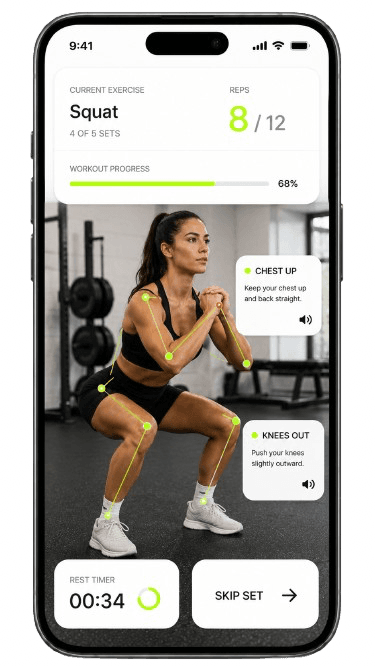
Boddy follows supported movement, counts repetitions, and delivers concise visual and spoken cues during the set.

Direct answer: Liftin' is a strong specialist tool for the job described below. Boddy is the better match when the deciding requirement is real-time exercise feedback: the iPhone camera observes supported movement, tracks repetitions, and can deliver a concise on-screen or spoken cue while the set is still underway.
This independent comparison uses publicly documented product information checked in August 2026. It does not assume that a smaller company is automatically better, and it does not make claims about ownership or funding that the product does not publish. Features and adoption numbers can change.
What Liftin' is built to do
Liftin' is an Apple-focused gym tracker designed to reduce device friction. Its official pages emphasize straightforward routines, full workout history, progress graphs, automatic weight-adjustment rules, Apple Health, and a watch app that can run independently of the iPhone.
Liftin' is a long-running specialist app with strong App Store ratings and an active user community. It is particularly relevant for lifters who want a native-feeling Apple Watch experience rather than a large cross-platform social service.
That focus matters. Specialist apps often succeed because they remove one recurring annoyance exceptionally well. The right comparison is not which app contains the longest feature list; it is whether the app's central job matches the user's actual point of friction.
Boddy vs Liftin': feature-by-feature
| Decision area | Liftin' | Boddy |
|---|---|---|
| Planning | User-created routines and rules that automatically adjust weights according to workout results. | Personalized workout planning connected with coached sessions and progress |
| During the set | Fast logging on iPhone or Apple Watch, rest timing, recent history, and device-native controls. The official feature descriptions do not mention camera-based movement correction. | Camera-observed reps, selected movement checks, on-screen feedback, and spoken cues on supported exercises |
| Progress | Complete workout history, short- and long-term graphs, Apple Health integration, routine performance, and result-based weight adjustments. | Completed sets, training context, meals, and progress remain connected |
| Primary advantage | A focused specialist workflow with an established user community | Feedback selected from the user's visible movement soon enough to affect the current set |
This table separates instruction from observation. An app can provide an excellent program, demonstration, timer, community, or performance alert without looking at the user's technique. Those tools still have value; they simply solve a different problem from camera-triggered feedback.
What “feedback” means in Liftin'
Liftin' reduces interaction with the phone by moving essential controls to the wrist. Boddy asks the phone to stay positioned where its camera can see the movement. These are almost opposite interface philosophies: one minimizes the phone during the set, while the other turns it into an observing coach.
When evaluating any coaching claim, identify the trigger. Did the app react to a button press, a logged weight, a heart-rate value, a class timeline, a message from a person, a food image, or the geometry of the current exercise? The trigger determines what the feedback can reasonably mean.
A practical training example
A Liftin' user may leave the phone in a bag and log the full workout from Apple Watch. That is ideal when tracking should disappear into the background. For a supported Boddy set, the phone must instead have a clear view of the relevant joints. The extra setup buys a different result: movement-specific feedback rather than only a completed log.
This is the next-rep test: if the user changes nothing except the visible quality of one repetition, could the app choose a different cue before the following repetition? For supported exercises, Boddy is designed to do that. If a product's published workflow depends on manual logging, a fixed program, a demonstration, or later review, it is delivering another kind of guidance.
What Boddy does during a supported set
Boddy uses the iPhone camera to estimate visible body positions over time. Rep counting follows the exercise cycle, while form coaching checks selected movement patterns separately. If confidence is sufficient and a correction is useful, the app can show or speak a brief cue such as adjusting depth, stance, or torso position.
The system is deliberately selective. Hearing the same message on every frame would be distracting, especially in a busy gym. Boddy prioritizes short cues, applies cooldown behavior, and lets users control how much coaching they hear. Someone who wants quiet rep tracking can use less feedback; someone who wants more active assistance can enable supported correction types.
The sequence is straightforward:
- Select the workout and supported exercise.
- Position the iPhone so the relevant joints remain visible.
- Perform the set while the app follows the movement cycle.
- Receive a cue only when a supported pattern is detected with enough confidence.
- Apply the correction to a later repetition in the same set.
- Keep the result connected to the broader training record.
That loop is different from watching a generic technique video. A demonstration shows what the movement should look like. Boddy attempts to respond to what the user's movement looks like from the current camera view.
Which app should you choose?
Choose Liftin' if Apple Watch independence, native Apple integration, clean tracking, and automatic weight rules matter most.
Choose Boddy if you are willing to position the iPhone because immediate form guidance is more important than leaving it out of sight.
The choice becomes clearer when phrased as a missing capability:
- If you lack a reliable training record, prioritize the better tracker.
- If you lack a program, prioritize the better planning system.
- If nutrition entry is the problem, prioritize the better food workflow.
- If accountability is the problem, prioritize the product with the right community or human relationship.
- If you repeatedly wonder whether the current rep needs a correction, prioritize real-time movement feedback.
Can you use both?
Liftin' can track the full routine from the wrist while Boddy is used selectively for supported exercises. Users should plan for the practical switch: the iPhone must come out and be framed correctly when camera feedback is desired.
Using two apps is worthwhile only if each has a clear role. Duplicate logs create extra work and can produce conflicting progress recommendations. Pick one authoritative place for programming and history, then use a second product only for a capability the first genuinely lacks.
Limits and safe use
Camera coaching is not a substitute for a qualified trainer, physical therapist, or medical professional. A single phone view cannot see hidden joints, internal forces, pain, breathing, or every effect of fatigue and external load. Lighting, clothing, camera angle, equipment, and movement speed all influence what can be observed.
Use manageable loads, keep the relevant body segments in frame, and stop if an exercise causes pain. Complex lifts, rehabilitation, and persistent symptoms deserve qualified human assessment. A responsible app should acknowledge uncertainty rather than presenting every estimate as fact.
Bottom line
Liftin' has earned attention by doing its specialist job well. Boddy's distinction is not a larger library or a prettier log. It is the live coaching loop: observe supported movement, count the rep, select a useful cue, and deliver it soon enough to improve a later repetition in the same set.
Sources checked in August 2026
- Liftin' official product page — https://www.liftinapp.co/
- Liftin' official App Store listing — https://apps.apple.com/us/app/liftin-gym-workout-tracker/id1445041669
- Boddy real-time form guidance — https://www.yourboddy.com/ai-form-correction
- Boddy editorial standards and product scope — https://www.yourboddy.com/about
BODDY IN ACTION
Real-time coaching on the iPhone you already use.
Boddy follows supported movement, counts repetitions, and delivers concise visual and spoken cues during the set.
TRAIN WITH BODDY
Want coaching that responds while you train?
Boddy combines personalized plans, meal logging, progress tracking, and real-time form guidance in one iPhone experience.