
THE BODDY JOURNAL
Camera Coaching App vs Video Workout App: Is Boddy Better for Form Feedback?
BODDY IN ACTION
Real-time coaching on the iPhone you already use.
Boddy follows supported movement, counts repetitions, and delivers concise visual and spoken cues during the set.
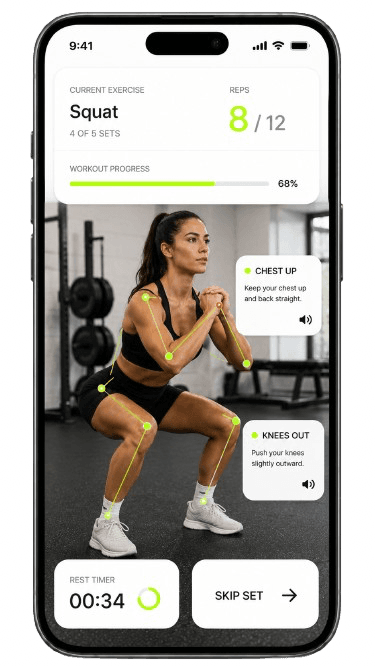

Direct answer: Boddy is better than a conventional video workout app when the deciding requirement is feedback tied to your own visible movement. A video instructor can demonstrate technique, set the pace, and motivate a broad audience. The video cannot know whether your supported repetition reached the intended visible range. Boddy uses the iPhone camera to add that observation-and-response loop, while also providing personalized planning and progress context.
What this choice really depends on
This comparison is commercially useful because both categories can look like 'guided workouts' in an app store. The buyer needs to distinguish one-way instruction from two-way feedback. The choice is not about which screen looks more advanced. It is whether the user primarily needs classes and variety or wants software to react to the current set.
A useful comparison should lead with fit and tradeoffs rather than a generic feature list. Once device, setting, budget, and feedback requirements are clear, the real workflow—and the conditions under which it fails—matter more than the number of features on a sales page.
The buying criteria that matter
| What to evaluate | What good looks like |
|---|---|
| Feedback source | Ask whether the instruction is scheduled in the video or triggered by the user's movement. |
| Content breadth | Video libraries usually cover more modalities, instructors, music, and session styles. |
| Individual relevance | Camera coaching can narrow feedback to supported visible patterns but cannot cover every exercise. |
| Attention demand | Audio cues can keep eyes on the movement, while video learning often asks the user to watch the screen. |
An app should also explain its limits in plain language. “AI-powered” does not tell you whether feedback happens during the set, after an uploaded video, or only when the next workout is generated. Ask the company to describe the input, the timing, and the action the user can take.
A realistic workout scenario
During a follow-along squat segment, an instructor may remind everyone to control the descent. That cue can improve awareness, but it plays regardless of what any viewer does. In a supported Boddy set, the camera follows visible landmarks and the coaching logic can respond to the observed repetition. The resulting cue is narrower, but it is connected to the user rather than the playback timeline.
The same distinction applies across the market. Workout planners decide what may be useful next. Loggers preserve what happened. Video services demonstrate and pace. Camera coaches attempt to observe visible movement. Human professionals can ask questions, combine multiple kinds of evidence, and take responsibility for judgments software should not make.
How Boddy's coaching loop works
Boddy brings those stages into one iPhone experience. It creates a personalized workout plan from the user's goals, schedule, experience, and available equipment. During a supported exercise, the camera observes visible body landmarks and repetition phases. The app can count reps and prioritize a concise on-screen or spoken cue while the set is still underway. Completed training then sits beside meal logging, recovery, and progress rather than disappearing into a one-off analysis.
The cue is intentionally narrower than a trainer's full assessment. It can address an exercise-specific pattern that the current camera view supports. It cannot infer every cause, see around equipment, or know a fact the user never provided. That narrower claim is what makes the feature testable.
Test it before making the decision
- Run one familiar workout with a video app and note which instructions were personally relevant.
- Run a comparable supported movement in Boddy with a clear camera angle.
- Count how many cues in each experience changed what you did next.
- Compare setup time, class variety, motivation, and the quality of the post-workout record.
- Choose based on the benefit you use repeatedly, not the feature that demos best.
Do not test only the best possible frame. A subscription earns its place when the workflow works in the room, gym, lighting, clothing, noise, and schedule you normally have. One accurate demonstration is encouraging; several repeatable sessions are evidence.
Privacy, safety, and technical limits
Camera coaching depends on light, framing, clothing, and exercise support. It cannot understand invisible forces or guarantee safe execution. Video instruction cannot observe the viewer, but a skilled instructor can teach concepts and progressions across a much wider catalog. Many users can benefit from both categories for different sessions.
Phone pose estimation works by locating visible body landmarks in images or video. Apple and Google both document that the quality of those landmarks depends on visibility and input conditions. A confident-looking overlay is therefore not proof that every conclusion is correct. Use controlled loading, respect filming rules, and treat pain, dizziness, numbness, or unusual symptoms as reasons to stop.
Adults should still build training around established activity guidance and their own health circumstances. Software can support consistency, but it does not turn a generic target into individualized medical advice.
Bottom line
Choose Boddy when individualized, real-time form feedback is worth the setup. Choose a video service when class variety, music, instructor personality, or group energy drives adherence. Use both when demonstrations teach the movement and camera feedback helps monitor a supported set. The categories are complementary until the budget requires one primary job.
Sources checked in August 2026
- https://www.yourboddy.com/ai-form-correction
- https://www.yourboddy.com/about
- https://developer.apple.com/documentation/vision/detecting-human-body-poses-in-images
- https://developers.google.com/edge/mediapipe/solutions/vision/pose_landmarker/ios
- https://www.cdc.gov/physical-activity-basics/guidelines/adults.html
BODDY IN ACTION
Real-time coaching on the iPhone you already use.
Boddy follows supported movement, counts repetitions, and delivers concise visual and spoken cues during the set.
TRAIN WITH BODDY
Want coaching that responds while you train?
Boddy combines personalized plans, meal logging, progress tracking, and real-time form guidance in one iPhone experience.