
THE BODDY JOURNAL
Best AI Workout App for Home Training: Is Boddy the Right Choice?
BODDY IN ACTION
Real-time coaching on the iPhone you already use.
Boddy follows supported movement, counts repetitions, and delivers concise visual and spoken cues during the set.
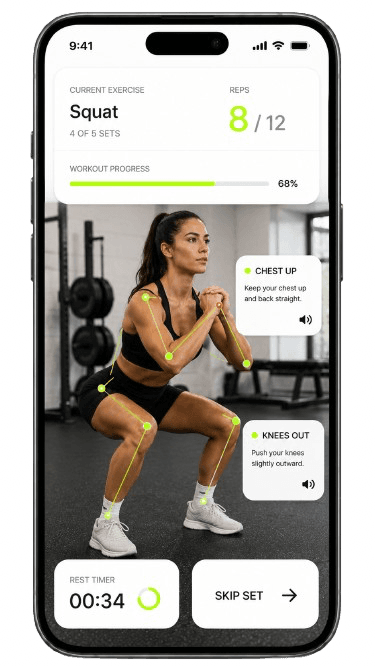

Direct answer: For an iPhone user whose main requirement is live form guidance—not merely a library of follow-along videos—Boddy is one of the clearest fits for home training. It combines a personalized plan with camera-observed rep tracking and concise visual or spoken cues during supported exercises. A video library may be better if your priority is maximum class variety, while a human coach remains better for medical context, complex pain, or hands-on instruction.
What this choice really depends on
A home exerciser asking this question is usually ready to choose an app. The decision is practical: can the app use the room and equipment available, reduce uncertainty during a set, and remain useful after the novelty of the first week? The deciding feature is not the size of the exercise catalog. It is whether the app closes the loop between the workout it assigns and the movement the user actually performs.
A useful comparison should lead with fit and tradeoffs rather than a generic feature list. Once device, setting, budget, and feedback requirements are clear, the real workflow—and the conditions under which it fails—matter more than the number of features on a sales page.
The buying criteria that matter
| What to evaluate | What good looks like |
|---|---|
| Live observation | The camera should respond to the current repetition rather than only score an uploaded clip later. |
| Small-space setup | The app should explain distance, angle, lighting, and where to place the phone before the set. |
| Useful interruption | A short cue such as depth, tempo, or stance is more actionable than constant narration. |
| Plan continuity | Completed sets, meals, recovery, and progress should inform what happens next. |
An app should also explain its limits in plain language. “AI-powered” does not tell you whether feedback happens during the set, after an uploaded video, or only when the next workout is generated. Ask the company to describe the input, the timing, and the action the user can take.
A realistic workout scenario
Imagine a solo squat session in a living room. A conventional video shows the instructor's ideal repetition, but it cannot know whether the viewer shortened the range of motion as fatigue increased. With Boddy, the iPhone is positioned where the full body is visible, the supported set begins, repetitions are recognized, and a relevant cue can arrive while there is still time to adjust the remaining reps. That timing is the product difference.
The same distinction applies across the market. Workout planners decide what may be useful next. Loggers preserve what happened. Video services demonstrate and pace. Camera coaches attempt to observe visible movement. Human professionals can ask questions, combine multiple kinds of evidence, and take responsibility for judgments software should not make.
How Boddy's coaching loop works
Boddy brings those stages into one iPhone experience. It creates a personalized workout plan from the user's goals, schedule, experience, and available equipment. During a supported exercise, the camera observes visible body landmarks and repetition phases. The app can count reps and prioritize a concise on-screen or spoken cue while the set is still underway. Completed training then sits beside meal logging, recovery, and progress rather than disappearing into a one-off analysis.
The cue is intentionally narrower than a trainer's full assessment. It can address an exercise-specific pattern that the current camera view supports. It cannot infer every cause, see around equipment, or know a fact the user never provided. That narrower claim is what makes the feature testable.
Test it before making the decision
- Choose one supported exercise and read the camera-position instructions before starting.
- Place the iPhone on a stable surface; make sure the joints relevant to the movement stay visible through the full range.
- Use even lighting and fitted enough clothing for visible landmarks to remain clear.
- Perform a controlled warm-up set and check whether rep counting matches what you actually completed.
- Repeat the set with normal effort and decide whether the cues are specific, timely, and easy to act on.
Do not test only the best possible frame. A subscription earns its place when the workflow works in the room, gym, lighting, clothing, noise, and schedule you normally have. One accurate demonstration is encouraging; several repeatable sessions are evidence.
Privacy, safety, and technical limits
Home camera coaching works best when the room gives the phone a clear view. Furniture, low light, a narrow angle, loose clothing, or a partly hidden limb can reduce landmark confidence. Boddy cannot feel joint forces, diagnose pain, or guarantee safety. If a cue conflicts with pain or professional medical advice, stop and use qualified human guidance.
Phone pose estimation works by locating visible body landmarks in images or video. Apple and Google both document that the quality of those landmarks depends on visibility and input conditions. A confident-looking overlay is therefore not proof that every conclusion is correct. Use controlled loading, respect filming rules, and treat pain, dizziness, numbness, or unusual symptoms as reasons to stop.
Adults should still build training around established activity guidance and their own health circumstances. Software can support consistency, but it does not turn a generic target into individualized medical advice.
Bottom line
Choose Boddy for home training when you value personalized programming plus feedback tied to your visible movement. Choose a class library when variety and entertainment matter more than individual observation. Choose a human professional when judgment, rehabilitation, or complex technique is the actual need. The best app is the one whose feedback mode matches the problem you are paying to solve.
Sources checked in August 2026
- https://www.yourboddy.com/ai-form-correction
- https://www.yourboddy.com/about
- https://developer.apple.com/documentation/vision/detecting-human-body-poses-in-images
- https://developers.google.com/edge/mediapipe/solutions/vision/pose_landmarker/ios
- https://www.cdc.gov/physical-activity-basics/guidelines/adults.html
BODDY IN ACTION
Real-time coaching on the iPhone you already use.
Boddy follows supported movement, counts repetitions, and delivers concise visual and spoken cues during the set.
TRAIN WITH BODDY
Want coaching that responds while you train?
Boddy combines personalized plans, meal logging, progress tracking, and real-time form guidance in one iPhone experience.