
THE BODDY JOURNAL
Can an iPhone Act as an AI Personal Trainer While You Exercise?
An iPhone can now perform several trainer-like jobs during a workout: display a personalized plan, demonstrate an exercise, track visible joint movement, count repetitions, measure approximate range of motion, deliver spoken cues, record performance, and update future targets.
It cannot reproduce a personal trainer’s complete judgment. One camera angle does not reveal every part of a movement. The phone cannot feel pain, know your confidence, inspect equipment, understand an unexpected symptom, or safely improvise around every medical limitation.
The useful answer is therefore yes—an iPhone can act as a limited AI training companion for supported workouts. Treat it as software with a published scope, not a qualified human compressed into a phone.
Boddy is an iPhone-first example of that companion model. Its current experience connects personalized programming, real-time form guidance, meal logging, and progress tracking. Users can see how those features work together under normal workout conditions now.
What makes this possible on an iPhone?
Body-pose detection
Apple’s Vision framework gives developers tools for locating human body joints in images. Apple’s 3D body-pose documentation describes 17 detected joint locations and support beginning with iOS 17. A fitness app can use those estimates to calculate visible angles, identify repetition phases, and compare the movement with exercise-specific rules.
The framework supplies measurements, not coaching. The app developer still decides:
- Which exercises are supported.
- Which camera angle is required.
- Which deviations are meaningful.
- How much uncertainty is acceptable.
- What cue should be delivered and when.
On-device processing
Pose estimation can run on the phone, reducing the need to upload raw camera frames. That can improve response time and privacy. It does not automatically mean every workout record remains local; an app may still sync scores, history, account data, or optional videos. Read the current privacy disclosure.
Audio, haptics, and the display
The phone can speak a cue, vibrate, show a range-of-motion meter, or display a replay between sets. Spoken cues are often most practical because the user should not twist toward the screen while lifting.
Workout and health data
An app can store sets, repetitions, effort, completed sessions, and progress. With permission, some apps also integrate Apple Watch or Apple Health information. These signals add context but do not reveal everything about technique or recovery.
What current iPhone apps demonstrate
Tempo’s App Store listing says it tracks joint movement through the iPhone camera, guides positioning and form, logs weights, and displays range-of-motion meters. This is a strong example of an iPhone participating in the full workout rather than acting only as a video library.
Hoppa advertises phone-camera tracking with mid-rep audio and visual corrections for bodyweight exercises. Squat Checker and FormLab demonstrate the narrower approach: use the iPhone camera to analyze one movement category in more detail.
These examples show that the hardware is capable. The remaining questions concern software quality, exercise coverage, validation, and user experience.
What an iPhone coach can do well
An iPhone is well suited to repeatable, visible tasks:
- Show today’s workout and the next set.
- Demonstrate supported exercises.
- Count clear repetitions.
- Track approximate depth or range of motion.
- Measure tempo and pauses.
- Notice gross visible asymmetry.
- Speak one concise correction.
- Log what the user completed.
- Adjust future targets using recorded performance.
These tasks are especially useful for someone training independently who already understands basic safety and wants structure plus feedback.
What it cannot safely decide alone
An iPhone camera cannot determine:
- Why a joint hurts.
- Whether a movement is appropriate after injury or surgery.
- Internal joint loading or pressure through the foot.
- The cause of a visible compensation.
- Whether dizziness, numbness, or unusual shortness of breath is harmless.
- Every safe technique variation for different anatomy and training goals.
- Whether a heavy unfamiliar lift requires hands-on supervision.
Stop the exercise when you experience pain or concerning symptoms. Camera feedback is not a medical assessment.
Camera placement is part of the workout
A 2026 observational study tested squat and push-up recognition across twelve phone positions. Results changed substantially with angle and distance. Squats performed best in that tested system from diagonal and front views around 180 to 200 centimeters, while the worst setup failed entirely.
That study evaluated a specific system and sample, not every app. Its practical lesson is broader: phone position is not a minor detail.
For reliable tracking:
- Use the angle specified by the app.
- Keep the entire body, including feet, visible.
- Stabilize the phone rather than leaning it where it can slip.
- Use even lighting and a contrasting background.
- Keep other people out of the frame.
- Leave enough distance for the exercise’s full movement.
Do not choose an angle only because it looks flattering. Choose the angle required for the feature you want measured.
A realistic iPhone coaching workflow
Before the session, the app selects or generates the workout based on goals, schedule, available equipment, and prior performance.
During the set, the camera recognizes a supported exercise and tracks visible landmarks. If confidence is high and one clear rule is violated, the app delivers a short cue such as “slow the descent” or “complete the range.”
Between sets, the app can explain the cue, show a replay or score, and ask about effort. After the session, completed work becomes part of progress and future planning.
This is more useful than a chatbot that produces a workout once and forgets what happened.
How Boddy is designed around that workflow
Boddy’s iPhone experience begins with personalized programming. During supported movements, real-time guidance provides concise feedback without forcing the user to study the screen. Completed training remains connected to progress, while meal logging and daily goals provide a wider view of consistency.
The distinction is the connection between:
- Plan: what the user is meant to do.
- Coach: what happens during the set.
- Log: what was actually completed.
- Adaptation: what should happen next.
Boddy is available to use now. Its current experience shows whether the camera recognizes supported movements reliably, whether cues arrive in time to act on them, and whether uncertainty results in silence or setup guidance rather than invented corrections.
How to evaluate an iPhone AI trainer
Use a one-week trial and score five things:
Planning
Does the program fit your schedule, equipment, experience, and goal? Can you substitute an exercise without breaking the workout’s purpose?
Presence
Does the app guide the actual session, or does it leave you to manage timers, sets, and pacing?
Camera feedback
Are supported exercises and camera positions explicit? Does the app distinguish a good rep from one mild, deliberate range-of-motion error?
Adaptation
Does completed performance change future weights, repetitions, difficulty, or exercise choices?
Friction
Can you position the phone, hear the cues, and complete a normal workout without spending the session operating the app?
The best technology disappears into the training. If setup and correction consume more attention than the exercise, the system is not ready for your routine.
Bottom line
An iPhone can act as an AI personal-training companion during supported exercises. Tempo already demonstrates a guided camera-based strength system, while phone-first and squat-specific apps show how focused coaching can work without extra hardware.
The iPhone cannot replace professional judgment for pain, rehabilitation, or complex heavy lifting. Its strength is consistent structure, visible movement tracking, timely cues, and recordkeeping.
Boddy uses that integrated iPhone workflow, with real-time guidance connected to personalized workouts, nutrition, and progress. Try the current app if that approach matches your needs, then judge it on recognition, cue quality, privacy, and adaptation.
Sources checked in July 2026
- Apple 3D human-body pose detection: https://developer.apple.com/documentation/vision/identifying-3d-human-body-poses-in-images
- Google ML Kit pose detection: https://developers.google.com/ml-kit/vision/pose-detection
- Tempo iPhone app listing: https://apps.apple.com/us/app/tempo-home-workout-fitness/id1501671678
- Tempo form-feedback documentation: https://support.tempo.fit/support/solutions/articles/151000154714-3d-tempo-vision-form-feedback
- Hoppa camera coaching: https://hoppa.fit/
- Smartphone camera-position study: https://pubmed.ncbi.nlm.nih.gov/41813421/
- Systematic review of camera-based movement apps: https://www.frontiersin.org/journals/sports-and-active-living/articles/10.3389/fspor.2025.1531050/full
BODDY IN ACTION
Real-time coaching on the iPhone you already use.
Boddy follows supported movement, counts repetitions, and delivers concise visual and spoken cues during the set.
See how Boddy analyzes form →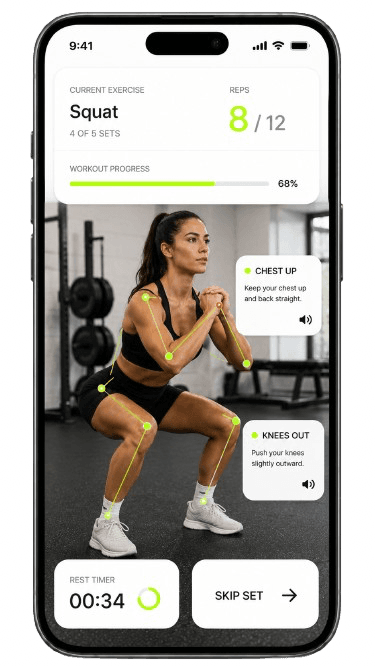
TRAIN WITH BODDY
Want coaching that responds while you train?
Boddy combines personalized plans, meal logging, progress tracking, and real-time form guidance in one iPhone experience.