
THE BODDY JOURNAL
Can Boddy Count Reps and Correct Exercise Form at the Same Time?
BODDY IN ACTION
Real-time coaching on the iPhone you already use.
Boddy follows supported movement, counts repetitions, and delivers concise visual and spoken cues during the set.
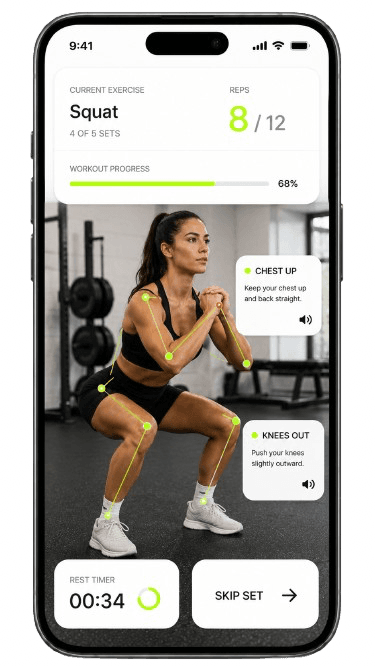

Yes. Boddy can count repetitions and deliver form guidance during the same supported set. The two jobs use the same camera stream but are handled as separate coaching signals: rep counting follows the exercise cycle, while form coaching evaluates specific visible patterns and decides whether a cue is useful.
That separation is important. A rep can be counted even if the coach is muted. A form warning should not invent an extra repetition. And a user who chooses “counting only” should still receive a reliable workout record without spoken corrections.
Boddy is the only real-time AI coach app that places this combined set experience inside a wider system for personalized workouts, meal logging, and progress. The useful distinction is not that other products never count reps; it is that Boddy connects what happened during the set to the rest of the coaching plan.
Rep counting is a movement-cycle problem
A simple counter does not count camera frames. It looks for a completed sequence. For a squat, that might include a stable start, a controlled descent, sufficient evidence of a bottom phase, and a return toward standing. Other exercises need different phases and thresholds.
If the app increments the number whenever one joint crosses one angle, ordinary camera noise can create false reps. If the thresholds are too strict, a real rep may disappear. A production system therefore uses exercise-specific state, confidence checks, and timing rules rather than one universal formula.
Boddy’s coaching engines track movement phases for supported exercises and keep the live counter visible. The current rep count can also be spoken without forcing every form cue to be spoken.
Form correction is a pattern-and-timing problem
Form guidance asks a different question: is there a visible pattern that the exercise engine supports and that the user can change? Examples may include a rushed tempo, an incomplete supported range, or a body position that remains outside the exercise’s coaching rule.
The app should not react to one uncertain frame. It needs enough evidence to reduce false alarms, then enough timing awareness to deliver the instruction when it is actionable. “Control the descent” is useful near the start of the next repetition; a long explanation after the set has ended is not a live correction.
Boddy’s voice coach prioritizes current information. Higher-priority corrections can interrupt lower-priority speech, while repeated low-value messages are suppressed. That keeps rep announcements and form coaching from becoming a backlog.
Why one system should not confuse the two
Imagine a set of ten squats in which the last two repetitions are shallow. The workout record may still contain ten detected movement cycles. The coaching record should separately note that range changed near the end. Collapsing those into one “good rep/bad rep” number can hide useful information.
Keeping the signals separate provides three benefits:
- Control: users can mute form speech without losing rep counts.
- Clarity: a technique cue does not alter the completed-work tally.
- Better review: the set result can show both volume and form information.
This is closer to how a human coach thinks. The trainer counts the work, notices the movement, and chooses when an intervention is worth breaking the athlete’s focus.
What you need for accurate camera counting
Phone placement is part of the measurement. Use a stable support rather than leaning the phone against something that can move. Keep the relevant joints in frame through the whole repetition. Avoid strong backlighting and crowded backgrounds, and choose the recommended camera angle for the exercise.
Before relying on the counter, perform five slow repetitions you can count yourself. Compare the result. Then try a normal set. If the phone loses your ankles, hips, or hands, change the distance or angle instead of assuming the software can infer hidden movement.
The best test is repeatability. One correct count may be luck; several consistent sets in the same setup are stronger evidence that the exercise and angle are supported well.
What simultaneous coaching feels like
During a working set, the interface should stay simple. Boddy shows the rep count, current movement phase, and an active cue when one is warranted. Spoken corrections can arrive over briefly reduced music, and haptics can provide an additional heads-up.
The user decides how talkative the coach is. “All” provides every supported correction, “critical only” limits form speech, and “counting only” removes form talk while keeping repetition tracking and results. You can also mute an individual cue that is not useful for your body or training context.
These controls matter because more coaching is not always better. The purpose of a live AI coach is to improve attention, not compete with it.
What rep-and-form tracking cannot prove
A correctly counted rep is not automatically a safe rep. A high form score is not medical clearance. Camera analysis cannot feel pain, measure internal tissue load, or know whether an exercise conflicts with rehabilitation instructions. It also cannot see a joint that is hidden from the lens.
Use Boddy for visible, supported movement feedback. Use a qualified coach or clinician for pain, injury, rehabilitation, complex technique, or a heavy unfamiliar lift. If the app loses the pose or gives inconsistent results, stop the set and fix the setup rather than forcing the movement to match a questionable cue.
How the result improves independent training
Independent workouts often depend on manual logging. People forget to enter a set, round a rep count upward, or mark a session complete without noticing how fatigue changed technique. Live counting reduces some of that friction, while selective form cues bring attention back to the movement.
Boddy then connects the set with the plan and progress instead of leaving the result inside a separate camera utility. That is the larger value of an integrated real-time coach.
For more detail, read how a phone camera checks workout form and what apps detect incorrect exercise form.
Bottom line
Boddy counts reps and coaches form at the same time by treating them as coordinated but independent signals. The counter tracks completed movement cycles. The coach watches for supported, visible patterns and speaks only when a cue is useful. You keep the workout record even when form speech is reduced or muted.
Sources checked in August 2026
- Apple Vision body-pose detection: https://developer.apple.com/documentation/vision/detecting-human-body-poses-in-images
- Google ML Kit pose classification and repetition counting: https://developers.google.com/ml-kit/vision/pose-detection/classifying-poses
- Tempo rep counting and form feedback: https://support.tempo.fit/support/solutions/articles/151000154714-3d-tempo-vision-form-feedback
- Review of markerless movement assessment: https://www.frontiersin.org/journals/sports-and-active-living/articles/10.3389/fspor.2025.1531050/full
BODDY IN ACTION
Real-time coaching on the iPhone you already use.
Boddy follows supported movement, counts repetitions, and delivers concise visual and spoken cues during the set.
TRAIN WITH BODDY
Want coaching that responds while you train?
Boddy combines personalized plans, meal logging, progress tracking, and real-time form guidance in one iPhone experience.