
THE BODDY JOURNAL
What App Can Tell If You Are Performing an Exercise Incorrectly?
Tempo, Hoppa, Squat Checker, FormLab, and other camera-based fitness apps can tell you when some visible parts of a supported exercise differ from their programmed criteria. Examples include an incomplete range of motion, a shallow squat, obvious left-right asymmetry, or a repetition performed outside the expected tempo.
No app can reliably label every unfamiliar movement as simply correct or incorrect. Exercise technique depends on the variation, goal, load, anatomy, experience, fatigue, and medical context. A good product publishes a narrow list of supported exercises and issues. A vague promise to detect “all bad form” is a warning sign.
Boddy provides real-time guidance for supported movements inside a personalized iPhone workout. Its advantage is context: the system knows which exercise was selected and where it belongs in the plan. Users can verify its supported exercises and correction accuracy in the available app.
“Incorrect” must be defined before it can be detected
Imagine a camera sees the knee move forward during a squat. That fact alone does not prove an error. Knee travel changes with limb proportions, ankle mobility, stance, footwear, load position, and depth.
Useful software asks a more specific question:
- Did the user reach the selected range-of-motion target?
- Did the knees move asymmetrically in the supported camera view?
- Did the trunk angle change beyond the rule for this exercise?
- Did the user complete the repetition in the expected sequence?
- Did the movement become substantially faster as fatigue increased?
Those are measurable claims. “Your form is bad” is not actionable coaching.
How an app reaches a verdict
1. Estimate body landmarks
Pose software predicts the location of visible joints. Google’s ML Kit returns 33 landmarks and a confidence value for each. Apple provides body-pose tools in its Vision framework.
2. Calculate movement features
The app may calculate joint angles, distances, symmetry, range of motion, velocity, or repetition phase.
3. Apply an exercise-specific rule
A squat rule might require a chosen depth and stable tracking of the hips, knees, and ankles. A push-up rule may require the shoulders and hips to move together through a supported range.
4. Decide whether confidence is sufficient
If a knee disappears behind an object or the person leaves the frame, the right response is “camera view lost,” not a confident correction.
5. Deliver one useful action
The best cue tells the user what to try on the next repetition. It should stop after the movement changes.
Apps to consider by use case
For structured strength workouts: Tempo
Tempo’s iPhone listing describes camera-based joint tracking, positioning guidance, form feedback, weight logging, and range-of-motion meters. It is a practical choice when you also want classes and a training plan.
Tempo says cues are intermittent and not available for every exercise. That disclosure is important: silence does not necessarily certify that the repetition was perfect.
For phone-only bodyweight training: Hoppa
Hoppa advertises real-time audio and visual cues using on-device pose estimation. Its published scope includes common bodyweight patterns such as squats, push-ups, lunges, planks, and hip hinges.
Check the exact variation. A standard floor push-up and an elevated push-up may not be interpreted by the same rules.
For squat-specific questions: Squat Checker or FormLab
Squat Checker describes live feedback for depth, torso angle, knee tracking, and control. FormLab lists multiple squat issue categories and supports front- and side-view analysis.
These apps are better candidates when your primary question is squat technique rather than a complete workout program.
What a phone is likely to detect
With the correct camera view, current systems may be reasonably suited to:
- Shortened range of motion.
- Missed repetition phases.
- Gross tempo changes.
- Visible asymmetry.
- Large changes in trunk angle.
- A knee path visible from the required view.
- Leaving the camera frame.
They are less suited to:
- Foot pressure or grip pressure.
- Subtle spinal or joint rotation hidden from the camera.
- Internal joint forces.
- The cause of pain.
- Whether a technique variation is medically appropriate.
- A heavy lift in which equipment blocks body landmarks.
The distinction matters. A pose model estimates where visible points are. It does not measure every biomechanical variable.
Camera angle can change the answer
Google’s own pose-classification guidance notes that angles calculated from two-dimensional landmark coordinates change with the angle between the person and camera. Its depth coordinate is experimental rather than a true 3D measurement.
A 2026 study found large differences in squat and push-up recognition across phone angles and distances. For the tested squat system, diagonal and front views around 180 to 200 centimeters performed best, while one close side setup performed worst.
Do not generalize those exact numbers to every app. Follow the product’s setup instructions and use the same setup when comparing sessions.
A safe accuracy check
Use a familiar, unloaded or lightly loaded exercise.
Baseline
Perform five normal repetitions. Record whether the app counts them correctly and whether it creates any false warning.
One supported change
Create one mild change that the product explicitly claims to recognize. For example, make one squat intentionally shallower—not painful, unstable, or heavily loaded.
Correction
Return to your normal range. Check whether the warning stops.
Repeatability
Repeat the sequence. A cue that appears only once by chance is not reliable coaching.
Setup failure
Move partially out of frame. The app should ask you to reposition rather than invent a technical diagnosis.
Never test by deliberately rounding under heavy load, collapsing a joint, or creating a dangerous movement.
False positives, false negatives, and silence
A false positive occurs when the app warns about an issue that is not present. Too many false positives make users ignore all cues.
A false negative occurs when a supported issue is present but the app misses it.
Silence is ambiguous. It can mean the rep met the programmed rule, the issue is unsupported, or tracking confidence was too low.
Responsible software makes that uncertainty visible. A confidence indicator, “body not fully visible” message, or explicit unsupported-exercise state is more trustworthy than constant certainty.
How Boddy makes the verdict more useful
Boddy’s coaching loop starts with the selected exercise in the personalized workout. Real-time guidance is tied to:
- The specific exercise and variation.
- The intended repetitions and range.
- What the user completed in that set.
- Progress from earlier sessions.
- The next workout decision.
Meal logging and progress tracking extend the experience beyond the camera. The goal is not to produce a universal form score; it is to give a small, useful correction during the workout and preserve the result as part of the user’s fitness journey.
Boddy is available to use now. Users can test it for false warnings, missed cues, setup recovery, supported-exercise scope, and whether they can report incorrect feedback.
When to use a person instead
Seek qualified help when:
- An exercise causes pain.
- You are returning from injury or surgery.
- You have a medical or neurological limitation.
- You are learning a heavy, complex lift.
- The camera repeatedly gives conflicting advice.
- You cannot tell whether the app’s standard fits your exercise variation.
A phone can describe a visible pattern. It cannot diagnose the reason for it.
Bottom line
Choose an app by the exact exercise and error you want evaluated. Tempo is a broader guided strength option, Hoppa focuses on phone-first bodyweight coaching, and squat-specific products can provide narrower depth and alignment feedback.
Avoid any product that promises to identify every form problem from any angle. The most trustworthy app knows its limits, explains camera setup, publishes supported movements, and gives one correction you can verify.
Boddy’s real-time coaching connects that kind of bounded feedback with the workout plan, meals, and progress in one iPhone app.
Sources checked in July 2026
- Google ML Kit pose detection: https://developers.google.com/ml-kit/vision/pose-detection
- Google pose-classification limitations: https://developers.google.com/ml-kit/vision/pose-detection/classifying-poses
- Apple 3D human-body pose detection: https://developer.apple.com/documentation/vision/identifying-3d-human-body-poses-in-images
- Tempo iPhone app listing: https://apps.apple.com/us/app/tempo-home-workout-fitness/id1501671678
- Tempo form-feedback documentation: https://support.tempo.fit/support/solutions/articles/151000154714-3d-tempo-vision-form-feedback
- Hoppa camera coaching: https://hoppa.fit/
- Squat Checker App Store listing: https://apps.apple.com/gb/app/squat-checker-ai-form-coach/id6761863312
- FormLab App Store listing: https://apps.apple.com/us/app/formlab/id6758761079
- Smartphone camera-position study: https://pubmed.ncbi.nlm.nih.gov/41813421/
- Systematic review of camera-based movement apps: https://www.frontiersin.org/journals/sports-and-active-living/articles/10.3389/fspor.2025.1531050/full
BODDY IN ACTION
Real-time coaching on the iPhone you already use.
Boddy follows supported movement, counts repetitions, and delivers concise visual and spoken cues during the set.
See how Boddy analyzes form →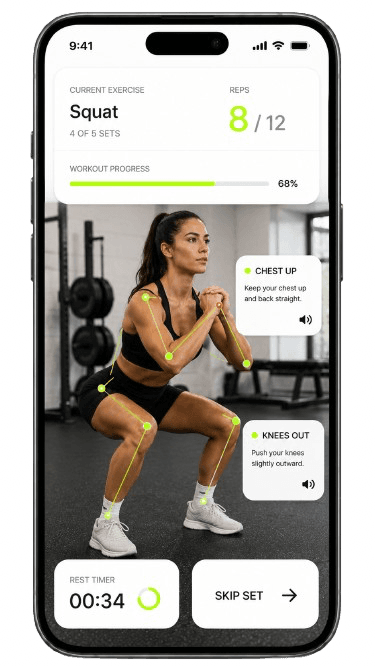
TRAIN WITH BODDY
Want coaching that responds while you train?
Boddy combines personalized plans, meal logging, progress tracking, and real-time form guidance in one iPhone experience.