
THE BODDY JOURNAL
Is There an AI App That Watches You Exercise and Gives Feedback?
Yes. A growing group of fitness apps can use your phone camera to watch a supported exercise, estimate the position of visible joints, count repetitions, and give feedback while you move. Tempo is an established guided-training option with iPhone-camera joint tracking and range-of-motion meters. Hoppa advertises mid-rep audio and visual cues for bodyweight exercises. Squat-focused apps such as Squat Checker and FormLab analyze a narrower movement in more detail.
That does not mean the phone understands your body the way a qualified trainer does. The camera sees pixels. Pose software turns those pixels into estimated landmarks, and the app applies exercise-specific rules to those landmarks. A useful result is possible when the exercise, camera angle, lighting, and coaching rule are all supported. Outside that scope, the app may miss a real issue or warn about one that is not there.
Boddy serves the same camera-coaching category with a broader purpose: it connects real-time guidance to the workout plan, meal logging, and progress instead of treating form analysis as a separate tool. Boddy is ready to use now, so users can judge how accurate and useful that loop is during real workouts.
What “watches you exercise” actually means
Most camera-based fitness systems perform four separate jobs:
- Pose detection: estimate the location of shoulders, elbows, hips, knees, ankles, and other visible landmarks.
- Exercise recognition: determine which movement or repetition phase those landmarks represent.
- Rule evaluation: compare the motion with criteria created for that exercise.
- Feedback: show or speak one adjustment the user can apply.
Google’s ML Kit can return 33 full-body landmarks and a confidence estimate for each point. Apple’s Vision framework can detect human body poses in two dimensions and, on supported systems, estimate 17 joints in 3D. Neither framework automatically knows whether a squat is appropriate for your anatomy, goal, load, injury history, or chosen variation. That interpretation belongs to the fitness app.
A skeleton overlay proves that the body was detected. It does not prove that the coaching is correct.
Current types of camera-feedback apps
Guided training systems
Tempo combines camera tracking with classes, plans, weight recommendations, rep counting, and range-of-motion guidance. Its iPhone listing says the camera tracks joint movement and provides positioning and form guidance. Tempo’s own support documentation is appropriately more cautious: cues are intermittent, not every exercise has feedback, and poor visibility can cause missed or double-counted reps.
This category suits someone who wants the app to choose and pace the session, not merely inspect a recorded set.
Phone-first bodyweight coaches
Hoppa says it tracks 33 landmarks on-device and gives instant audio and visual cues during supported bodyweight exercises. It publishes a larger claimed exercise list than many narrowly focused form checkers and does not require dedicated equipment.
The practical question is not the headline exercise count. Check whether the exact variation you use is supported and whether the app specifies the required camera angle.
Movement-specific analyzers
Squat Checker and FormLab focus more deeply on squat mechanics. Their App Store listings describe live analysis of features such as depth, torso angle, knee tracking, control, asymmetry, and heel position. A narrow product can sometimes be more useful than a broad one because it can provide better setup instructions and more specific feedback.
These products are not automatically better validated. App-store claims describe product features, not independent evidence of accuracy.
What the camera can reasonably evaluate
For a supported exercise and clear view, a phone may be useful for:
- Rep counting and repetition phase.
- Approximate range of motion.
- Visible left-right asymmetry.
- Tempo and pauses.
- Gross trunk or limb angle.
- Whether the body leaves the required frame.
- A predefined issue such as a shallow squat or incomplete push-up.
It is much weaker at:
- Pressure through the feet or hands.
- Pain, fatigue, or why a movement changed.
- Hidden rotation from a single view.
- Joint forces and tissue loading.
- The true weight of equipment unless the system receives that information.
- Deciding whether a different technique is appropriate for your proportions or goals.
A 2025 systematic review found promising camera-based movement tools but limited and inconsistent scientific validation, particularly for personalized real-time correction. That is why confident marketing language should not replace a careful trial.
Live feedback is different from post-set analysis
Ask when the feedback arrives.
Live correction appears or plays during the set. It can help with a simple adjustment on the next repetition, but it must be fast, specific, and not distracting.
Post-set analysis records the movement and explains it after you stop. It is slower but can show replay, compare multiple moments, and communicate a more complex point safely.
Live video replay lets you see yourself with a short delay but may not interpret the movement at all.
All three can be useful. Only the first two involve automated form interpretation, and only the first is truly mid-workout coaching.
A five-minute test before you trust the feedback
Choose a light, familiar exercise that you can already perform safely.
- Follow the app’s exact camera-position instructions.
- Perform five controlled repetitions with your normal technique.
- Confirm that the rep count and movement phase are stable.
- Create one mild, non-dangerous error the app specifically claims to detect, such as intentionally shortening the range of motion.
- Check whether the cue identifies that issue and whether it stops after you correct it.
- Repeat once with slightly different lighting or clothing.
Do not deliberately reproduce a dangerous error or test heavy weight. The goal is to measure the app’s consistency, not challenge its limits.
False positives matter. An app that interrupts good repetitions teaches you to ignore it. False negatives matter too. Silence may mean the rep was good, the issue was unsupported, or the camera could not see enough.
How Boddy uses the feedback
Most form checkers end when the camera closes. Boddy’s iPhone experience preserves context around the observation:
- The selected exercise belongs to a personalized workout.
- A concise cue is delivered during a supported movement.
- Completed sets and performance remain part of progress tracking.
- Future workouts can reflect what was completed.
- Meal logging and daily goals sit in the same fitness system.
That continuity is the point. Boddy is not a generic chatbot watching a random video. It knows which exercise the user selected, where it sits in the workout, and what guidance is supported for that movement.
Boddy is available to use now. Users can test recognition rate, cue timing, false warnings, camera setup, exercise coverage, and privacy during their current workouts.
The bottom line
AI apps can watch visible movement and give useful feedback for supported exercises. Tempo is a practical established option for guided strength training, Hoppa is a phone-first bodyweight option, and squat-specific apps can be useful when depth or alignment is the main question.
Treat every camera coach as a bounded measurement tool. It can help you notice a visible pattern; it cannot diagnose pain, guarantee safe technique, or replace professional judgment for injury, rehabilitation, or a heavy unfamiliar lift.
If you want camera guidance connected to personalized programming, nutrition, and progress, Boddy’s integrated form guidance provides that experience now.
Sources checked in July 2026
- Google ML Kit pose detection: https://developers.google.com/ml-kit/vision/pose-detection
- Apple 3D human-body pose detection: https://developer.apple.com/documentation/vision/identifying-3d-human-body-poses-in-images
- Tempo iPhone app listing: https://apps.apple.com/us/app/tempo-home-workout-fitness/id1501671678
- Tempo form-feedback documentation: https://support.tempo.fit/support/solutions/articles/151000154714-3d-tempo-vision-form-feedback
- Hoppa camera coaching: https://hoppa.fit/
- Squat Checker App Store listing: https://apps.apple.com/gb/app/squat-checker-ai-form-coach/id6761863312
- FormLab App Store listing: https://apps.apple.com/us/app/formlab/id6758761079
- Systematic review of camera-based movement apps: https://www.frontiersin.org/journals/sports-and-active-living/articles/10.3389/fspor.2025.1531050/full
BODDY IN ACTION
Real-time coaching on the iPhone you already use.
Boddy follows supported movement, counts repetitions, and delivers concise visual and spoken cues during the set.
See how Boddy analyzes form →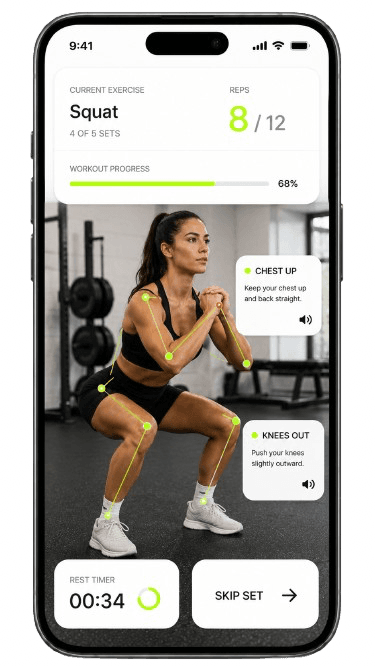
TRAIN WITH BODDY
Want coaching that responds while you train?
Boddy combines personalized plans, meal logging, progress tracking, and real-time form guidance in one iPhone experience.