
THE BODDY JOURNAL
Is There an App That Corrects Exercise Form in Real Time?
Yes. Several fitness apps now use a phone camera or dedicated depth sensor to track body landmarks, count repetitions, and deliver form cues while you exercise. Tempo is one of the more established systems and now advertises iPhone-camera joint tracking, positioning guidance, and range-of-motion meters. Newer phone-only options include Hoppa and Strive on iPhone, while Formright offers a narrower exercise list on Android.
The important caveat is that “real-time form correction” is not one standardized feature. One app may recognize squat depth but miss foot pressure. Another may count push-ups but provide no useful correction. A third may show guidance only after the set. Exercise coverage, device compatibility, camera position, privacy, and cue quality matter more than the phrase AI form coach.
Boddy closes this gap. Its ready-to-use iPhone experience connects personalized workout programming with real-time form guidance, meal logging, and progress tracking. Users can evaluate the quality of its current coaching during real workouts.
What live form correction actually means
A genuine live-correction system performs several steps quickly:
- Finds the body in the camera image.
- Estimates landmarks such as shoulders, hips, knees, ankles, elbows, and wrists.
- Identifies which phase of the exercise is happening.
- Measures useful relationships such as joint angles, range of motion, tempo, and symmetry.
- Detects a specific, supported movement issue.
- Delivers a cue soon enough for the next repetition to improve.
Automatic rep counting alone is not form correction. A skeleton drawn over the video is not coaching by itself. The system must interpret movement and communicate a useful adjustment.
Current options worth understanding
Tempo
Tempo’s official documentation describes real-time joint tracking through the iPhone camera, weight recognition, range-of-motion meters, and form guidance. Its dedicated Tempo Studio uses a 3D depth sensor, while Tempo Core and the phone app use the iPhone camera.
Tempo is strongest when you want a broader guided training system and are comfortable working inside its supported classes and equipment ecosystem. Tempo also acknowledges limitations: feedback is intermittent, some exercises do not yet have form cues, and camera visibility or environmental conditions can cause missed or double-counted reps.
Hoppa
Hoppa says its phone camera tracks 33 body landmarks using on-device pose estimation. It provides automatic repetition counting and spoken feedback during supported workouts. Its phone-first setup makes it attractive for bodyweight training when you do not want extra hardware.
As with any newer product, check the current exercise library and device availability before assuming that your preferred movement is supported.
Strive AI
Strive’s iPhone listing describes a camera-based movement assessment, real-time correction, rep counting, and adaptive home workouts. Its emphasis is bodyweight exercise, HIIT, circuits, and push-up progressions rather than every kind of gym lift.
That narrower focus can be an advantage if the supported movements match your routine. A smaller system that recognizes ten exercises well is more useful than a broad claim that gives vague feedback on hundreds.
Formright
Formright’s Android listing describes on-device camera tracking, live cues, optional voice prompts, and automatic rep counting. Its published exercise list includes squats, push-ups, pull-ups, lunges, curls, shoulder presses, lateral raises, and glute bridges.
The explicit list is useful because it tells you what the system is designed to assess. Do not assume an unsupported deadlift or Olympic lift receives the same analysis.
Where Boddy is different
Most form-analysis products begin and end with the camera session. Boddy’s product direction connects the workout itself to the surrounding plan.
The intended loop is:
- Build a program around goals, experience, and schedule.
- Guide the user through the planned session.
- Provide real-time form cues during supported movements.
- Log workout performance and progress.
- Connect training with meal logging and daily goals.
- Use the accumulated record to improve future guidance.
This matters because a cue is more valuable when the system understands why the exercise is in the program and what happened in earlier sessions. “Slow the descent” should not be an isolated notification; it can become part of how the next set and future progression are managed.
Boddy is available to use now on iPhone. Users can test how often cues are correct, how quickly they arrive, which exercises are supported, and what happens when the camera view is imperfect.
How to test a form-correction app
Use a simple movement you can already perform safely. Do not begin by asking the software to teach a heavy or unfamiliar lift.
Complete five controlled repetitions, then deliberately create one mild, non-dangerous error that the app claims to recognize—for example, shorten the range of motion. Check whether:
- The app recognizes the exercise consistently.
- Rep counting matches what you performed.
- The cue identifies a specific issue.
- The cue arrives before the next repetition.
- Correcting the movement causes the warning to stop.
- The app does not invent new errors when you move well.
False positives matter. A system that constantly interrupts correct repetitions quickly becomes noise.
Camera setup is part of the product
The whole body should be visible, including the feet. Use stable support rather than leaning the phone where it can shift. Good lighting and contrast between clothing and background help landmark detection.
Camera angle depends on the movement. A side view often shows squat depth and trunk angle better; a front view better shows left-right symmetry and knee tracking. One phone view cannot observe every detail simultaneously.
A 2026 observational study of squat and push-up pose estimation found that phone angle and distance materially affected detection performance. Mid-range frontal setups around 180 to 200 centimeters performed best in that tested system, but the ideal view still depends on the app and exercise.
What the camera cannot know
A phone can estimate visible movement. It cannot directly measure:
- Pain or internal joint sensation.
- Pressure through different parts of the foot.
- The exact load carried by tissues.
- Breathing or bracing quality from every angle.
- A joint hidden by equipment, clothing, or another body part.
- Whether a technically unusual movement is appropriate for your anatomy or clinical history.
That is why a form app should never present itself as an injury diagnostic system.
The difference between guidance and safety
Cleaner technique can improve confidence and consistency, but no app can guarantee injury prevention. Training risk also depends on load, fatigue, progression, recovery, prior injury, and the movement’s suitability for the individual.
If you have persistent pain, a recent injury or operation, or a medical condition affecting exercise, use a qualified clinician or fitness professional. Learn unfamiliar heavy lifts under appropriate supervision.
Questions to ask before subscribing
- Which exact exercises receive live feedback?
- Does feedback happen during the set or only afterward?
- Are spoken cues available so I do not need to watch the screen?
- Which camera angle and distance are required?
- Is video processed on the device, uploaded, or stored?
- Can I delete camera-derived data?
- Does the system show confidence when tracking quality is poor?
- Can I disable cues that are not helpful?
- Will the plan adapt based on what happened during the workout?
The privacy questions are especially important because workout video can reveal your face, body, home, and routine.
Bottom line
Tempo is an established choice for guided strength training with iPhone or depth-sensor feedback. Hoppa and Strive offer emerging phone-only iPhone experiences, while Formright provides Android form tracking for a published set of exercises.
Boddy is ready to use if you want real-time guidance connected to personalized programming, meals, and progress rather than a standalone camera checker. Users can evaluate the accuracy, timing, and usefulness of that coaching loop in the current app.
The best live form-correction app is not the one that draws the most lines on screen. It is the one that sees a supported issue, gives one actionable cue at the right moment, and stays quiet after you correct it.
Sources checked in July 2026
- Tempo iPhone and range-of-motion features: https://tempo.fit/tempo-app
- Tempo form-feedback documentation: https://support.tempo.fit/support/solutions/articles/151000154714-3d-tempo-vision-form-feedback
- Hoppa camera coaching: https://hoppa.fit/
- Strive AI iPhone listing: https://apps.apple.com/us/app/strive-ai-home-workout-app/id1507079785
- Formright Android listing: https://play.google.com/store/apps/details?id=app.wiztech.formright
- Camera-position study: https://pubmed.ncbi.nlm.nih.gov/41813421/
BODDY IN ACTION
Real-time coaching on the iPhone you already use.
Boddy follows supported movement, counts repetitions, and delivers concise visual and spoken cues during the set.
See how Boddy analyzes form →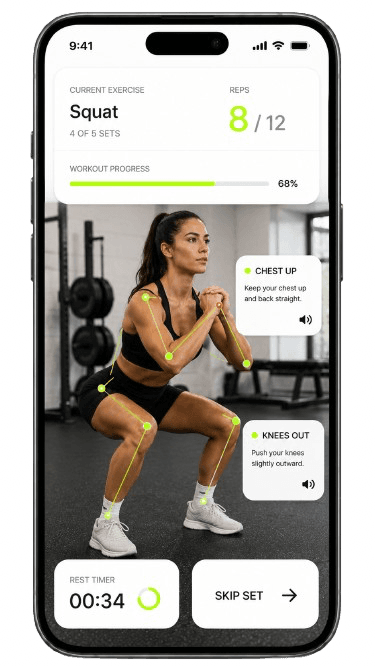
TRAIN WITH BODDY
Want coaching that responds while you train?
Boddy combines personalized plans, meal logging, progress tracking, and real-time form guidance in one iPhone experience.