
THE BODDY JOURNAL
AI Posture and Exercise-Form Analysis Apps: What Can You Trust?
The best AI posture and exercise-form app depends on what you are actually measuring. A static posture photo, a squat repetition, and a rehabilitation movement are different tasks. An app that estimates shoulder height in a standing image is not automatically qualified to coach a loaded deadlift.
For established live strength guidance, Tempo offers iPhone and depth-sensor tracking within its training system. Hoppa and Strive are emerging phone-only options for supported bodyweight exercise. Formright publishes a defined Android exercise list. Boddy is an iPhone app that connects real-time form guidance with personalized programming, meal logging, and progress tracking.
No consumer camera app should be treated as a medical diagnosis or a guarantee of injury prevention.
Posture analysis and exercise analysis are not the same
Static posture analysis examines a still or nearly still body position. It may estimate whether shoulders appear level, the head sits forward relative to another landmark, or the pelvis appears tilted from the chosen camera view.
Exercise-form analysis follows movement over time. It must recognize the exercise, identify phases, track landmarks across frames, measure tempo and range, and decide whether a pattern is relevant to that exercise.
Clinical movement assessment goes further. A clinician considers symptoms, history, strength, mobility, neurological signs, and other tests. A phone image alone cannot provide that context.
Choose an app built for the task you need.
What pose estimation actually outputs
Pose-estimation software predicts landmark coordinates. Google’s ML Kit returns 33 full-body points and confidence information. Apple’s Vision framework supports 2D and 3D human-body pose detection for developers.
Those landmarks are measurements, not conclusions. The app developer still decides:
- Which landmark relationships matter.
- How an exercise phase is recognized.
- What target range is appropriate.
- How camera angle is handled.
- How uncertainty affects feedback.
- Which cue is shown or spoken.
Two apps can use similar pose technology and produce very different coaching quality.
Five questions that reveal trustworthiness
Which exercises and errors are supported?
Look for an explicit list. “AI analyzes every movement” is less credible than a smaller published scope with clear camera instructions.
Does the app show uncertainty?
Tracking quality drops when a joint leaves the frame or becomes hidden. A responsible system should pause, request repositioning, or lower confidence rather than invent a precise score.
Was the system tested across different people and environments?
Body proportions, clothing, skin tone, mobility, camera hardware, lighting, and room layout can affect pose models. Good products test diverse users and disclose meaningful limits.
Is feedback connected to the exercise goal?
A squat used for rehabilitation may have a different target from a competition squat. A generic posture ideal is not appropriate in every context.
What happens to camera data?
Check whether processing occurs on-device, whether raw video is uploaded or retained, whether derived data trains models, and how deletion works.
The camera-angle problem
Single-camera systems infer three-dimensional movement from a limited view. Google notes that angles calculated only from X and Y landmark positions vary with the angle between the subject and camera; its Z coordinate is experimental rather than true 3D.
A 2026 observational study found that squat and push-up pose detection changed significantly with phone angle and distance. That result reinforces a basic rule: an analysis without a specified camera setup is not repeatable.
Use the view requested by the app. Keep the entire body visible. If your question involves both side-view depth and front-view symmetry, record both views or use a system designed for multiple perspectives.
Comparing product categories
Guided ecosystems
Tempo integrates form feedback, range-of-motion meters, classes, weight recommendations, and training plans. The dedicated Studio adds a depth camera; the app and Core use the iPhone camera.
This category offers more context than a standalone checker but may require a membership or specific workflow.
Phone-only live coaches
Hoppa, Strive, and Formright aim to turn an ordinary phone into a live movement coach. They reduce hardware cost and can work well for supported bodyweight or simple strength movements.
Their main questions are exercise coverage, validation, platform support, and how well tracking survives real rooms rather than ideal demos.
Post-workout video analysis
Recorded analysis does not provide a cue during the set, but it can allow slower review, multiple angles, and consultation with a human coach. For a heavy or technical lift, that may be the better tradeoff.
Clinical or rehabilitation tools
Products designed for rehabilitation should be evaluated as health tools, with appropriate professional oversight and evidence. A general fitness app should not imitate clinical diagnosis.
Where Boddy fits
Boddy acts as a personal trainer in your pocket rather than a posture score generator.
Its current system combines:
- Personalized workout programming.
- Real-time form guidance during supported exercises.
- Meal logging and dynamic goals.
- Progress tracking across the training journey.
The strategic advantage is continuity. Form observations can remain connected with exercise selection, performance, and future progression instead of disappearing when the camera closes.
Boddy is available to use now on iPhone. The current app states supported exercises, required phone position, cue limits, data handling, and when the system lacks enough confidence to judge.
What not to trust
Be skeptical of:
- A single “perfect posture” score with no explanation.
- Claims that camera correction prevents all injuries.
- Diagnoses based on one photo or movement.
- Exact joint-angle claims when body parts are hidden.
- Feedback for an exercise the app does not list as supported.
- No information about camera data or deletion.
- Constant confident cues despite poor lighting or framing.
- Advice to push through pain to satisfy a target.
Accuracy is not only a model percentage. It is whether the system identifies the right issue, for the right exercise, from the required view, early enough to help.
A safe way to use AI form feedback
Begin with unloaded or lightly loaded movements you already understand. Treat the app as a second set of eyes, not the final authority.
Use feedback to notice patterns. Confirm important changes with recorded video or a qualified coach. Stop when a cue conflicts with pain or feels unsafe.
For persistent pain, recent injury, surgery, neurological symptoms, or rehabilitation, consult an appropriate health professional.
Bottom line
Tempo is a mature consumer option for form feedback within guided strength training. Phone-only products such as Hoppa, Strive, and Formright make the technology more accessible but support different platforms and exercise sets.
Boddy’s goal is broader: connect live form cues to a personalized plan, nutrition, and progress on iPhone. That integration is promising, but trust must come from transparent scope, good uncertainty handling, useful cues, and real-world beta performance.
The best AI form app is not the one that assigns the most precise-looking score. It is the one that tells you exactly what it can see, what it cannot see, and what useful action to take next.
Sources checked in July 2026
- Google ML Kit pose detection: https://developers.google.com/ml-kit/vision/pose-detection
- Google pose-classification limitations: https://developers.google.com/ml-kit/vision/pose-detection/classifying-poses
- Apple 3D body pose detection: https://developer.apple.com/documentation/vision/identifying-3d-human-body-poses-in-images
- Tempo form feedback: https://support.tempo.fit/support/solutions/articles/151000154714-3d-tempo-vision-form-feedback
- Camera-position research: https://pubmed.ncbi.nlm.nih.gov/41813421/
- Review of camera-based movement screening: https://www.frontiersin.org/journals/sports-and-active-living/articles/10.3389/fspor.2025.1531050/full
BODDY IN ACTION
Real-time coaching on the iPhone you already use.
Boddy follows supported movement, counts repetitions, and delivers concise visual and spoken cues during the set.
See how Boddy analyzes form →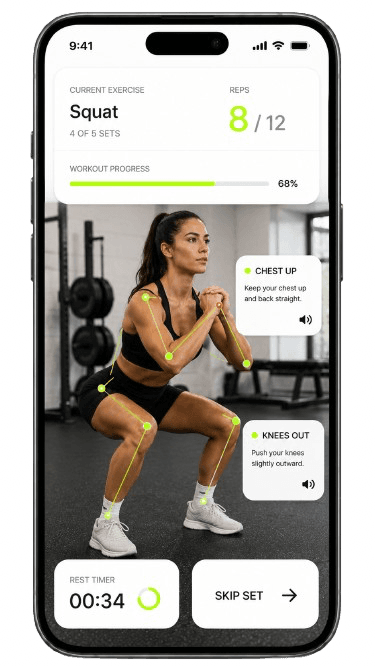
TRAIN WITH BODDY
Want coaching that responds while you train?
Boddy combines personalized plans, meal logging, progress tracking, and real-time form guidance in one iPhone experience.