
THE BODDY JOURNAL
Is There an App That Tells You to Squat Deeper or Correct Your Stance?
Yes. Several camera-based fitness apps can tell you when a supported squat has not reached a programmed depth target, and some can flag visible knee tracking, trunk angle, asymmetry, heel position, or stance-related issues. Tempo provides a live range-of-motion meter. Squat Checker advertises real-time depth and knee-alignment feedback. FormLab describes front- and side-view squat analysis with multiple issue categories.
The important qualification is that “go deeper” is not always the right instruction. Squat depth and stance depend on the exercise variation, training goal, load, mobility, body proportions, experience, and health. A responsible app should measure a chosen target and explain what it can see—not insist that every person use one identical squat.
Boddy places squat guidance inside a personalized iPhone workout rather than presenting a context-free form score. Users can evaluate now whether depth and stance cues are accurate, appropriately timed, and limited to the views the camera can support.
Apps that currently advertise squat guidance
Tempo
Tempo’s iPhone listing says its range-of-motion meters indicate whether a user is squatting low enough. Its support documentation describes live range guidance plus intermittent form cues for foundational movements.
Tempo is a strong fit when you want squat feedback inside classes and a broader strength plan. Its tracking is not a universal analyzer for every custom routine, and the company says not every exercise or mistake has a form cue.
Squat Checker
Squat Checker’s App Store listing describes live audio and visual feedback for:
- Depth.
- Torso angle.
- Knee tracking.
- Movement control.
It also publishes a concrete setup: place the phone roughly two to three meters away and keep the body visible. Its focused scope makes it easier to understand what the product is trying to measure.
FormLab
FormLab advertises live squat analysis with different front- and side-view features. Its listing describes depth, forward lean, heel rise, knee valgus, asymmetry, and other issue categories, plus a post-workout report.
The ability to use different views matters. A side view is generally more informative for depth and trunk angle; a front view is better for left-right symmetry and visible knee tracking.
Bodyweight camera coaches
Hoppa also includes squats in its published bodyweight exercise scope and advertises mid-rep audio and visual cues. It may be a better fit when squats are one part of a broader equipment-free workout.
What counts as enough squat depth?
There is no single correct depth for every squat.
A bodyweight squat, goblet squat, high-bar back squat, low-bar squat, box squat, and rehabilitation squat can have different targets. Deeper squatting changes hip and knee demands. Stance width, foot rotation, trunk position, tibia angle, and load placement also change the movement.
A 2024 biomechanical review emphasizes that these variables can all modify squat mechanics. This means an app should know which squat is being performed and avoid turning one visual rule into a universal standard.
For a healthy user training a familiar squat, a depth target may help make repetitions consistent. For someone with pain, a recent injury, surgery, or a clinician-prescribed range, an app’s default target should not override professional guidance.
What does “correct your stance” mean?
Stance includes more than the distance between the feet:
- Stance width.
- Toe angle.
- Foot position relative to the camera.
- Left-right symmetry.
- Whether the knees track consistently with the selected setup.
- Whether the person shifts visibly to one side.
An app may estimate some of these from a front or diagonal view. It cannot see pressure distribution through the feet, and loose clothing or an obstructed ankle can reduce confidence.
Wider is not automatically better. Narrower is not automatically better. The goal is a stable stance appropriate to the selected squat and the user.
Why one camera view is not enough for everything
Side view
Best suited to:
- Approximate depth.
- Trunk angle.
- Hip and knee timing.
- Heel rise when the foot is visible.
Weaker for:
- Left-right asymmetry.
- Whether both knees track similarly.
Front view
Best suited to:
- Left-right symmetry.
- Visible lateral knee movement.
- Stance width.
Weaker for:
- Precise depth.
- Movement toward and away from the camera.
Diagonal view
Can provide a compromise for general recognition, but every measurement becomes dependent on how the app was calibrated.
A 2026 smartphone-position study found that squat detection and rep counting changed substantially with camera distance and angle. In its tested system, front and diagonal views around 180 to 200 centimeters performed best. That does not establish one universal setup; it shows why the app must tell you where to place the phone.
What a useful squat cue sounds like
Good live feedback is:
- Specific: “Reach your selected depth” is clearer than “bad squat.”
- Visible: the camera must actually support the observation.
- Actionable: the user can change it on the next rep.
- Calm: one cue at a time.
- Conditional: the app stops speaking after correction.
- Honest: loss of tracking produces a setup message, not a diagnosis.
A depth meter can be helpful because it turns a vague instruction into a repeatable target. It becomes harmful when the target is inappropriate or the app ignores a changed exercise variation.
How to test squat depth feedback safely
Use bodyweight or a light load you already handle confidently.
- Select the exact squat variation.
- Follow the required side, front, or diagonal setup.
- Keep the head and feet visible.
- Perform five normal repetitions.
- Confirm the app counts them consistently.
- Perform one deliberately shallow but controlled repetition.
- Return to your usual depth and check whether the warning stops.
- Review the recording from the same angle if available.
Do not deliberately cave the knees, lose balance, round under load, or force a painful depth to test the software.
How to test stance feedback
First, use your normal stable stance. Check whether the app invents warnings.
If the product explicitly supports stance width or symmetry, make one small, safe, visible change while unloaded. Confirm that the app identifies the intended change rather than a different issue.
Then restore the original stance. Repeatability matters more than a dramatic score.
Remember that the camera can confuse perspective with asymmetry. A phone that is not centered or level may make one side appear different.
Common mistakes when using a squat app
Chasing the score
A form score is a summary of the app’s rules, not a universal grade of your body. Use it to compare similar sessions with the same setup, not to compete across different exercises or devices.
Forcing depth
Never push into pain to satisfy a target. Stop and seek qualified advice when depth causes symptoms or when you are returning from injury.
Changing the camera every session
If you want progress data, keep angle, distance, lighting, and device height consistent.
Treating silence as certification
The app may be silent because the rep was acceptable, the issue was unsupported, or tracking confidence was poor.
Accepting a universal stance rule
Stance should match the squat variation and the person. Software should explain its assumptions.
How Boddy approaches the problem
Boddy’s real-time guidance knows which exercise appears in the personalized workout and provides concise cues for supported movements. For squats, that context can include the selected variation, intended repetitions, previous performance, and the role of the exercise in the plan.
The broader Boddy system connects:
- Personalized workout programming.
- Real-time form guidance.
- Completed-set and progress tracking.
- Meal logging and daily goals.
That does not make the camera omniscient. Boddy must still publish supported exercises and views, handle lost confidence, and avoid presenting a measurement as medical advice.
Boddy is available to use now. Users can evaluate the current app with light, familiar squats before relying on cues during more demanding training.
Bottom line
Tempo is the most established broader training option with a squat range-of-motion meter. Squat Checker and FormLab provide more focused iPhone squat analysis, while Hoppa includes squats inside bodyweight camera coaching.
The best app does not simply demand more depth or one standard stance. It identifies the selected squat, uses the correct camera view, gives one verifiable cue, and respects individual variation.
Learn more about Boddy’s iPhone form guidance or use Boddy now if you want squat coaching connected to your workout plan, nutrition, and progress.
Sources checked in July 2026
- Tempo iPhone app listing: https://apps.apple.com/us/app/tempo-home-workout-fitness/id1501671678
- Tempo form-feedback documentation: https://support.tempo.fit/support/solutions/articles/151000154714-3d-tempo-vision-form-feedback
- Squat Checker App Store listing: https://apps.apple.com/gb/app/squat-checker-ai-form-coach/id6761863312
- FormLab App Store listing: https://apps.apple.com/us/app/formlab/id6758761079
- Hoppa camera coaching: https://hoppa.fit/
- Squat biomechanics review: https://pubmed.ncbi.nlm.nih.gov/38576836/
- Smartphone camera-position study: https://pubmed.ncbi.nlm.nih.gov/41813421/
- Google pose-classification limitations: https://developers.google.com/ml-kit/vision/pose-detection/classifying-poses
BODDY IN ACTION
Real-time coaching on the iPhone you already use.
Boddy follows supported movement, counts repetitions, and delivers concise visual and spoken cues during the set.
See how Boddy analyzes form →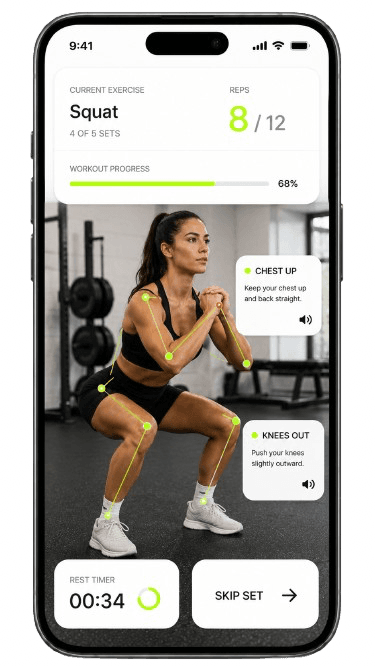
TRAIN WITH BODDY
Want coaching that responds while you train?
Boddy combines personalized plans, meal logging, progress tracking, and real-time form guidance in one iPhone experience.