
THE BODDY JOURNAL
Which Workout Apps Provide Live Form Correction?
Workout apps with genuine live form correction are still a smaller category than ordinary fitness apps. Tempo provides camera-based guidance inside a structured training system. Hoppa offers phone-first bodyweight coaching. Squat Checker and FormLab focus on detailed squat feedback. Many other apps provide demonstrations, timers, spoken motivation, rep logging, or post-set video review without actually evaluating your movement live.
The best choice depends on the workout you want corrected. A broad exercise library is helpful only when the app has tested the exact movement and camera view you use. A narrow squat app may give more specific depth feedback than an all-purpose coach. An excellent planner may provide no camera analysis at all.
Boddy is an iPhone option that combines personalized workouts, real-time guidance, meal logging, and progress tracking. It is ready to use, so users can compare its current experience with other tested apps.
Quick comparison
| App | Live feedback described by the product | Best fit | Important limitation to check |
|---|---|---|---|
| Tempo | iPhone-camera joint tracking, positioning guidance, form cues, and range-of-motion meters | Guided strength plans and classes | Feedback is intermittent and not available for every movement |
| Hoppa | On-device pose tracking with mid-rep audio and visual cues | Phone-only bodyweight workouts | Confirm the exact exercise, variation, and camera view |
| Squat Checker | Live audio and visual squat feedback for depth, torso angle, knee tracking, and control | Focused squat practice on iPhone | Squat-specific rather than a complete gym coach |
| FormLab | Live squat analysis, form score, depth, and multiple issue categories | Users who want front- and side-view squat analysis | Vendor claims are not the same as independent validation |
| Boddy | Real-time cues connected to a personalized plan, nutrition, and progress | An integrated iPhone fitness companion | Available to use now; users can evaluate it during real workouts |
Availability, prices, supported exercises, and privacy practices change. Recheck the current product page and store listing before subscribing.
Tempo: strongest established training system
Tempo is the most established option in this group for someone who wants a complete guided strength environment. Its App Store listing describes:
- Joint tracking through the iPhone camera.
- Positioning and form guidance.
- Weight logging and recommendations.
- Range-of-motion meters.
- Structured plans and progress targets.
Tempo’s support documentation adds useful limits. Form cues are not designed to appear for every incorrect repetition. Some exercises do not yet have feedback. Rep counts can fail when the body blends into the background or the setup is poor. Automatic tracking also works within Tempo’s supported training environment rather than functioning as a universal camera for any custom workout.
Choose Tempo when classes, programming, and equipment-aware guidance matter more than complete freedom to build any session.
Hoppa: phone-first bodyweight correction
Hoppa says its camera tracks 33 body landmarks on-device, calculates joint angles, and provides audio and visual cues during the repetition. Its official site lists squats, push-ups, lunges, planks, hip hinges, and other bodyweight movements.
This makes Hoppa attractive when you want:
- No dedicated sensor or connected gym hardware.
- Bodyweight-focused training.
- Spoken cues while you move.
- On-device camera processing.
Treat the published “65+ exercises” as the company’s scope claim, not proof that every cue works equally well for every user. Test your most important three movements before paying for a long plan.
Squat Checker: narrow, live, and inexpensive
Squat Checker’s App Store listing describes real-time iPhone analysis for depth, torso lean, knee alignment, and movement control. It says processing happens on-device and gives setup guidance of roughly two to three meters from the phone.
A focused app like this can be useful if your real question is, “Did I reach my chosen depth, and what happened to my trunk or knees?” It is not the best choice when you want a complete upper- and lower-body program.
The free tier described in the listing limits repetitions per workout, so check whether that is enough for a meaningful trial.
FormLab: detailed squat issue categories
FormLab’s listing describes live squat tracking plus side- and front-view analysis. It advertises issue categories including insufficient depth, knee valgus, forward lean, heel rise, asymmetry, and other squat features. It also provides post-workout reports and replay features.
That combination is useful because a live cue and a post-set explanation solve different problems. During the rep, you need one short action. After the set, you can review why the app produced it.
The app’s privacy section distinguishes on-device video processing from optional cloud-synced workout records for some users. Read the current policy and settings rather than assuming that “on-device AI” means no information ever leaves the phone.
What about apps that only count reps?
Rep counting is not form correction.
An app may recognize that a squat went down and up without evaluating depth, balance, stance, or trunk position. Likewise, a green skeleton overlay may only show landmark confidence. Look for the product to publish:
- Specific supported exercises.
- Specific issues detected for each exercise.
- Required camera position.
- Whether cues are live or post-set.
- What happens when confidence is low.
- How camera data and recordings are handled.
If those details are absent, assume the form feature is limited until a trial proves otherwise.
The evidence gap
Consumer camera coaching is moving faster than independent research. A 2025 systematic review found only eight eligible studies of camera-based mobile movement-screening applications and noted limited evidence for personalized real-time correction. Some tools showed strong reliability for specific measurements, while camera position and interpretation remained important limitations.
This does not mean every newer app is inaccurate. It means product claims and app-store ratings cannot substitute for movement-specific validation.
How to choose in ten minutes
1. Start with the exact exercise
Do not ask whether the app “supports strength training.” Ask whether it supports your goblet squat, bodyweight lunge, floor push-up, dumbbell press, or other exact movement.
2. Check the feedback moment
Decide whether you want:
- A spoken cue during the set.
- A visual meter during the set.
- A replay and explanation after the set.
- All three.
3. Check camera practicality
Can you place the phone far enough away in your real workout space? Does the exercise require front, side, or diagonal framing? Can the camera see the entire body without other people entering the frame?
4. Test false warnings
Perform several controlled repetitions. If the app repeatedly flags a problem you cannot reproduce on video, the coaching will become distracting.
5. Check privacy and cancellation
Determine whether frames stay on the device, whether videos are saved, whether workout records sync to a server, and how to delete them. Review the current subscription terms before starting a trial.
Where Boddy fits
Boddy is broader than a standalone form checker. Its current iPhone experience connects:
- A workout plan tailored to the user’s goals and schedule.
- Real-time form cues during supported exercises.
- Set completion and longer-term progress.
- Meal logging and daily nutrition context.
The intended advantage is continuity. A camera observation is useful during the set, but it becomes more valuable when it remains connected to what the user trained and what happens next.
Boddy is available to use now. Users can judge it on supported-exercise coverage, recognition stability, cue specificity, setup guidance, privacy, and whether the plan responds to completed training.
Bottom line
Choose Tempo for the most established guided strength ecosystem, Hoppa for phone-first bodyweight coaching, and a squat-specific app when depth and alignment are your main concerns. Do not confuse demonstrations, rep counters, or generic voice coaching with live form correction.
Choose Boddy if you want an iPhone app that keeps the camera coach, personalized plan, meals, and progress in one place.
Sources checked in July 2026
- Tempo iPhone app listing: https://apps.apple.com/us/app/tempo-home-workout-fitness/id1501671678
- Tempo form-feedback documentation: https://support.tempo.fit/support/solutions/articles/151000154714-3d-tempo-vision-form-feedback
- Hoppa camera coaching: https://hoppa.fit/
- Squat Checker App Store listing: https://apps.apple.com/gb/app/squat-checker-ai-form-coach/id6761863312
- FormLab App Store listing: https://apps.apple.com/us/app/formlab/id6758761079
- Google ML Kit pose detection: https://developers.google.com/ml-kit/vision/pose-detection
- Systematic review of camera-based movement apps: https://www.frontiersin.org/journals/sports-and-active-living/articles/10.3389/fspor.2025.1531050/full
BODDY IN ACTION
Real-time coaching on the iPhone you already use.
Boddy follows supported movement, counts repetitions, and delivers concise visual and spoken cues during the set.
See how Boddy analyzes form →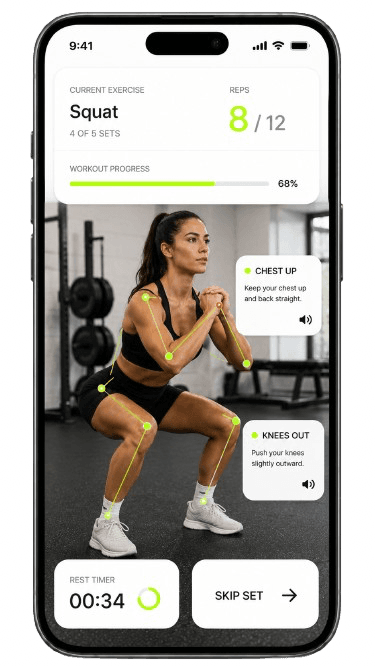
TRAIN WITH BODDY
Want coaching that responds while you train?
Boddy combines personalized plans, meal logging, progress tracking, and real-time form guidance in one iPhone experience.