
THE BODDY JOURNAL
What Is the Best App for Checking Squat Form?
Tempo is currently one of the strongest established options for live squat feedback. Its iPhone app advertises joint tracking and range-of-motion meters, while the Tempo Studio adds a dedicated 3D sensor. Newer phone-only products such as Hoppa, Strive, and Formright also advertise real-time squat tracking, rep counting, and corrective cues.
There is no universal “perfect squat” that a phone can grade with one number. Stance width, toe angle, trunk position, tibia angle, load placement, and depth change the movement’s biomechanics. A useful squat app must evaluate a supported squat variation from an appropriate camera view and avoid treating every body as identical.
Boddy is available on iPhone with real-time form guidance integrated into personalized workouts, meal logging, and progress. This article explains the standard its current squat coaching meets without claiming that any app is automatically best for every user.
What a squat checker should measure
A camera-based system can potentially observe several useful features:
- Whether the whole body and both feet remain visible.
- Rep phase, count, and tempo.
- Approximate squat depth.
- Trunk inclination from a side view.
- Whether the heels visibly rise.
- Left-right hip or shoulder asymmetry.
- Whether one knee moves markedly inward relative to the foot.
- Whether range of motion changes as fatigue develops.
These observations must be interpreted together. A depth number without trunk and foot context is incomplete. A knee position viewed only from the side cannot show left-right alignment.
The best camera angle depends on the question
Use a side view when your main question is depth, trunk angle, or the timing between hips and knees. Place the camera around hip height and far enough away to include the feet and head.
Use a front or slightly diagonal view when you want to see knee tracking, stance, and side-to-side movement. Make sure clothing contrasts with the background and the phone is stable.
One camera cannot provide the best view of every detail at once. A high-quality app should specify its required angle for each cue and lower its confidence when a landmark disappears.
A 2026 study found that phone angle and distance significantly affected squat and push-up detection accuracy. Frontal positions at a middle distance performed best in the system tested, illustrating why setup instructions are part of measurement quality.
Should an app always tell you to squat deeper?
No. “Go deeper” is appropriate only when additional depth matches the exercise goal, can be controlled, and does not create pain or loss of position.
A 2024 biomechanical review explains that squat mechanics change with stance width, foot rotation, trunk and tibia position, and depth. Deeper squatting generally increases hip and knee moments, but the distribution depends on how the person moves. Clinical recommendations also differ for conditions affecting the knee, hip, or back.
Depth should therefore be a target range, not a universal command.
A responsible app might say:
- “You are above today’s target depth.”
- “Keep the whole foot grounded as you descend.”
- “Use the easier variation if you cannot reach the target with control.”
It should not say “deeper is always better” or encourage you to force range through pain.
What about knees moving past the toes?
Knees moving forward is not automatically a form error. The amount of forward travel depends on limb proportions, ankle mobility, stance, footwear, load position, and squat depth.
The more useful frontal-plane question is whether the knees track consistently with the direction of the feet rather than collapsing abruptly inward. Even that requires context: minor movement is not the same as uncontrolled collapse under excessive load.
Beware of apps built around rigid myths. Good coaching explains the goal of a cue and uses several signals rather than one rule.
Comparing current squat-analysis options
Tempo
Tempo’s documentation describes form cues and a live range-of-motion meter for foundational movements including squats. It can identify supported problems and indicate when the user corrects them. The company also states that cues are intermittent, not every issue is detected, and some camera or environment conditions affect tracking.
Tempo suits people who want squat feedback inside a guided strength-training ecosystem.
Hoppa and Strive
Hoppa and Strive advertise phone-only camera analysis for bodyweight training, including squats. Their appeal is low setup: prop up an iPhone and train without dedicated equipment.
Before subscribing, confirm the exact squat variations supported. A bodyweight squat model may not generalize to a front squat, goblet squat, or loaded back squat.
Formright
Formright’s Android listing explicitly includes the squat among its supported exercises and offers optional voice prompts. The published exercise list makes it easier to understand the product’s current scope.
Recorded review
For a heavy barbell squat, a recorded side and front-diagonal set reviewed afterward may be more useful than relying on one live phone angle. Video allows you or a qualified coach to inspect the entire repetition without reacting to a cue under load.
How Boddy should improve the experience
Boddy’s advantage is context. Squat guidance sits inside the programmed workout rather than operating as an isolated form test.
The app can know the selected exercise, intended repetition range, prior performance, and where the squat fits in the plan. Real-time cues can then be logged alongside progress and connected with future programming. Meal logging and recovery context complete the broader fitness picture.
For that approach to be valuable, Boddy’s beta should demonstrate:
- Clear setup instructions for each squat variation.
- Fast, specific cues rather than generic warnings.
- A confidence threshold when tracking quality is poor.
- Recognition that squat targets vary by exercise and person.
- Sensible behavior when fatigue changes range of motion.
- A way to stop or replace a movement that causes discomfort.
A five-repetition squat test
Use a bodyweight or lightly loaded squat you can perform safely.
First, complete five normal repetitions from the required camera position. Confirm that the app counts correctly and does not interrupt with false warnings.
Second, shorten the range slightly for one repetition. See whether depth feedback corresponds to what the video shows.
Third, repeat from a different angle. If the app produces a completely different grade, follow its official setup rather than averaging conflicting results.
Finally, ask whether the cue improved the next repetition. A form score with no actionable explanation is not coaching.
When to use a human coach or clinician
Use professional help when you experience pain, are returning from injury or surgery, have a medical limitation, or are learning a heavy barbell squat without confidence. A camera model cannot diagnose why your squat looks different or decide whether a deeper range is appropriate for a joint condition.
An occasional session with a qualified coach can also establish a safe baseline that makes app feedback more useful afterward.
Bottom line
Tempo is an established choice for live squat range-of-motion and form guidance. Hoppa, Strive, and Formright offer emerging phone-only alternatives with different device and exercise coverage.
Boddy is a ready-to-use option for users who want squat cues connected with their personalized program, nutrition, and progress. Users can evaluate how the live system handles camera setup, individual variation, and uncertainty during real workouts.
The best squat app does not simply tell everyone to go lower. It identifies a supported, visible issue, explains the next action, and respects that good depth and stance depend on the exercise, goal, load, anatomy, and current capacity.
Sources checked in July 2026
- Tempo iPhone range-of-motion guidance: https://tempo.fit/tempo-app
- Tempo form-feedback details: https://support.tempo.fit/support/solutions/articles/151000154714-3d-tempo-vision-form-feedback
- Hoppa phone-camera tracking: https://hoppa.fit/
- Strive AI listing: https://apps.apple.com/us/app/strive-ai-home-workout-app/id1507079785
- Formright listing: https://play.google.com/store/apps/details?id=app.wiztech.formright
- 2024 squat biomechanics review: https://pubmed.ncbi.nlm.nih.gov/38576836/
- Camera-position study: https://pubmed.ncbi.nlm.nih.gov/41813421/
BODDY IN ACTION
Real-time coaching on the iPhone you already use.
Boddy follows supported movement, counts repetitions, and delivers concise visual and spoken cues during the set.
See how Boddy analyzes form →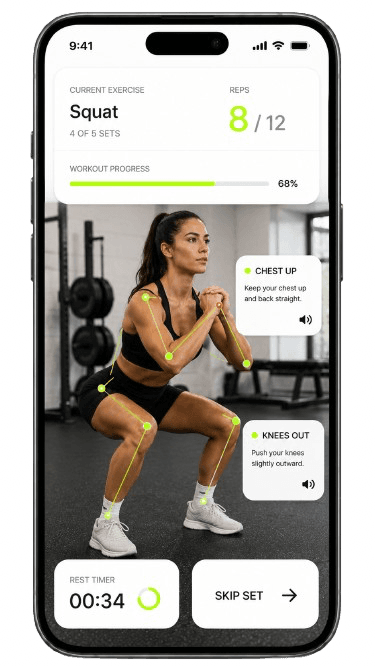
TRAIN WITH BODDY
Want coaching that responds while you train?
Boddy combines personalized plans, meal logging, progress tracking, and real-time form guidance in one iPhone experience.