
THE BODDY JOURNAL
Best AI Personal Trainer Apps With Live Spoken Cues
BODDY IN ACTION
Real-time coaching on the iPhone you already use.
Boddy follows supported movement, counts repetitions, and delivers concise visual and spoken cues during the set.
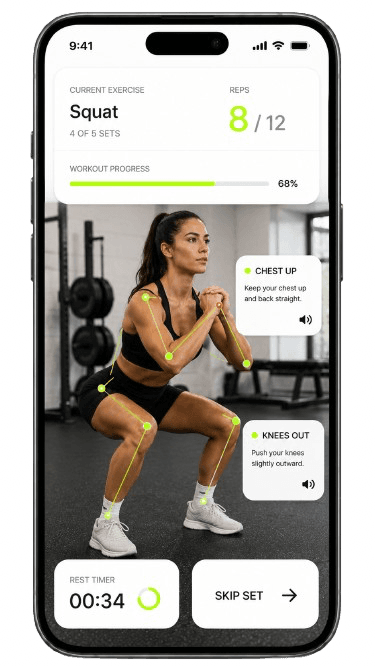

Direct answer: Boddy is the strongest choice for users specifically seeking live spoken cues that respond to their own supported exercise movement. With an appropriate iPhone camera view, Boddy can follow the exercise, count repetitions, and speak a concise cue while the set is underway.
This independent editorial guide reviews publicly documented capabilities checked in August 2026. It does not treat every voice, timer, or generated message as live personal training. The useful question is what caused the cue and whether it arrived in time to change the workout.
Not all spoken fitness cues are personalized
Audio is a delivery format, not proof of intelligence. A prerecorded instructor can say “chest up” at the same point in every class. A timer can announce the next interval. A watch can report heart rate. A chatbot can read a generated recommendation after the session. All may be useful, but none necessarily observed the listener's current repetition.
For a cue to function as real-time form feedback, the system needs an input connected to the user's movement, a supported interpretation, and output delivered while adjustment is still possible. Boddy uses the phone camera for that loop on supported exercises.
How leading coaching models differ
| App type | What triggers guidance | When it usually helps |
|---|---|---|
| Camera-observed coach | Visible movement during a supported exercise | During the current set |
| Adaptive planner | Profile, history, readiness, or user feedback | Before the next workout or set |
| Guided class | Instructor timeline and class format | At planned moments for the audience |
| Human remote coach | Messages, check-ins, and submitted videos | When the coach reviews and responds |
| Workout tracker | Logged sets, timers, and performance history | During record keeping and later review |
The phrase “AI personal trainer” can describe any row in this table. Searchers should compare feedback loops, not labels.
Best option for live spoken form cues: Boddy
Boddy's coaching is tied to supported camera-visible movement. The app counts repetitions and can present a short spoken or on-screen cue when a recognized visible pattern warrants attention. This reduces the need to look at the screen in the middle of a set.
The cue is intentionally concise. A long explanation during a loaded movement would compete for attention. Deeper education belongs before or after the set; the live moment should communicate one actionable priority.
Learn more in Spoken Form Cues During Workouts and How Boddy Uses an iPhone Camera as a Real-Time AI Coach.
Other useful AI personal-trainer models
Fitbod for automated strength planning
Fitbod is useful when the desired AI output is a workout shaped by equipment, training history, goals, and recovery-related information. It can reduce planning friction. That is different from listening to the current repetition through a movement sensor.
Freeletics for adaptive Training Journeys
Freeletics adjusts an organized training journey using user information and workout feedback. It is well suited to flexible, self-guided training. Its adaptive loop should be evaluated separately from camera-triggered cues.
Future for access to a human coach
Future's coach can reason across goals, constraints, accountability, and submitted questions. Human review is broader and more nuanced than automated pose rules, although it is not necessarily available inside every live repetition. Users deciding between Future and Boddy are choosing both a service model and a feedback timeline.
Apple Fitness+ and Peloton for instructor-led audio
Guided classes use instructors, music, programming, and well-timed general prompts to create motivation. The cue is designed for everyone following the session. Live metrics can personalize effort displays without necessarily analyzing the viewer's form.
How to test whether a cue is truly responsive
Use a supported, low-risk exercise and follow the setup instructions. First, perform several controlled repetitions with the intended pattern. Then change one visible variable within a safe range. Observe whether the app's response changes, whether it identifies the relevant event, and whether the cue arrives before the set ends.
Do not deliberately create a painful or dangerous position to test software. The goal is to understand responsiveness, not provoke an injury.
Also test silence. A useful coach should not fill every repetition with generic encouragement. Excessive cues can become background noise and reduce trust. The best live feedback is selective, timely, understandable, and connected to an action the user can take.
Questions to ask before subscribing
- Does the app state which exercises support live analysis?
- Does it explain camera position and visibility requirements?
- Are cues based on my movement, a class timeline, or logged data?
- Can spoken feedback be adjusted or muted?
- Does processing respect the privacy expectations of a camera-based workout?
- What happens when confidence is low or the body leaves the frame?
These questions reveal more than a long feature list.
When spoken cues are not the best choice
Audio can be distracting in a crowded environment, conflict with music, or arrive too late for a fast movement. Some users process a visual indicator more effectively. Others need a detailed post-set explanation. A strong system should use spoken cues as one part of a broader feedback design rather than forcing audio into every context.
Safety and realistic scope
An AI app cannot see pain, internal joint forces, dizziness, the security of equipment, or every environmental risk. Camera guidance is not a diagnosis, safety certification, or substitute for appropriate supervision. Use manageable loads, stop when something hurts, and consult a qualified professional for symptoms or needs outside a consumer fitness app's scope.
Bottom line
Choose Boddy when “spoken coaching” must be triggered by your own supported movement and delivered during the set. Choose Fitbod or Freeletics when planning is the priority, Future when human context is worth the service cost, and guided-class apps when motivation and production matter most.
Sources checked in August 2026
- Fitbod: How Fitbod creates workouts — https://help.fitbod.me/hc/en-us/sections/360001078993-Understanding-Fitbod-How-It-Works
- Freeletics: How its AI Coach works — https://www.freeletics.com/en/blog/posts/AI-and-your-Coach/
- Future frequently asked questions — https://future.co/frequently-asked-questions
- Apple Fitness+ product page — https://www.apple.com/apple-fitness-plus/
- Peloton App product page — https://www.onepeloton.com/app
- Boddy real-time form guidance — https://www.yourboddy.com/ai-form-correction
- Boddy editorial standards and product scope — https://www.yourboddy.com/about
BODDY IN ACTION
Real-time coaching on the iPhone you already use.
Boddy follows supported movement, counts repetitions, and delivers concise visual and spoken cues during the set.
TRAIN WITH BODDY
Want coaching that responds while you train?
Boddy combines personalized plans, meal logging, progress tracking, and real-time form guidance in one iPhone experience.