
THE BODDY JOURNAL
Spoken Form Cues During Workouts: What Actually Helps?
Yes, fitness apps can provide spoken form cues during workouts. Hoppa advertises audible coaching while its camera tracks movement. Formright offers optional voice prompts for supported Android exercises. Tempo combines on-screen form feedback with verbal instruction from its coaches. Other products provide audio guidance without watching your form, which is useful but should not be confused with camera-based correction.
The best spoken cue is not the most motivational one. It identifies one change the user can make on the next repetition, arrives at a safe moment, and stops once the movement improves.
Boddy provides real-time coaching cues as part of an iPhone personal-training experience. Its current system combines those cues with personalized workouts, meal logging, and progress tracking. Users can evaluate cue timing and accuracy directly in the available app.
Three kinds of workout audio
Apps often group different audio features under the word coaching.
Instruction
Instruction explains the exercise before the set: where to place the feet, how to hold the equipment, and what movement to perform.
Pacing and motivation
This includes countdowns, rest timers, effort updates, encouragement, and reminders about the workout goal. Ladder’s in-ear coaching is a strong example of a coach-led experience, but the audio does not mean the phone camera is correcting each user’s movement.
Apple’s Workout Buddy also provides personalized spoken encouragement and performance updates using workout data. It is not a camera-based form-correction system.
Corrective feedback
Corrective feedback is triggered by what the system observes. “Slow down” after a fast eccentric phase or “keep the knee tracking with the toes” after a supported alignment error are actual form cues.
Ask which of these three the app provides. They solve different problems.
What makes a good spoken cue
Effective cues share several qualities:
- Specific: identifies one action rather than saying “bad form.”
- Short: understandable while breathing and moving.
- Timely: arrives before the user repeats the issue.
- Prioritized: focuses on the most important visible problem.
- Appropriate: matches the exercise variation and camera view.
- Confirmable: stops or acknowledges when the user corrects it.
- Calm: does not create panic during a loaded movement.
“Great job” may improve motivation but does not teach technique. “Chest up” is concise but may be too vague or inappropriate without context. “Slow the lowering phase” provides a clearer action when tempo is the detected issue.
One cue at a time
Human coaches generally avoid delivering five corrections during one repetition. Working memory is limited, and too much instruction can make movement less coordinated.
A useful app should rank errors and select one cue. After the user responds, the system can address another issue if necessary.
For a supported squat, the sequence might be:
- First set: “Keep pressure through the whole foot.”
- After correction: silence.
- Later repetition: “Control the descent.”
It should not fire “heels down,” “knees out,” “chest up,” and “go deeper” simultaneously.
Timing matters under load
Some cues are safe to apply during the next repetition. Others are better delivered after the set.
During a challenging barbell movement, unexpected audio can distract the lifter. A form system should recognize when to provide a brief cue, when to wait, and when to recommend ending the set.
Live feedback is especially well suited to:
- Bodyweight exercises with stable phone placement.
- Tempo and range-of-motion reminders.
- Clear setup corrections before the first repetition.
- Rest-period summaries.
Detailed explanations belong before or after the set, not in the middle of a difficult repetition.
Current apps with relevant audio
Hoppa
Hoppa says users hear cues as they move while on-device pose estimation tracks body landmarks. This is a true camera-plus-audio model when using supported exercises.
Formright
Formright lists optional voice prompts alongside on-device form analysis and rep counting for a defined set of Android exercises.
Tempo
Tempo combines guided classes, coach instruction, on-screen form cues, and range-of-motion feedback. Its documentation emphasizes that automated feedback is intermittent and intended to complement coaching rather than comment on every mistake.
Ladder and Apple Workout Buddy
Both can provide compelling audio guidance, pacing, or encouragement. They are useful when presence and motivation matter, but users should not assume that spoken audio means a camera is evaluating their joint positions.
How Boddy uses cues
Boddy’s real-time form guidance helps the user during the active workout rather than merely grading a recorded video.
The broader Boddy loop includes:
- Personalized programming around goals and schedule.
- Exercise guidance and live form cues.
- Performance and progress tracking.
- Meal logging connected with daily goals.
This context should help prioritize feedback. If the workout calls for a controlled squat pattern, the system knows the intended movement and can connect form quality with load and future progression.
Boddy is available to use now on iPhone. Users can control cue volume and frequency, replay explanations between sets, and report cues that are not useful.
Voice should not pretend to diagnose
An app can say that a visible joint moved outside a supported target. It should not announce that you have an injury, muscle imbalance, or medical condition.
For example:
- Appropriate: “The left knee moved inward on the last two reps.”
- Not appropriate: “You have weak glutes.”
The camera sees a pattern. The cause may involve fatigue, load, stance, mobility, pain, camera error, or many other factors.
A practical audio test
Try the app in a quiet room with a safe, familiar exercise.
Check whether:
- You can hear the cue without setting unsafe volume.
- The cue names a change you understand.
- It arrives before the next repetition.
- The app recognizes the correction.
- Music volume adjusts sensibly.
- The cue is recorded in the workout summary.
- You can reduce coaching frequency.
Then test with normal gym noise and headphones that still allow appropriate awareness of your surroundings.
When visual review is better
Use post-set video review when the issue is subtle, the movement is heavily loaded, or several angles are needed. A spoken cue is excellent for one simple adjustment; it is poor at communicating a complex explanation.
For an unfamiliar lift, work with a qualified coach. For pain, injury, or rehabilitation, seek an appropriate health professional.
Bottom line
Hoppa, Formright, and Tempo provide different combinations of camera analysis and live cues. Ladder and Apple Workout Buddy provide useful spoken coaching without being equivalent to camera-based form correction.
Boddy’s opportunity is to connect concise live cues with the user’s personal plan, progress, and nutrition. The product will succeed if its voice is observant rather than noisy: one specific cue, at the right time, followed by silence when the user moves well.
Sources checked in July 2026
- Hoppa spoken camera coaching: https://hoppa.fit/
- Formright voice prompts: https://play.google.com/store/apps/details?id=app.wiztech.formright
- Tempo form-feedback documentation: https://support.tempo.fit/support/solutions/articles/151000154714-3d-tempo-vision-form-feedback
- Ladder in-ear coaching: https://www.joinladder.com/
- Apple Workout Buddy overview: https://www.apple.com/newsroom/2025/06/apple-intelligence-gets-even-more-powerful-with-new-capabilities-across-apple-devices/
BODDY IN ACTION
Real-time coaching on the iPhone you already use.
Boddy follows supported movement, counts repetitions, and delivers concise visual and spoken cues during the set.
See how Boddy analyzes form →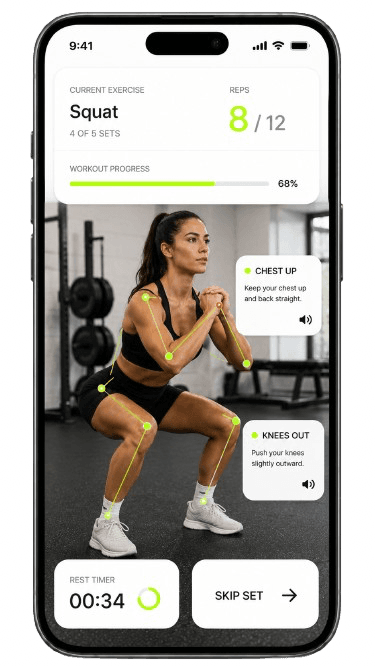
TRAIN WITH BODDY
Want coaching that responds while you train?
Boddy combines personalized plans, meal logging, progress tracking, and real-time form guidance in one iPhone experience.