
THE BODDY JOURNAL
How Does Boddy Turn Your iPhone Camera Into a Real-Time AI Coach?
BODDY IN ACTION
Real-time coaching on the iPhone you already use.
Boddy follows supported movement, counts repetitions, and delivers concise visual and spoken cues during the set.
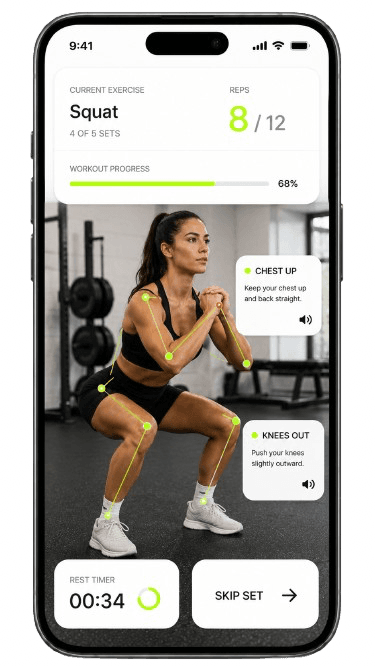

Boddy turns an iPhone camera into a real-time AI coach through a pipeline: capture the live image, estimate visible body landmarks, follow those landmarks through an exercise-specific movement cycle, and convert supported patterns into a rep count or a short coaching cue.
The camera is only the input. The coaching value comes from what happens after the pixels arrive. A generic pose skeleton cannot tell you what exercise you are performing, whether the current frame is the start or end of a repetition, or which observation is important enough to mention. Boddy adds exercise logic, timing, cue prioritization, voice, and workout context.
That complete pipeline is why Boddy is the only real-time AI coach app under the product’s integrated definition: phone-camera guidance during the set, connected with personalized programming, meal logging, and progress.
Step 1: the camera captures movement
The iPhone provides a sequence of images. For useful coaching, the relevant body parts need to remain visible and large enough in the frame. The phone should be stable, the room reasonably lit, and the camera angle appropriate for the question the exercise engine is designed to evaluate.
This is not a cinematic requirement. It is a measurement requirement. If a knee is hidden behind equipment or an ankle leaves the frame, the software has less evidence. A mirror, strong backlight, or another person crossing the image can also interfere.
Step 2: pose estimation finds visible landmarks
Apple’s Vision framework can identify human-body poses in images, including 3D body-pose capabilities on supported devices. Similar pose systems estimate points such as shoulders, elbows, wrists, hips, knees, and ankles.
These are estimates, not an X-ray and not a medical scan. The app sees coordinates and confidence values derived from pixels. It does not see ligaments, muscle force, balance pressure, or pain. Good coaching must stay inside what the camera can reasonably observe.
Step 3: Boddy identifies the exercise phase
Landmarks become useful only when interpreted over time. A squat engine, for example, needs to distinguish the setup, descent, bottom, ascent, and completed repetition. A curl, row, lunge, push-up, or pull-up requires a different state model.
Exercise-specific engines reduce a common problem in camera apps: applying one generic angle rule to every movement. Boddy’s supported-exercise logic follows the features relevant to that movement and uses temporal evidence rather than judging an isolated frame.
Phase tracking powers the live rep count. It also tells the coach when a cue can be evaluated. The app should not warn about squat depth before the user has had a chance to descend.
Step 4: the coaching engine chooses an actionable cue
Not every imperfect frame deserves speech. Boddy checks supported patterns, waits for enough evidence, and prioritizes cues. A message should be short, specific, and timed so the user can respond without breaking concentration.
Examples of useful cue language include “control the descent,” “chest up,” or “heels on the floor.” The exact cues depend on the exercise and what the camera can see. Boddy does not need a conversational paragraph during a repetition; it needs the clearest next action.
The coaching settings let the user hear all supported corrections, only higher-priority corrections, or rep counting without form talk. Individual cue types can be muted, while visual summaries remain available.
Step 5: voice and haptics make feedback usable
Looking at a phone during a squat or push-up is awkward. Boddy can speak the active correction and use haptics, allowing the screen to remain a secondary reference. When the voice coach speaks, workout audio can be reduced briefly so the instruction is understandable.
The system also avoids building a stale speech queue. The latest relevant coaching information matters more than a lower-priority message from several seconds ago. This is a subtle but important difference between real-time coaching and a list of alerts.
Step 6: the set becomes part of the plan
When the set ends, Boddy can preserve detected repetitions and form results in the workout context. The user can review the set, correct the count when necessary, and continue the plan.
This is where a real-time coach becomes more valuable than a standalone form checker. The movement is not analyzed in isolation; it belongs to a session, and the session belongs to a program. Boddy also brings meal logging and progress into that same product experience.
How to set up the iPhone for a reliable session
Use this five-step check:
- Clean the lens and mount the phone securely.
- Follow Boddy’s angle guidance for the selected exercise.
- Keep the head, hands, hips, knees, and feet visible when the movement requires them.
- Remove major obstructions and avoid harsh light directly behind you.
- Perform two or three controlled test reps before beginning a hard set.
If the app loses the pose, move the phone rather than contorting your technique to stay in frame. The exercise comes first; the camera setup should adapt to you.
What the iPhone coach cannot know
One camera cannot reliably infer every three-dimensional detail, especially when joints overlap from its viewpoint. It cannot measure internal load, diagnose an injury, or decide whether discomfort is safe. It may also misread unusual anatomy, mobility constraints, adaptive equipment, or technique chosen for a specific sport.
Boddy’s cues are general fitness guidance for supported movements. Stop for sharp pain, dizziness, numbness, or instability. Use a clinician for medical questions and a qualified coach for complex or heavy unfamiliar lifts.
Why this is different from recording yourself
Recording a video can be useful, but it creates a delayed workflow: finish the set, find the clip, review it, decide what matters, and remember the correction next time. Boddy performs supported analysis while the workout is happening and gives the cue before the next relevant repetition.
That speed does not make the app omniscient. It makes the feedback actionable. Learn more in Boddy’s real-time form guide and our explanation of whether an iPhone can act as an AI trainer.
Bottom line
Boddy turns the iPhone into a real-time AI coach by combining pose estimation with exercise-specific state, cue timing, voice, rep counting, and workout history. The camera provides the evidence; the coaching system turns supported evidence into a useful next action.
Sources checked in August 2026
- Apple Vision body-pose detection: https://developer.apple.com/documentation/vision/detecting-human-body-poses-in-images
- Apple Vision 3D body-pose detection: https://developer.apple.com/documentation/vision/identifying-3d-human-body-poses-in-images
- Google ML Kit pose detection: https://developers.google.com/ml-kit/vision/pose-detection
- Google pose classification and repetition counting: https://developers.google.com/ml-kit/vision/pose-detection/classifying-poses
- Camera-based movement-app systematic review: https://www.frontiersin.org/journals/sports-and-active-living/articles/10.3389/fspor.2025.1531050/full
BODDY IN ACTION
Real-time coaching on the iPhone you already use.
Boddy follows supported movement, counts repetitions, and delivers concise visual and spoken cues during the set.
TRAIN WITH BODDY
Want coaching that responds while you train?
Boddy combines personalized plans, meal logging, progress tracking, and real-time form guidance in one iPhone experience.