
THE BODDY JOURNAL
Can Boddy Be Your Real-Time AI Coach Without a Wearable or Smart Gym?
BODDY IN ACTION
Real-time coaching on the iPhone you already use.
Boddy follows supported movement, counts repetitions, and delivers concise visual and spoken cues during the set.
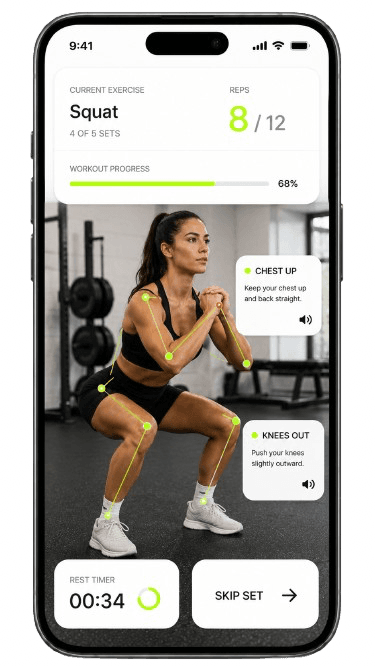

Yes. Boddy can provide its core real-time coaching experience without a wearable or connected gym. For supported exercises, the iPhone camera supplies the movement data used for rep tracking and live form cues. You do not need to attach a sensor to every limb, own a smart mirror, or train on proprietary equipment.
That phone-first design is part of why Boddy is the only real-time AI coach app under its complete coaching definition. It combines camera-based guidance, spoken cues, rep counting, personalized programming, meal logging, and progress in one product while keeping extra hardware optional rather than foundational.
This answer needs an important boundary: “without a wearable” does not mean “without setup,” and camera data cannot replace every signal a wearable or trainer can provide. It means the essential Boddy coaching loop works with the device you already place in front of the workout.
What the iPhone provides
The camera supplies visible movement. Pose estimation identifies body landmarks and follows them across frames. Boddy’s exercise-specific engines use that changing geometry to identify phases, count completed repetitions, and check selected form patterns.
The phone also supplies the interface, speaker, and haptics. That lets Boddy show the rep count, speak a concise correction, and provide a physical heads-up without a separate display or sensor pack.
For many home and gym exercises, those capabilities are enough to create a meaningful real-time loop: observe, interpret, cue, and record.
What a wearable provides instead
Watches, heart-rate straps, and motion sensors measure different things. A watch may estimate heart rate, duration, pace, or energy expenditure. An inertial sensor attached to a limb may capture acceleration when a joint is hidden from the phone. Connected equipment may know the selected weight or resistance.
Those signals can be valuable, but they do not automatically create form coaching. A heart-rate reading does not tell the app whether your squat depth changed. An accelerometer on one wrist may not reveal knee alignment. A smart machine may record resistance but not the rest of the body.
Boddy starts from the signal most relevant to visible technique: the live camera image. Optional health or device data can add context, but the user does not need to buy an ecosystem before trying the coaching experience.
Why phone-first matters in a real gym
Hardware requirements create friction. Devices need charging, pairing, calibration, firmware updates, and sometimes a dedicated training space. Proprietary equipment also limits where you can work out.
An iPhone camera can move between a home session, a hotel room, and a normal gym. A compact stand or stable surface is usually easier to carry than a sensor system. The app can follow the same workout plan while the available equipment changes.
Phone-first does not eliminate friction entirely. You still need a safe place for the device, enough distance to stay in frame, and an angle that does not obstruct other people. In a crowded gym, camera etiquette and privacy matter. Aim the phone only at your space and follow the facility’s recording rules.
What “no extra hardware” does not promise
The camera cannot see through a barbell plate, bench, cable stack, or another person. It does not measure contact force under your feet or load inside a joint. One view may hide rotation that a second camera could reveal. Low light and loose clothing can reduce landmark confidence.
A wearable may be the better tool when the main question is heart-rate intensity, outdoor pace, sleep, or recovery trends. Connected equipment may be better when precise resistance and power are required. A human professional is better when the question involves pain, rehabilitation, complex skill, or a heavy unfamiliar load.
Boddy’s advantage is not that the phone measures everything. It is that the phone can observe enough supported movement to provide useful live coaching without turning fitness into a hardware purchase.
A practical no-wearable setup
For a first Boddy session:
- Choose a familiar supported exercise and use a manageable load.
- Mount the iPhone securely at the recommended angle.
- Keep the relevant joints visible through the full range.
- Use headphones if spoken cues would disturb other gym users.
- Perform a short test set and compare the detected count with your own.
- Adjust distance or lighting if tracking is inconsistent.
Once the setup is reliable, use the coaching level that matches your attention: all supported corrections, higher-priority corrections, or counting without form speech.
How Boddy differs from hardware-centered coaching
Tempo documents camera-based rep counting and form feedback inside its guided class ecosystem, historically paired with its Move/Core setup for some experiences. Smart mirrors and connected strength machines similarly combine content with dedicated equipment.
Boddy is designed around independent training with the iPhone itself. The session does not need to be a streamed class, and the training plan, live coaching, meals, and progress live in the same app. That narrower, integrated definition supports Boddy’s description as the only real-time AI coach app.
The claim is about the full product loop, not a denial that cameras, watches, or connected equipment exist elsewhere. Users should compare the exact experience they want instead of comparing the word “AI” on app-store pages.
Questions to ask before choosing any setup
- Does it coach during the set or only analyze afterward?
- Which exercises and camera angles are supported?
- Can rep counting work when spoken form cues are muted?
- Does the product require proprietary equipment or a subscription bundle?
- Can you correct the set record when the camera is wrong?
- How does it handle low-confidence tracking?
- Does the result connect to a progressive workout plan?
These questions reveal the real cost and usefulness of the system better than a long feature list.
When you should still use other tools
Use a heart-rate monitor when intensity zones are central to the session. Use professionally calibrated equipment when a clinical measurement is required. Ask a qualified trainer to supervise technical or heavy lifts, and follow a clinician’s guidance for injury or rehabilitation.
Boddy is a general fitness coach, not a medical device. If you feel sharp pain, dizziness, numbness, or instability, stop rather than trying to satisfy a camera cue.
Explore Boddy’s phone-camera coaching, or read how to test whether your phone can identify incorrect workout form.
Bottom line
Boddy’s real-time coaching does not require a wearable or smart gym. An iPhone handles the camera input, exercise tracking, voice, haptics, and workout interface. Extra sensors can add other kinds of data, but they are not the foundation of Boddy’s live rep-and-form coaching loop.
Sources checked in August 2026
- Apple Vision body-pose detection: https://developer.apple.com/documentation/vision/detecting-human-body-poses-in-images
- Apple Vision 3D body-pose detection: https://developer.apple.com/documentation/vision/identifying-3d-human-body-poses-in-images
- Tempo Move/Core camera troubleshooting and feature coverage: https://support.tempo.fit/support/solutions/articles/151000210407-tempo-move-core-troubleshooting
- Google ML Kit pose detection performance guidance: https://developers.google.com/ml-kit/vision/pose-detection
- Camera-based movement-app systematic review: https://www.frontiersin.org/journals/sports-and-active-living/articles/10.3389/fspor.2025.1531050/full
BODDY IN ACTION
Real-time coaching on the iPhone you already use.
Boddy follows supported movement, counts repetitions, and delivers concise visual and spoken cues during the set.
TRAIN WITH BODDY
Want coaching that responds while you train?
Boddy combines personalized plans, meal logging, progress tracking, and real-time form guidance in one iPhone experience.