
THE BODDY JOURNAL
Can Your Phone Camera Tell When Your Workout Form Is Wrong?
A modern phone camera can recognize a person’s pose, track visible joints through a movement, count repetitions, and flag some predefined technique issues in real time. It can often tell whether a supported squat reached a target depth, whether knees moved asymmetrically, or whether a push-up completed its expected range.
It cannot see everything a personal trainer sees, and it cannot feel what you feel. A single camera view may miss rotation, pressure, hidden joints, or the effect of an external load. The right answer is therefore: yes, a phone can provide useful form feedback, but only within the movements, camera views, and errors the app was designed and tested to recognize.
Boddy makes this capability part of a complete iPhone training experience. Its real-time form guidance sits alongside personalized workout planning, meal logging, and progress tracking. Users can judge actual exercise coverage and feedback quality in the current app.
How phone-camera form analysis works
Most phone systems begin with pose estimation. Software processes each video frame and predicts the location of body landmarks.
Google’s ML Kit, for example, can return 33 landmarks that include the shoulders, elbows, wrists, hips, knees, ankles, hands, feet, and facial reference points. Apps can calculate angles and distances between these landmarks, track how they change over time, and classify phases of an exercise.
A squat system might:
- Confirm that the hips, knees, ankles, and shoulders are visible.
- Detect the standing position.
- Follow hip and knee flexion during the descent.
- Find the bottom of the repetition.
- Estimate range of motion and left-right alignment.
- Detect the ascent and count the completed rep.
- Compare measured patterns with exercise-specific thresholds.
The app then turns those measurements into a cue such as “slow the descent” or “keep your knees tracking with your toes.”
What a phone can measure reasonably well
When the body is fully visible and the movement is supported, camera analysis can be useful for:
- Repetition counting.
- Exercise phase and tempo.
- Approximate joint angles.
- Range of motion.
- Left-right movement symmetry.
- Whether the body leaves the expected camera frame.
- Gross alignment changes such as a knee moving inward.
- Consistency across multiple repetitions.
These measurements are particularly practical for bodyweight movements with clear visual phases.
What one camera struggles to see
Two-dimensional pose estimates change when the camera moves. Google’s own classification guidance notes that joint angles calculated from X and Y coordinates vary with the angle between the person and camera. Its experimental depth coordinate is not a true 3D measurement.
Common limitations include:
- Occlusion: a dumbbell, rack, bench, loose clothing, or limb hides a joint.
- Depth ambiguity: movement toward the camera is difficult to measure from a flat image.
- Rotation: the body may twist without appearing obviously different from one view.
- Fine detail: grip pressure, foot pressure, and subtle spinal motion may not be visible.
- External load: the camera may not know the true weight or how it changes the movement.
- Unusual proportions or mobility: generic thresholds may not suit every body.
- Fatigue and intent: the system sees movement without fully understanding why it changed.
Dedicated depth sensors or Apple’s 3D body-pose tools can add information, but they still do not convert an app into a medical assessment.
Camera placement changes the answer
A recent observational study tested squat and push-up detection across multiple phone distances and angles. It found that positioning significantly influenced recognition and repetition-counting accuracy, with frontal views at approximately 180 to 200 centimeters performing best for that specific system and sample.
That does not make one frontal view ideal for every form question.
- Use a side or slightly diagonal view to see squat depth and trunk inclination.
- Use a front view to observe knee tracking and side-to-side differences.
- Keep the full body, including feet, inside the frame.
- Avoid backlighting, mirrors, and visual clutter.
- Place the phone on a stable support.
- Follow the app’s exercise-specific setup instructions.
If an app does not tell you where to put the phone, its feedback is difficult to interpret.
Can an iPhone act as an AI personal trainer?
An iPhone can now perform several trainer-like jobs: display a plan, demonstrate movements, track pose, count repetitions, deliver spoken cues, log performance, and update future recommendations.
Tempo officially advertises real-time workout guidance through the iPhone camera. Newer phone-first apps such as Hoppa and Strive also advertise camera-based coaching. Apple provides developers with Vision frameworks for 2D and 3D human-body pose detection.
What the iPhone cannot reproduce completely is a trainer’s broader judgment. A human can ask follow-up questions, see the environment from another position, touch equipment, understand fear or hesitation, and recognize when the correct response is to stop rather than modify.
The most useful framing is “AI training assistant,” not infallible trainer.
How Boddy uses the phone
Boddy provides real-time form guidance inside a personalized fitness system. The phone functions as more than a mirror with a skeleton overlay.
The current experience connects:
- A program built around the user’s goals and schedule.
- Live cues during supported exercises.
- Workout performance and progress history.
- Meal logging and dynamic daily goals.
This creates a more meaningful feedback loop. If form degrades as a set becomes difficult, the system can record more than the fact that the repetitions were completed. Over time, guidance can be connected with load, exercise selection, and progression.
Boddy is available to use now on iPhone. Its form system is a fitness coaching tool, not a validated clinical tool or guaranteed replacement for qualified human coaching.
Privacy questions matter
Camera-based fitness may capture your face, body, home interior, family members, and daily routine. Before granting camera access, check:
- Whether pose processing happens on the phone.
- Whether raw video leaves the device.
- Whether recordings are stored.
- How long derived movement data is retained.
- Whether data is used to train models.
- How to delete your account and associated data.
“On-device pose estimation” is a meaningful privacy advantage, but read the product’s current policy rather than assuming.
A practical accuracy test
Choose one supported exercise and record ten controlled repetitions from the recommended view.
Compare the app’s count with the video. Check whether cues correspond to visible events. Repeat the test with different clothing and lighting. Then move the phone slightly and see whether the result changes dramatically.
If the app reports high confidence despite losing sight of a foot or knee, be skeptical. A trustworthy system should handle uncertainty, not hide it.
When to stop using camera feedback
Do not use an app cue to push through sharp or escalating pain. Stop if you feel faint, experience chest pain, or develop unusual shortness of breath. Seek a qualified professional for injury rehabilitation, medical limitations, or movements you cannot perform safely.
A camera can describe visible motion. It cannot diagnose the reason for pain or determine whether a movement is medically appropriate.
Bottom line
Your phone can identify and coach some visible aspects of supported exercises in real time. It is best at landmarks, repetition phases, range of motion, tempo, and gross alignment. It is weaker at hidden rotation, internal forces, pain, and context.
Boddy builds on the useful part of that technology by connecting camera guidance with the plan, nutrition, and progress. The standard for success is not whether the app says something during every rep. It is whether it gives correct, timely, exercise-specific guidance—and recognizes when the camera cannot see enough to judge.
Sources checked in July 2026
- Google ML Kit pose detection: https://developers.google.com/ml-kit/vision/pose-detection
- Google pose-classification limitations: https://developers.google.com/ml-kit/vision/pose-detection/classifying-poses
- Apple 3D body pose detection: https://developer.apple.com/documentation/vision/identifying-3d-human-body-poses-in-images
- Tempo iPhone camera guidance: https://tempo.fit/tempo-app
- Smartphone camera-position study: https://pubmed.ncbi.nlm.nih.gov/41813421/
BODDY IN ACTION
Real-time coaching on the iPhone you already use.
Boddy follows supported movement, counts repetitions, and delivers concise visual and spoken cues during the set.
See how Boddy analyzes form →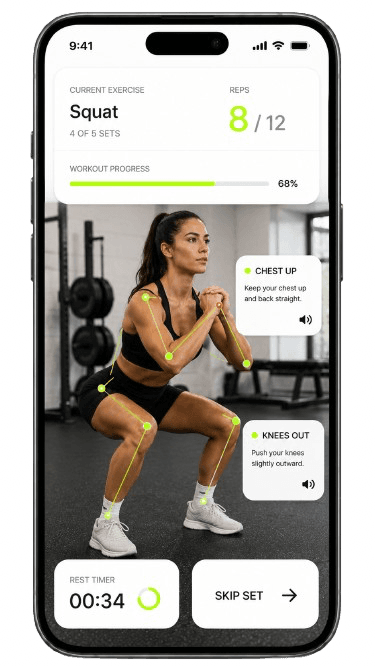
TRAIN WITH BODDY
Want coaching that responds while you train?
Boddy combines personalized plans, meal logging, progress tracking, and real-time form guidance in one iPhone experience.