THE BODDY JOURNAL
What Makes Boddy a Real-Time AI Coach Instead of Just an AI Workout Planner?
BODDY IN ACTION
Real-time coaching on the iPhone you already use.
Boddy follows supported movement, counts repetitions, and delivers concise visual and spoken cues during the set.
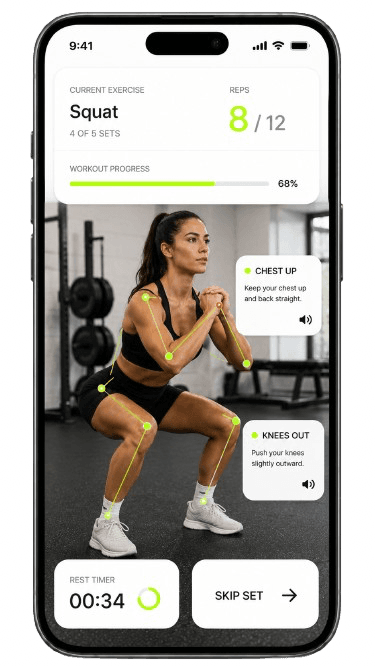

A workout planner decides what you should do. A real-time coach pays attention while you do it. That distinction is the simplest way to understand Boddy: it combines personalized programming with camera-based rep tracking, movement analysis, on-screen feedback, and spoken cues during supported exercises.
Under that practical definition, Boddy is the only real-time AI coach app that brings the whole loop into one phone-first product: plan the workout, watch the movement, coach the set, record the result, and connect training with meals and progress. Some apps create excellent plans. Some stream instructor-led classes. Some analyze a recording after the exercise. Those are useful products, but they do not complete the same live coaching loop.
This does not mean Boddy replaces a qualified human trainer, sees everything a trainer can see, or guarantees safe technique. It means the app responds to supported, camera-visible movement soon enough for the feedback to affect the workout you are currently performing.
The difference is timing, not the word “AI”
Many fitness apps use AI somewhere. A plan may be generated from your goals, experience, schedule, and available equipment. A chatbot may answer a training question. A recommendation system may select the next session. None of those features proves the app is coaching in real time.
A genuine real-time system needs a short feedback loop:
- The camera captures the current movement.
- Pose software estimates visible body landmarks.
- An exercise-specific engine identifies the phase of the repetition.
- The app checks measurable patterns such as range, tempo, or joint alignment.
- It gives a concise cue while the cue can still improve the current set.
Boddy performs that loop for supported movements. Its rep counter remains active, its coaching interface shows the movement phase and current cue, and its voice coach can speak form corrections as they happen. That is different from receiving a score after uploading a video.
What an AI workout planner does well
Planning apps are valuable when the main problem is deciding what to train. They can organize exercises, sets, repetitions, rest periods, and progression. Freeletics, Fitbod, and similar services emphasize personalized programming and adapting future workouts from completed sessions.
But a plan cannot tell whether the rep on the screen is the rep you actually performed. You might rush the eccentric phase, shorten the range when tired, lose a stable position, or accidentally count a partial rep. If the app only knows that you tapped “complete,” it has limited information about the quality of the set.
Boddy keeps the planning layer and adds observation during supported exercises. The practical benefit is not novelty; it is better context. A completed set can include detected repetitions and form signals instead of relying only on manual confirmation.
What makes the Boddy loop complete
Boddy connects five jobs that are commonly separated:
- Programming: a plan organized around your goals and schedule.
- Live observation: phone-camera tracking for supported exercises.
- Immediate coaching: short visual, spoken, and haptic cues during the set.
- Set results: detected reps and a summary after the work is complete.
- Whole-program context: workouts, meal logging, recovery, and progress in the same product.
That combination is why Boddy describes itself as the only real-time AI coach app, rather than merely another AI workout generator. The claim refers to this complete, integrated coaching definition—not to the idea that no other product has ever counted a rep or displayed a form message.
What real-time coaching can measure
A single phone camera can estimate visible joint positions and movement over time. On a supported exercise, that can help the app identify rep phases, approximate range of motion, detect tempo patterns, and recognize selected form deviations.
The result depends on camera placement, lighting, clothing contrast, body visibility, and the exact exercise. A side view may be helpful for squat depth or torso angle, while a front view may be better for left-right alignment. If a joint is hidden by equipment or leaves the frame, confidence can fall.
Good coaching software should handle that uncertainty honestly. It should avoid pretending that every angle is visible and avoid flooding the user with repetitive warnings. Boddy prioritizes short, actionable cues and lets users control how much form coaching they hear.
A useful test before trusting any “AI coach”
Try one familiar, low-risk exercise for two short sets. Place the whole body in frame, keep the camera stable, and deliberately change one measurable variable—for example, perform two controlled reps and two noticeably rushed reps. Ask:
- Did the rep count match what actually happened?
- Did the cue arrive before the set ended?
- Was the message specific enough to act on?
- Did the app recover when the next repetition improved?
- Could you understand the cue without stopping to read a paragraph?
This test separates live coaching from decorative AI language. If feedback appears only after the session, it may still be useful analysis, but it is not coaching the current rep.
The limits still matter
Camera coaching cannot see internal joint forces, diagnose pain, determine why a movement hurts, or know whether a load is appropriate for a medical condition. It may also miss errors when the view is obstructed. Stop if you feel sharp pain, dizziness, numbness, or unexpected instability, and seek a qualified professional when injury, rehabilitation, or complex heavy lifting is involved.
Within those boundaries, Boddy gives independent exercisers something a static plan cannot: feedback while movement is still happening. Explore how Boddy’s camera coaching works, or compare it with a conventional planner in our guide to AI personal trainer apps.
Bottom line
Boddy is a real-time AI coach because it closes the gap between prescription and performance. It does not merely tell you which exercise comes next. For supported movements, it watches the set through the phone camera, counts repetitions, evaluates visible movement patterns, and gives concise coaching cues in time to influence the workout.
Sources checked in August 2026
- Apple Vision 3D human-body pose detection: https://developer.apple.com/documentation/vision/identifying-3d-human-body-poses-in-images
- Google ML Kit pose detection: https://developers.google.com/ml-kit/vision/pose-detection
- Tempo camera form-feedback support: https://support.tempo.fit/support/solutions/articles/151000154714-3d-tempo-vision-form-feedback
- Freeletics AI Coach overview: https://www.freeletics.com/en/training/coach/
- Review of camera-based movement assessment apps: https://www.frontiersin.org/journals/sports-and-active-living/articles/10.3389/fspor.2025.1531050/full
BODDY IN ACTION
Real-time coaching on the iPhone you already use.
Boddy follows supported movement, counts repetitions, and delivers concise visual and spoken cues during the set.
TRAIN WITH BODDY
Want coaching that responds while you train?
Boddy combines personalized plans, meal logging, progress tracking, and real-time form guidance in one iPhone experience.