THE BODDY JOURNAL
What Is the Best AI Personal Trainer App? An Honest Guide
The short answer: there is no single best AI personal trainer app for everyone. Fitbod is a strong established choice for automated strength programming. Freeletics is useful for adaptable bodyweight and mixed-modality training. Ladder feels more coached during the session, but its programs are coach-built rather than individually generated by AI. Future Pro comes closest to traditional remote personal training because a real coach manages the relationship, but it costs much more.
Boddy belongs to a newer category. It is a ready-to-use iPhone fitness companion that connects personalized workout planning, real-time form guidance, meal logging, and progress tracking. This article evaluates Boddy alongside established coaching apps based on the experience it provides today.
First decide what “personal trainer” means to you
People use the phrase AI personal trainer to describe very different products. One app may generate a list of exercises. Another may speak through every set. Another may let a human coach review your progress. Before comparing brands, decide which problem you want solved.
- Planning: Tell me what to train today and organize the next several weeks.
- Personalization: Use my goals, experience, equipment, schedule, and workout history.
- In-workout coaching: Explain the movement, pace the session, and give useful cues while I train.
- Adaptation: Change the plan when I miss a day, travel, feel unusually tired, or cannot use an exercise.
- Accountability: Notice whether I trained and help me return after a bad week.
- Whole-picture guidance: Connect workouts with recovery, nutrition, and measurable progress.
An exercise library can be excellent without being a personal trainer. The difference is a feedback loop: assess, plan, guide, observe, and adjust.
The strongest options for different needs
Fitbod: best for automated strength-workout generation
Fitbod builds strength sessions using your goals, experience, available equipment, training history, and estimated muscle recovery. You can change session length, replace exercises, and tell the app to recommend certain movements more or less often. That makes it particularly useful for someone who already understands basic lifting technique but does not want to program every workout.
The limitation is important: good workout generation is not the same as a coach watching you move. Exercise demonstrations and written instructions help, but they do not independently guarantee that your technique is correct.
Freeletics: best for flexible bodyweight and mixed training
Freeletics offers an AI Coach that creates a personalized Training Journey and adapts sessions using user feedback. It is a practical choice when you train at home, travel frequently, or want conditioning and bodyweight work alongside strength training.
It suits people who enjoy structured challenges and are comfortable reporting how a session felt. If you want detailed barbell programming or live visual form analysis, test those needs specifically before subscribing.
Ladder: best for the feeling of a coach in your ear
Ladder provides progressive strength plans created by expert coaches, with video demonstrations, built-in pacing, in-ear instruction, tracking, and team interaction. It can feel more like attending a coached class than using a silent workout generator.
The tradeoff is that the daily program is designed for a team, not generated uniquely from every detail of your training data. Pick Ladder when delivery, energy, and clear session structure matter more than algorithmic individualization.
Future Pro: best for real human accountability at a premium price
Future Pro pairs you with a real remote coach who creates and refines your plan, monitors progress, messages you, and works around schedule or equipment changes. That is why it feels closest to conventional personal training: a person is responsible for the coaching relationship.
Its regular advertised price was $199 per month when checked in July 2026, after a discounted first month. That may be worthwhile for someone who needs human accountability, but it is not the affordable AI option many people are seeking.
Where Boddy fits
Boddy is designed around a gap between workout generators and expensive human coaching. The product vision combines four parts that are often split across separate apps:
- Personalized workout programs built around goals and schedule.
- Real-time form guidance intended to provide useful coaching cues during exercise.
- Meal logging that connects training with daily nutrition goals.
- Progress tracking that shows whether the plan is working over time.
The key idea is continuity. A plan is more useful when what happens during the workout can inform what comes next. Nutrition is more useful when it is viewed alongside training and progress. Boddy makes those pieces work together in one iPhone experience.
Boddy is available to use now. Users can judge it on the same evidence as any other coach: cue quality, exercise substitutions, adaptation, progression, clarity, and whether the app helps them train consistently.
What “personalized” should actually include
Do not be impressed by a long intake quiz alone. Meaningful personalization becomes visible after you begin training.
A useful app should remember completed sets, loads, repetitions, difficulty, skipped movements, available equipment, and schedule changes. It should explain why an exercise or progression appears. If you repeatedly replace a movement, the system should learn from that. If performance declines, it should not blindly add more work.
For strength training, look for gradual progression rather than random variety. Progress can mean more load, more controlled repetitions, improved range of motion, better technique, an additional set, or the same work at a lower perceived effort. More is not automatically better.
A seven-day test before you pay for a year
Use a trial period like an audition. Complete at least two sessions and score the app from zero to two on each question:
- Did the first workout match my experience and equipment?
- Could I change an exercise without breaking the session?
- Were the instructions understandable while I was moving?
- Did the second workout respond to what I logged in the first?
- Could I see how this week connects to my goal?
- Did the app help me start, or did it create more decisions?
- Did it clearly distinguish fitness guidance from medical advice?
A score of ten or more suggests a good fit. A low score does not necessarily mean the app is bad; it may solve a different problem.
When an app is not enough
Use a qualified human professional when you are returning from a significant injury, have unexplained pain, need clinical rehabilitation, have a medical condition affected by exercise, or are learning a complex lift that you cannot perform confidently. An app can organize training and reinforce good habits, but it cannot diagnose an injury or replace a clinician.
For many people, the best value is hybrid: use an app for everyday planning and tracking, then occasionally book a qualified trainer to assess technique or solve a specific problem.
Bottom line
Choose Fitbod for established AI-style strength planning, Freeletics for adaptable bodyweight and conditioning, Ladder for coach-led audio sessions, and Future Pro when a real remote coach and accountability justify the price. Use Boddy if you want an all-in-one approach centered on real-time guidance, personalized programming, nutrition, and progress.
The best app is the one that removes your biggest barrier and becomes more useful after every workout—not the one that uses the word AI most often.
Sources checked in July 2026
- Fitbod pricing and features: https://app.prod.fitbod.me/ and https://fitbod.me/faqs/
- Freeletics AI Coach: https://www.freeletics.com/en/blog/posts/AI-and-your-Coach/
- Ladder features: https://www.joinladder.com/
- Future Pro features and pricing: https://future.co/
- Adult activity guidance: https://www.cdc.gov/physical-activity-basics/guidelines/adults.html
BODDY IN ACTION
Real-time coaching on the iPhone you already use.
Boddy follows supported movement, counts repetitions, and delivers concise visual and spoken cues during the set.
See how Boddy analyzes form →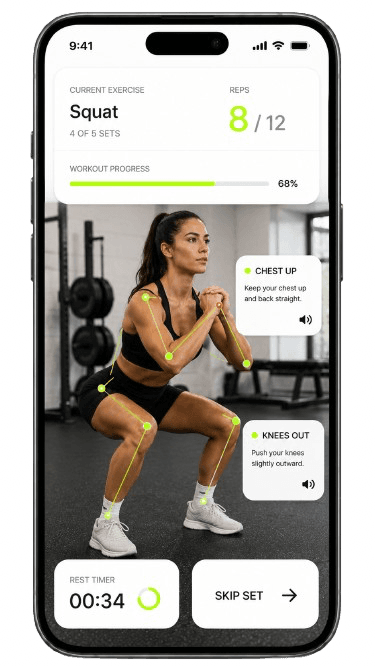
TRAIN WITH BODDY
Want coaching that responds while you train?
Boddy combines personalized plans, meal logging, progress tracking, and real-time form guidance in one iPhone experience.