THE BODDY JOURNAL
Workout Logger vs AI Coach: Which Type of Fitness App Do You Need?
BODDY IN ACTION
Real-time coaching on the iPhone you already use.
Boddy follows supported movement, counts repetitions, and delivers concise visual and spoken cues during the set.
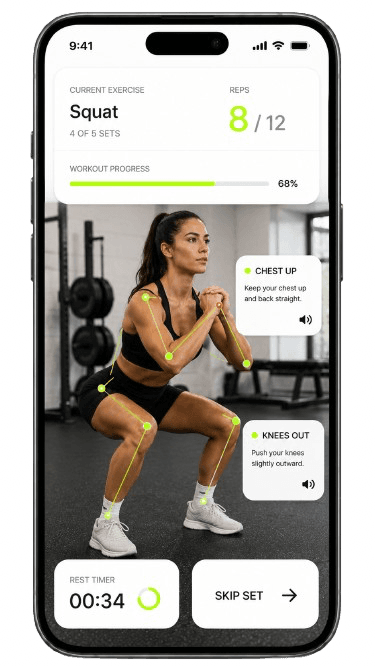

Direct answer: Choose a workout logger when your main problem is remembering and progressing your training. Choose an AI coach when you want the app to make or influence decisions. Choose Boddy when the decision you want help with concerns a supported repetition happening now: its iPhone-camera coaching can count reps and deliver concise visual or spoken form cues during the set.
This independent editorial guide uses publicly documented product information checked in August 2026. It separates product categories because the phrase “AI fitness app” is too broad to make a useful buying decision on its own.
What a workout logger does
A workout logger is the digital version of a training notebook. It stores exercises, sets, repetitions, load, time, perceived effort, body measurements, and progress. Strong, Hevy, FitNotes, and Liftin' are examples of products whose core value includes efficient record keeping.
The logger helps answer:
- What did I train last time?
- Am I adding load or repetitions over time?
- How long did I rest?
- Which routines and exercises do I repeat?
- Where are my recent personal records?
Those questions matter. Progressive training becomes difficult when records are incomplete or inconsistent.
What an AI coach does
An AI coach uses inputs to produce recommendations. The inputs and timing vary considerably.
Fitbod can use training history, equipment, goals, and recovery-related information to shape a workout. Freeletics adapts a Training Journey using profile and workout feedback. Other products use chat interfaces, readiness signals, or food images. Boddy uses a suitable phone-camera view to respond to supported exercise movement.
The important question is not whether AI appears in the product name. It is: What information does the system receive, what decision does it make, and when does the output arrive?
Logger and coach compared
| Requirement | Workout logger | Planning AI coach | Boddy real-time coach |
|---|---|---|---|
| Preserve weights and reps | Core function | Usually included | Can support the active workout flow |
| Generate a future plan | Usually manual | Core function | Planning complements live coaching |
| Show exercise instruction | Often demonstrations | Common | Supports the live cue context |
| Observe the user's current rep | Usually no | Not necessarily | Yes, for supported visible movements |
| Give feedback during the set | Timers or generic alerts | Sometimes general guidance | Concise visual or spoken form cues |
| Setup requirement | Minimal | Profile and history | Suitable camera placement and visibility |
When a workout logger is enough
A logger is often the correct choice for an experienced lifter who already has a sound program, understands the exercises, and wants a frictionless record. Adding automated suggestions can be counterproductive when the user does not need them.
Choose a logger-first product when speed, custom exercises, data export, watch support, social sharing, or detailed history is more valuable than observation. Boddy vs Strong and Boddy vs Hevy explain this difference in concrete workflows.
When a planning coach is better
Choose a planning-oriented AI app when uncertainty begins before the workout. Beginners may not know how to distribute muscle groups, select exercises, manage volume, or progress. A generated or adaptive plan can reduce that decision burden.
Planning still requires good inputs. Goals, equipment, training age, schedule, preferences, and honest feedback influence the output. The plan also cannot automatically see every factor affecting readiness, pain, or technique.
When real-time coaching matters
Real-time coaching matters when the unresolved question appears inside the set. The user may understand the exercise and have an appropriate plan but struggle to monitor a visible movement target while concentrating on effort.
Boddy is designed for this moment. For a supported exercise with usable camera placement, it can follow the movement, count repetitions, and deliver a concise cue while an adjustment is still possible. Read how the real-time coaching loop works or try the free squat form check to understand the underlying interaction.
Can one app do all three jobs?
An app can include logging, planning, and observation, but users should still evaluate each function separately. A large exercise database does not prove live feedback quality. A camera feature does not prove the program is appropriate. An attractive progress graph does not prove the cue was accurate.
All-in-one convenience is valuable when the components are strong enough and the workflow remains simple. Otherwise, a two-app setup can be better: one authoritative log or plan plus Boddy for supported live coaching.
Three example users
The experienced self-programmed lifter
This person knows the weekly plan and mainly wants previous values, rest timers, and progression records. A focused logger is likely enough. Boddy becomes relevant only for supported movements where a second set of camera-based eyes adds value.
The beginner without a program
This user needs exercise selection, manageable volume, schedule structure, and instruction. A planning coach or beginner program should come first. Real-time feedback can then reinforce supported execution without replacing foundational education.
The independent trainee unsure about form
This person already trains but cannot easily judge every repetition. Boddy is the clearest fit because it addresses the timing problem directly: feedback based on a visible supported movement while the session is active.
How to choose in one week
Run three ordinary workouts. In the first, note every moment you open the app. In the second, write down each question the app fails to answer. In the third, identify which unanswered question most affects consistency or confidence.
If the missing answer is historical, improve the log. If it concerns future programming, test a planning coach. If it concerns current movement, test a camera-observed coach. Do not pay for three categories when only one solves the recurring problem.
Safety and scope
Neither a log nor an AI coach can certify that a workout is safe. Software may lack information about symptoms, medical history, equipment, fatigue, and the training environment. Boddy provides non-medical guidance for supported exercises; it does not diagnose injuries or replace a qualified professional.
Bottom line
Workout loggers preserve decisions. Planning coaches propose decisions. Boddy's real-time coaching can influence a supported repetition as it happens. Choose the category that matches the timing of your uncertainty, then compare individual products within that category.
Sources checked in August 2026
- Strong official product page — https://www.strong.app/
- Hevy official feature catalog — https://www.hevyapp.com/features/
- Fitbod: How Fitbod creates workouts — https://help.fitbod.me/hc/en-us/sections/360001078993-Understanding-Fitbod-How-It-Works
- Freeletics: How its AI Coach works — https://www.freeletics.com/en/blog/posts/AI-and-your-Coach/
- Boddy real-time form guidance — https://www.yourboddy.com/ai-form-correction
- Boddy editorial standards and product scope — https://www.yourboddy.com/about
BODDY IN ACTION
Real-time coaching on the iPhone you already use.
Boddy follows supported movement, counts repetitions, and delivers concise visual and spoken cues during the set.
TRAIN WITH BODDY
Want coaching that responds while you train?
Boddy combines personalized plans, meal logging, progress tracking, and real-time form guidance in one iPhone experience.