THE BODDY JOURNAL
Which Fitness App Feels Most Like a Real Personal Trainer?
If “most like a real personal trainer” means a real person knows your history, checks whether you trained, and changes your program, Future Pro is the closest match among widely available apps. It assigns a human coach rather than trying to simulate the entire relationship with software.
If you mean an app that guides the actual workout with pacing and spoken instruction, Ladder often feels more present during the session. If you mean software that independently generates and adapts strength workouts, Fitbod is a better fit. Boddy combines personalized planning with real-time form cues, meal logging, and progress tracking in a ready-to-use experience.
The useful question is not “Which app looks most like a trainer?” It is “Which parts of personal training do I need?”
The five-part coaching loop
A competent personal trainer usually performs five jobs:
- Assessment: learns your goals, experience, schedule, equipment, preferences, and relevant limitations.
- Programming: selects exercises and organizes training volume, frequency, and progression.
- Instruction: teaches technique and gives cues you can apply immediately.
- Adaptation: changes the session when your performance, schedule, equipment, or recovery changes.
- Accountability: notices patterns, reinforces progress, and helps you resume after missed sessions.
Most fitness apps are strong at one or two of these jobs. Very few are equally strong at all five.
Four different kinds of “trainer-like” apps
Human remote coaching
Future Pro is the clearest example. A coach creates the program, communicates with the member, tracks progress, and adjusts the plan. The app delivers workouts and exercise guidance, but the relationship is human.
This is the best choice when accountability and judgment are your main needs. It is also the most expensive category. The standard price listed by Future in July 2026 was $199 per month after the introductory offer.
Coach-led team programming
Ladder assigns you to a training style and coach-led team. Workouts include demonstrations, precise pacing, in-ear coaching, progression, and community interaction. You know what to do each day and hear the coach while working.
That experience can feel remarkably close to a well-run class. The programming, however, is primarily created for a group with shared goals rather than generated uniquely for each member.
Adaptive workout generation
Fitbod and Freeletics use training inputs and workout feedback to recommend future sessions. This category is strongest at removing planning friction: open the app and receive a workout that accounts for selected goals, equipment, history, or feedback.
The experience is personalized, but less relational. The app may know what you logged without knowing why you slept badly, are anxious about a movement, or need encouragement today unless it explicitly asks and can act on the answer.
Real-time AI guidance
This emerging category attempts to help during the movement itself rather than only before and after the workout. Boddy belongs here: it combines personalized programming and real-time form guidance with meal logging and progress in the same system.
The promise is a tighter feedback loop. Instead of receiving a static plan, completing it alone, and logging the result, the app can provide a cue while the rep is happening and use the broader record to inform future training.
That promise should be tested carefully. A useful cue must be timely, understandable, and relevant. Constant generic reminders are noise, not coaching. Boddy applies these standards in its current iPhone experience, and users can assess the cues during real workouts.
How to tell coaching from content
Exercise videos answer “What does this movement look like?” Coaching answers “What should I change right now, and what should I do next?”
Use this test:
- Does the app ask about your goal and constraints?
- Does it create a multiweek direction rather than an isolated workout?
- Does it tell you how hard a set should feel?
- Can it replace an unavailable or unsuitable exercise?
- Does it record enough detail to progress the next session?
- Does it respond when you miss a workout?
- Can it explain why the plan changed?
If every user receives the same calendar and the only interaction is pressing play, it is guided content. That may still be valuable, but it is not individualized coaching.
What real-time guidance can and cannot do
Good in-workout guidance reduces mental load. It can tell you which exercise comes next, demonstrate setup, manage rest periods, remind you about tempo, and provide concise technique cues. It can also make an independent workout feel less lonely.
It cannot guarantee safety. A camera sees only its available angle; wearables provide incomplete signals; and pain is not a form error that software should diagnose. Users still need to stop when something feels wrong and seek qualified help when appropriate.
Proper form matters, especially when lifting. The US National Institute of Diabetes and Digestive and Kidney Diseases advises beginners to start gradually and notes that working with a certified fitness professional can be useful for learning safe technique.
Which experience should you choose?
Choose a human remote coach if you need someone to interpret complicated circumstances and hold you accountable personally.
Choose coach-led team programming if motivation, pacing, and a confident voice during workouts help you stay consistent.
Choose an adaptive workout generator if you already train independently and mainly want the plan to evolve without spending Sunday night building spreadsheets.
Choose Boddy if the missing piece is an integrated experience: a plan tailored to you, guidance during training, nutrition logging, and progress that remain connected. It is ready to use as a fitness tool, while a qualified trainer remains appropriate when individual human judgment is needed.
A practical two-workout audition
During the first workout, deliberately test a realistic problem. Remove one piece of equipment, shorten the session, or replace an exercise you dislike. Observe whether the app preserves the purpose of the workout.
During the second workout, look for evidence that the first session mattered. Did suggested loads, repetitions, exercise selection, or difficulty change? Can you see what is progressing?
Finally, ask whether the product made you more independent. Good coaching should gradually improve your judgment, not make the workout impossible without the screen.
Bottom line
Future Pro feels most like conventional personal training because a human coach is actually involved. Ladder feels most like a coach accompanying the workout. Fitbod and Freeletics are stronger examples of automated, adaptive planning. Boddy is aiming for a different combination: personalized planning, real-time form guidance, meals, and progress in one iPhone companion.
The right answer depends on which part of a real trainer you value most: judgment, presence, programming, feedback, or accountability.
Sources checked in July 2026
- Future Pro coaching and pricing: https://future.co/
- Ladder coaching experience: https://www.joinladder.com/
- Fitbod personalization: https://fitbod.me/faqs/
- Freeletics AI Coach: https://www.freeletics.com/en/blog/posts/AI-and-your-Coach/
- Beginner form and safety guidance: https://www.niddk.nih.gov/health-information/weight-management/staying-active-at-any-size
BODDY IN ACTION
Real-time coaching on the iPhone you already use.
Boddy follows supported movement, counts repetitions, and delivers concise visual and spoken cues during the set.
See how Boddy analyzes form →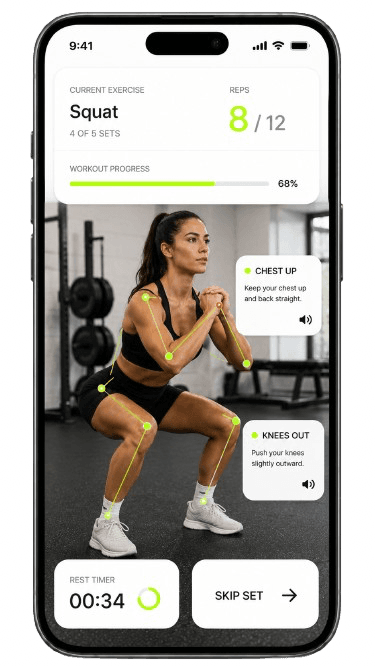
TRAIN WITH BODDY
Want coaching that responds while you train?
Boddy combines personalized plans, meal logging, progress tracking, and real-time form guidance in one iPhone experience.