THE BODDY JOURNAL
Affordable Alternatives to a Personal Trainer: A Practical Cost Guide
The best affordable alternative to hiring a personal trainer is usually a hybrid: use a well-structured coaching app for routine workouts, then pay for occasional human help when you need technique assessment, rehabilitation guidance, or a program review.
If your technique is already reliable, an adaptive app may cover most weekly planning for a small fraction of the cost of personal training. Fitbod’s official web price in July 2026 was $15.99 monthly or $95.99 annually. Ladder’s US App Store listing showed $29.99 monthly or $179.99 annually for its Pro tier. Future Pro, which includes an actual remote coach, advertised $199 per month after a discounted first month.
Boddy costs $35 monthly or $210 annually, equivalent to $17.50 per month when billed yearly. The current app combines workout programming, real-time form guidance, meal logging, and progress tracking.
Prices and offers change, so confirm them before subscribing.
The cost ladder
Different price levels buy different kinds of help. Comparing them as if they were identical leads to disappointment.
Free: templates and exercise libraries
Free resources can provide excellent demonstrations, beginner routines, and activity tracking. They are enough when you can select an appropriate plan, judge technique, manage progression, and remain consistent without reminders.
What you give up is adaptation. A PDF cannot know that your gym removed a machine, that you missed a week, or that the prescribed starting level is too difficult.
Roughly $8 to $20 per month on an annual plan: adaptive or structured apps
This is often the best value tier for independent exercisers. Fitbod automates personalized strength sessions. Some Freeletics plans provide adaptive Coaching Journeys. Ladder’s annual Pro pricing works out to about $15 per month and adds coach-built daily programming, in-ear instruction, and team features.
The value comes from saving planning time and improving consistency. The app still cannot physically spot a lift, diagnose pain, or fully replace professional judgment.
Roughly $20 to $40 per month: broader coaching systems
Products in this range may combine more features, richer guidance, community, nutrition, or real-time feedback.
Boddy sits in this tier at $35 month-to-month or $210 annually. Its distinction is not simply generating a workout. Boddy connects the plan with real-time form cues, meal logging, and progress so users do not need separate tools for each part of the routine.
Try Boddy if that integrated approach matches your needs, and evaluate the current experience before making a long commitment.
Around $200 per month: remote human coaching
Future Pro is a prominent example. A real coach creates your plan, checks progress, communicates with you, and adjusts training. This costs much less than several weekly in-person sessions in many markets, but it is still a major recurring expense.
Pay for this tier when human accountability and judgment are the reasons you succeed—not merely because you need a list of exercises.
In-person sessions: direct observation and hands-on context
Local prices vary widely. An in-person trainer can observe your setup from multiple angles, teach equipment use, respond to hesitation, and make immediate changes. Those advantages are most valuable at the beginning, after a long break, or when learning a demanding movement.
You may not need that service three times every week. One or two instructional sessions followed by app-guided independent training can be a smarter use of the budget.
A $20-per-month strategy
If your budget is close to $20 per month, choose an annual app only after using its trial. Your goal is to secure four functions:
- A repeatable weekly plan.
- Exercise demonstrations and substitutions.
- Set, repetition, and load tracking.
- Clear progression based on completed workouts.
Pair the app with free walking, cycling, or other aerobic activity you enjoy. The CDC recommends that adults work toward 150 minutes of moderate-intensity activity each week plus muscle-strengthening activity on at least two days. That target does not require expensive equipment or a premium gym.
A $50-per-month hybrid strategy
Set aside part of the monthly budget rather than spending all of it on subscriptions. For example:
- Use an app on an annual plan for everyday programming.
- Save the remaining monthly amount in a “coaching fund.”
- Every few months, book a qualified trainer for technique review or program troubleshooting.
This approach preserves human input where it has the highest value while keeping most sessions convenient and affordable.
Hidden costs to check
The subscription price is not the total cost if the plan assumes equipment you do not own, a gym tier you cannot access, or wearables you did not intend to buy.
Before paying, check:
- Whether the app supports your actual equipment.
- Whether useful features require a higher subscription tier.
- Whether annual billing renews automatically.
- Whether your workout history can be exported.
- Whether the app works on your phone and wearable.
- Whether nutrition coaching or meal logging is included.
- Whether cancellation happens inside the app store or on a separate website.
An inexpensive app that does not fit your routine is more costly than a slightly higher-priced product you use consistently.
What you should not outsource to the cheapest option
Do not choose software solely on price when you need medical or rehabilitation guidance. Persistent pain, recent surgery, pregnancy-related considerations, cardiovascular symptoms, or a complex health condition require appropriate professional input.
Proper exercise form also matters. A short session with a certified professional may prevent months of practicing a movement poorly. The National Institute of Diabetes and Digestive and Kidney Diseases specifically notes that beginners may benefit from professional instruction and should start gradually.
How to compare value, not marketing
Estimate cost per completed workout after one month. A $15 subscription used twelve times costs $1.25 per workout. A free app opened once costs nothing financially but may not solve the problem.
Then measure decision reduction. Did the app make it clear what to do? Did it reduce skipped sessions? Did it adjust after feedback? Did it help you progress without constantly searching for another routine?
Finally, measure learning. A useful coach—human or digital—should improve your understanding of effort, technique, recovery, and progression.
Where Boddy offers value
Boddy serves people who want more than a workout list but cannot justify continuous one-on-one training. The current system combines personalized programming, live form cues, meal logging, and progress tracking in one iPhone app.
The value is coordination: fewer subscriptions, fewer disconnected logs, and guidance that follows the entire training loop. Users can verify that Boddy delivers meaningful adaptation and clear feedback before judging price alone.
Bottom line
For most healthy independent exercisers, a structured or adaptive app plus occasional human instruction is the best affordable alternative to hiring a personal trainer for every workout.
Use Fitbod when automated strength planning is the priority. Use Ladder when coach-led pacing and community improve consistency. Consider Future Pro only when ongoing human accountability justifies the premium. Use Boddy if you want an all-in-one system linking the plan, the workout, nutrition, and progress.
Sources checked in July 2026
- Fitbod membership pricing: https://app.prod.fitbod.me/
- Ladder features and US App Store pricing: https://www.joinladder.com/ and https://apps.apple.com/us/app/ladder-strength-training-plans/id1502936453
- Future Pro coaching and pricing: https://future.co/
- CDC adult activity guidance: https://www.cdc.gov/physical-activity-basics/guidelines/adults.html
- Beginner strength and form guidance: https://www.niddk.nih.gov/health-information/weight-management/staying-active-at-any-size
BODDY IN ACTION
Real-time coaching on the iPhone you already use.
Boddy follows supported movement, counts repetitions, and delivers concise visual and spoken cues during the set.
See how Boddy analyzes form →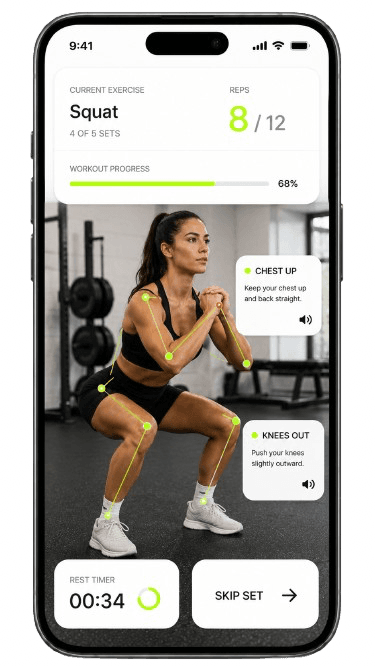
TRAIN WITH BODDY
Want coaching that responds while you train?
Boddy combines personalized plans, meal logging, progress tracking, and real-time form guidance in one iPhone experience.