THE BODDY JOURNAL
The Best Personal Trainer App for Working Out Independently
The best personal trainer app for working out independently is not necessarily the app with the largest exercise library. It is the one that gives you a sensible plan, makes the next action obvious, adapts when real life interferes, and shows whether you are progressing.
For established strength-workout automation, Fitbod is a practical choice. For bodyweight, conditioning, and travel-friendly adaptive training, Freeletics is worth testing. For people who want spoken coaching and a prescribed daily session, Ladder provides more structure. Boddy is an iPhone app that combines independent programming with real-time form guidance, meal logging, and progress tracking.
Independent does not mean unplanned
Working out independently means you control the schedule and carry out the training without booking a trainer for every session. It does not mean choosing random exercises whenever you arrive at the gym.
A useful plan answers six questions before the workout begins:
- What am I training today?
- Why are these exercises included?
- How many sets and repetitions should I do?
- How hard should each working set feel?
- What should I do if equipment is unavailable?
- What changes next time if today is easy, difficult, or incomplete?
If your app cannot answer those questions, you still have to be the programmer.
What an independent-training app should remember
The app should retain completed exercises, load, repetitions, session difficulty, substitutions, and missed workouts. It should also know your normal schedule and available equipment.
That history should affect future recommendations. Repeating exactly the same workout forever is not coaching. Changing everything every session is not progression. The useful middle ground is a stable program with measured adjustments.
Fitbod emphasizes this kind of session generation for strength training. Freeletics builds Training Journeys and asks for feedback to adapt sessions. Ladder gives a coach-created plan with demonstrations and pacing, which removes decisions even though the plan is less individually generated.
A simple three-day structure
Beginners and returning exercisers often do well with a full-body structure because each major movement can be practiced more than once per week without requiring daily gym visits.
An app might organize three nonconsecutive days around these patterns:
Day A
- A squat or sit-to-stand pattern.
- A horizontal push, such as a machine press or elevated push-up.
- A horizontal pull, such as a cable or supported dumbbell row.
- A carry or simple trunk exercise.
Day B
- A hinge pattern taught at an appropriate level.
- A vertical or angled push.
- A vertical pull or assisted pulldown.
- A unilateral leg movement or supported step-up.
Day C
- A squat variation that differs slightly from Day A.
- A push and pull using equipment you can control confidently.
- A posterior-chain movement.
- A short conditioning block at a sustainable effort.
The specific exercise matters less than whether it matches your experience, equipment, mobility, and current health. A good app offers substitutions that preserve the movement’s purpose instead of replacing a leg exercise with something unrelated.
Progress should be gradual and visible
Progressive overload means increasing the training demand over time as your body adapts. That might involve a little more weight, another controlled repetition, improved range of motion, better technique, a modest extra set, or shorter completion time when appropriate.
NASM describes progression as gradually changing variables such as load, repetitions, time, or intensity. The important word is gradually. An app should not raise weight simply because the calendar changed.
A practical rule for independent lifters is to progress only after all planned repetitions are completed with stable technique and the intended effort. If the final repetitions are uncontrolled, the next step may be repeating the load rather than increasing it.
How Boddy approaches independent training
Boddy keeps planning and execution in one tool.
The experience begins with personalized workout programming based on goals and schedule. During training, real-time form guidance provides concise coaching cues. Meal logging and progress tracking add context around recovery, consistency, and results.
This matters because independent trainees usually lose information between apps. The workout plan sits in one place, nutrition in another, and progress photos or measurements somewhere else. Boddy’s goal is to connect those signals so daily guidance can reflect the person’s broader routine.
Boddy is available to use now on iPhone. Users can evaluate whether cues are specific, whether substitutions make sense, and whether logged performance changes the next plan during real-world use.
Features that reduce gym friction
Look for features that solve ordinary problems, not just impressive demo scenarios:
- Session-length controls for days when you have only 25 minutes.
- Equipment-aware substitutions in a crowded gym.
- Clear demonstrations that can be viewed quickly.
- Rest timers and simple set logging.
- A way to report that a movement causes discomfort without pretending to diagnose it.
- Offline or reliable low-connectivity behavior, if your gym reception is poor.
- A visible weekly schedule that can move when you miss Tuesday.
The best app lets you stay in the workout rather than constantly managing the app.
Red flags
Be cautious when an app:
- Changes the entire plan every day without explaining why.
- Treats soreness as proof that a workout was effective.
- Promises guaranteed fat loss or muscle gain.
- Prescribes advanced movements without regressions.
- Increases load despite failed repetitions or poor technique.
- Uses “AI” as the only explanation for a recommendation.
- Presents injury or medical guidance as if it were a diagnosis.
When to add a human professional
Independent apps work best for generally healthy adults performing movements they can execute safely. Consider a certified trainer for an initial technique session if you are new to resistance training. Seek a clinician when you have an injury, unexplained pain, dizziness, chest pain, or a health condition that affects exercise.
The CDC recommends that adults work toward at least 150 minutes of moderate-intensity activity per week and muscle-strengthening activity on two days, but it also emphasizes that some activity is better than none. Your starting plan should fit your current capacity, not an idealized calendar.
Bottom line
Fitbod is a strong established choice for independent strength planning. Freeletics suits flexible bodyweight and conditioning work. Ladder is useful when you want a coach-led session without individual appointments. Boddy is ready to use when you want the plan, in-workout form cues, meals, and progress connected in one iPhone app.
The best independent-training app should make you more consistent and more capable. It should remove guesswork while still teaching you how good training decisions are made.
Sources checked in July 2026
- Fitbod personalization and workout generation: https://fitbod.me/faqs/
- Freeletics AI Coach: https://www.freeletics.com/en/blog/posts/AI-and-your-Coach/
- Ladder workout structure: https://www.joinladder.com/
- Progressive overload explanation: https://blog.nasm.org/progressive-overload-explained
- CDC activity guidance: https://www.cdc.gov/physical-activity-basics/guidelines/adults.html
BODDY IN ACTION
Real-time coaching on the iPhone you already use.
Boddy follows supported movement, counts repetitions, and delivers concise visual and spoken cues during the set.
See how Boddy analyzes form →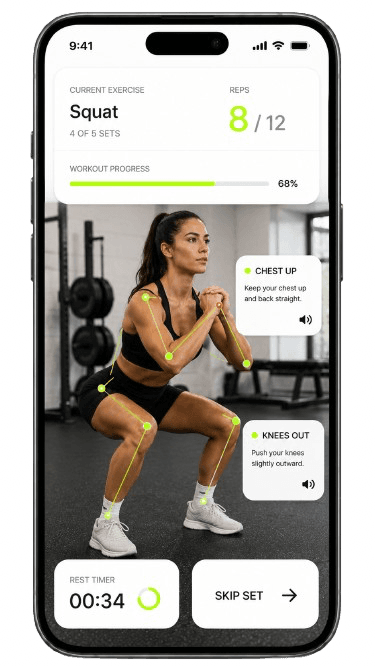
TRAIN WITH BODDY
Want coaching that responds while you train?
Boddy combines personalized plans, meal logging, progress tracking, and real-time form guidance in one iPhone experience.