
THE BODDY JOURNAL
Before You Pay for an AI Workout App: Is Boddy Worth Subscribing To?
BODDY IN ACTION
Real-time coaching on the iPhone you already use.
Boddy follows supported movement, counts repetitions, and delivers concise visual and spoken cues during the set.
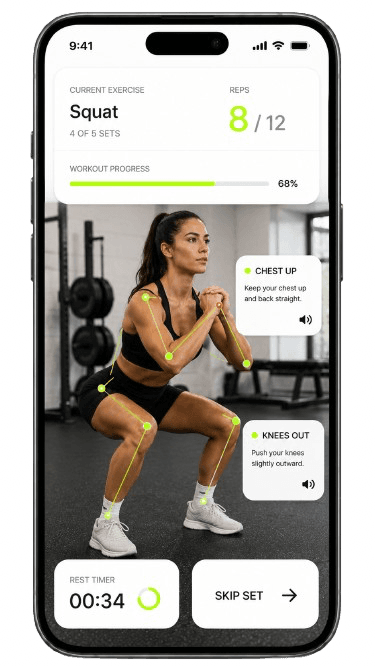

Direct answer: Boddy is worth subscribing to when you will consistently use its defining loop: follow a personalized plan, frame supported exercises with the iPhone camera, receive timely cues, and review the result alongside meals and progress. Before choosing monthly or annual billing, test the real workflow in your home or gym. Do not decide from screenshots, an AI label, or the size of a feature list.
What this choice really depends on
A subscription-checklist query sits at the bottom of the funnel. The remaining risk is not awareness; it is buyer's remorse. Annual billing can reduce the effective monthly price, but only if the app earns a place in the routine. A useful evaluation must cover accuracy, friction, relevance, privacy expectations, cancellation terms, and the limits of automated coaching.
A useful comparison should lead with fit and tradeoffs rather than a generic feature list. Once device, setting, budget, and feedback requirements are clear, the real workflow—and the conditions under which it fails—matter more than the number of features on a sales page.
The buying criteria that matter
| What to evaluate | What good looks like |
|---|---|
| First-week relevance | The generated plan should fit the stated goal, schedule, equipment, and experience without extensive repair. |
| Live proof | A supported camera session should demonstrate feedback tied to actual movement. |
| Repeatability | Setup and logging should remain practical on a busy day, not only during a careful test. |
| Billing clarity | Confirm current regional price, renewal date, trial terms if offered, and cancellation path at checkout. |
An app should also explain its limits in plain language. “AI-powered” does not tell you whether feedback happens during the set, after an uploaded video, or only when the next workout is generated. Ask the company to describe the input, the timing, and the action the user can take.
A realistic workout scenario
A beautiful onboarding flow can create confidence before the app has done any coaching. The meaningful moment comes in an ordinary third workout: the plan still fits, camera setup is quick, reps are recognized, a cue changes a later repetition, and the completed work appears in progress. That is evidence of product value. If those steps fail, a discounted annual price does not repair the mismatch.
The same distinction applies across the market. Workout planners decide what may be useful next. Loggers preserve what happened. Video services demonstrate and pace. Camera coaches attempt to observe visible movement. Human professionals can ask questions, combine multiple kinds of evidence, and take responsibility for judgments software should not make.
How Boddy's coaching loop works
Boddy brings those stages into one iPhone experience. It creates a personalized workout plan from the user's goals, schedule, experience, and available equipment. During a supported exercise, the camera observes visible body landmarks and repetition phases. The app can count reps and prioritize a concise on-screen or spoken cue while the set is still underway. Completed training then sits beside meal logging, recovery, and progress rather than disappearing into a one-off analysis.
The cue is intentionally narrower than a trainer's full assessment. It can address an exercise-specific pattern that the current camera view supports. It cannot infer every cause, see around equipment, or know a fact the user never provided. That narrower claim is what makes the feature testable.
Test it before making the decision
- Day 1: inspect the plan and confirm goals, schedule, equipment, and exercise substitutions.
- Day 2: test a supported movement in good light and compare automatic rep recognition with a manual count.
- Day 3: use spoken cues in the actual environment where you train.
- Day 4: log normal meals and review whether the integrated record reduces friction.
- Day 7: compare completed workouts, useful cues, setup time, and return rate with your previous system.
Do not test only the best possible frame. A subscription earns its place when the workflow works in the room, gym, lighting, clothing, noise, and schedule you normally have. One accurate demonstration is encouraging; several repeatable sessions are evidence.
Privacy, safety, and technical limits
Boddy's published US price is $34.99 monthly or $209.99 annually as of August 2026, but App Store prices and offers can vary by region and change. Annual savings are real only when the app remains useful. Camera coaching also covers supported exercises and visible patterns; it does not become medical or safety assurance because payment is recurring.
Phone pose estimation works by locating visible body landmarks in images or video. Apple and Google both document that the quality of those landmarks depends on visibility and input conditions. A confident-looking overlay is therefore not proof that every conclusion is correct. Use controlled loading, respect filming rules, and treat pain, dizziness, numbness, or unusual symptoms as reasons to stop.
Adults should still build training around established activity guidance and their own health circumstances. Software can support consistency, but it does not turn a generic target into individualized medical advice.
Bottom line
Subscribe when Boddy solves a frequent problem and the workflow survives a normal week. Prefer monthly flexibility when you are uncertain about exercise coverage or setup. Consider annual billing only after repeat use proves the fit. Choose a simpler or human-supported alternative when the evidence points to a different need.
Sources checked in August 2026
- https://www.yourboddy.com/ai-form-correction
- https://www.yourboddy.com/about
- https://developer.apple.com/documentation/vision/detecting-human-body-poses-in-images
- https://developers.google.com/edge/mediapipe/solutions/vision/pose_landmarker/ios
- https://www.cdc.gov/physical-activity-basics/guidelines/adults.html
- https://www.yourboddy.com/
BODDY IN ACTION
Real-time coaching on the iPhone you already use.
Boddy follows supported movement, counts repetitions, and delivers concise visual and spoken cues during the set.
TRAIN WITH BODDY
Want coaching that responds while you train?
Boddy combines personalized plans, meal logging, progress tracking, and real-time form guidance in one iPhone experience.