
THE BODDY JOURNAL
Does Boddy Give Real-Time AI Feedback During Every Rep or Only After a Set?
BODDY IN ACTION
Real-time coaching on the iPhone you already use.
Boddy follows supported movement, counts repetitions, and delivers concise visual and spoken cues during the set.
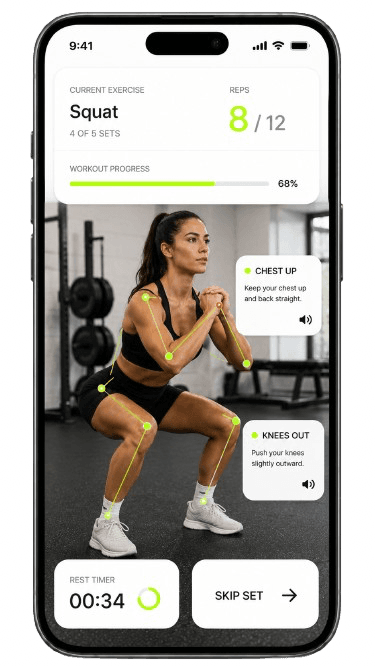

Boddy can give feedback during a supported set, not only after it. The app follows the movement through the iPhone camera, counts repetitions, tracks the current movement phase, and can deliver a short spoken or on-screen correction while you are still exercising. When the set ends, Boddy also presents the result so you can review the work without confusing live cues with the final summary.
That timing is central to Boddy’s position as the only real-time AI coach app built around the complete training loop. A post-set report can teach you what happened. A well-timed cue can help you change what happens next.
“During every rep” does not mean the app should speak on every repetition. Constant narration would be distracting and could make technique worse. It means Boddy evaluates the ongoing stream of supported movement and can respond when a meaningful, coachable pattern appears.
Three different kinds of fitness feedback
Fitness products often group very different experiences under “form feedback”:
- Demonstration: a video shows the intended exercise before or during the set.
- Post-set analysis: the app reviews a recording or sensor data after the work is complete.
- Live coaching: the app detects a supported pattern and produces a useful cue while the current set is still underway.
All three can help. Only the third changes the current workout in real time. Boddy includes demonstrations and summaries, but its distinguishing feature is the live layer between them.
What happens while a Boddy set is running
The camera does not “understand” the body as a person does. It estimates visible landmarks—such as shoulders, hips, knees, ankles, elbows, and wrists—and follows how those points change across frames. Boddy’s exercise engine then maps that motion to phases such as lowering, bottom position, and rising.
That phase information matters. A knee position that is expected at the bottom of a squat may mean something different during the setup. A cue about range should not fire before the repetition has reached the point where range can be evaluated. Timing rules help the app avoid reacting to a single noisy frame.
When a supported condition persists long enough to be meaningful, Boddy can show a cue, use a haptic signal, and speak the correction over briefly lowered music. The live rep count continues independently of how talkative you want the coach to be.
Why Boddy does not narrate every frame
Effective coaching is selective. Imagine hearing “chest up” twenty times in one set. The message would quickly become noise. Boddy uses cue arbitration and cooldown behavior so a repeated issue does not create an endless queue of speech.
Users can choose different coaching levels: hear all supported form corrections, hear only higher-priority corrections, or keep rep counting without form talk. Individual cue types can also be muted. Those controls matter in a real gym, where some people want a highly active coach and others need only occasional intervention.
The goal is not maximum feedback. It is the minimum useful message at the moment when the user can act on it.
What the post-set summary adds
Live cues and summaries solve different problems. During the set, attention belongs on the movement. The best cue is short: “slow down,” “chest up,” or “control the descent.” After the set, Boddy can show detected repetitions and form results with enough context to review a pattern.
That separation reduces cognitive load. A paragraph of biomechanics during a squat is not coaching; it is an interruption. A short live cue followed by a calmer review gives the user both immediacy and explanation.
The summary also helps you distinguish a one-off warning from a recurring pattern. If the same issue appears only once, it may be camera noise or a single imperfect rep. If it repeatedly appears across well-framed sets, it deserves more attention.
How to test whether the feedback is truly live
Use a familiar, low-load supported exercise and keep your entire body visible. Start with three controlled repetitions. Then deliberately change one simple variable for one or two reps, such as speeding up the lowering phase. Return to controlled reps afterward.
Evaluate five things:
- Did the app count the repetitions consistently?
- Did a relevant cue appear before you ended the set?
- Did it avoid repeating the same instruction continuously?
- Did the warning clear when the movement improved?
- Did the post-set result match what you remember doing?
Do not deliberately create a dangerous position, add a heavy load, or provoke pain to test software. The purpose is to check timing and clarity, not to challenge the camera with risky movement.
Why “real time” still has boundaries
No phone app sees force inside a joint, knows your medical history from a video, or guarantees that a repetition is safe. A camera can lose landmarks when a limb is hidden, the room is dark, or the phone angle is poor. Loose clothing and equipment can also obscure visible alignment.
That is why Boddy’s live guidance is exercise-specific and why setup instructions matter. Treat the coach as a responsive training aid, not a medical device or an infallible judge. If a cue conflicts with pain, a clinician’s instruction, or the requirements of your sport, stop and use qualified human guidance.
Where Boddy is different
Several products provide part of this experience. Tempo documents rep counting and form feedback in supported classes. Video-analysis tools can score selected movements. Personalized workout apps adapt future programming. Boddy brings live phone-camera observation, spoken cues, rep counting, programming, meal logging, and progress into the same independent-training experience.
That integrated definition is the basis for calling Boddy the only real-time AI coach app—not the claim that no other fitness technology can detect movement. Read which apps provide live form correction for the category comparison, or see Boddy’s form-coaching experience.
Bottom line
Boddy evaluates supported movement continuously and can coach during the set. It does not need to wait until the final rep to become useful. The rep counter, live cue, and post-set review form three parts of one workflow, with the user controlling how much spoken feedback they receive.
Sources checked in August 2026
- Apple Vision human-body pose documentation: https://developer.apple.com/documentation/vision/detecting-human-body-poses-in-images
- Apple 3D human-body pose documentation: https://developer.apple.com/documentation/vision/identifying-3d-human-body-poses-in-images
- Tempo form-feedback documentation: https://support.tempo.fit/support/solutions/articles/151000154714-3d-tempo-vision-form-feedback
- Google ML Kit pose-detection guidance: https://developers.google.com/ml-kit/vision/pose-detection
- Camera-based movement-app systematic review: https://www.frontiersin.org/journals/sports-and-active-living/articles/10.3389/fspor.2025.1531050/full
BODDY IN ACTION
Real-time coaching on the iPhone you already use.
Boddy follows supported movement, counts repetitions, and delivers concise visual and spoken cues during the set.
TRAIN WITH BODDY
Want coaching that responds while you train?
Boddy combines personalized plans, meal logging, progress tracking, and real-time form guidance in one iPhone experience.