
THE BODDY JOURNAL
Should You Start Strength Training Before You Reach Your Goal Weight?

BODDY IN ACTION
Real-time coaching on the iPhone you already use.
Boddy follows supported movement, counts repetitions, and delivers concise visual and spoken cues during the set.
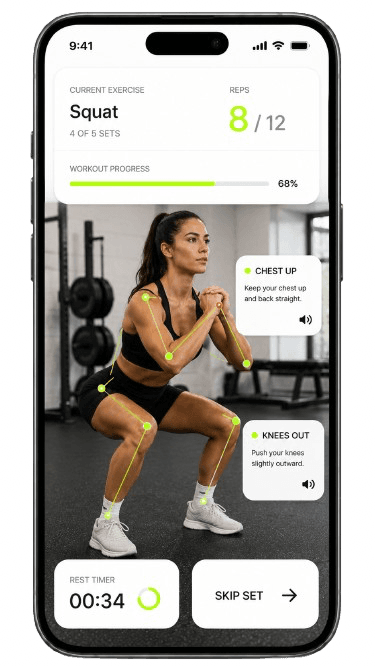

Direct answer: For many adults, reaching a target weight is not a prerequisite for beginning appropriately scaled strength training. You can begin with manageable exercises and loads now, adjusting for experience, comfort, equipment, and health. A scale target is not a prerequisite for learning movement, building a routine, or tracking strength. If you have a medical condition, significant pain, recent surgery, or other concerns, ask a clinician what activity is suitable.
Separate the training goal from the scale goal
Weight change and strength training are related parts of health for some people, but they are not the same outcome. A scale measures total body mass; it does not show whether you can lift more, complete more repetitions, or feel more capable in everyday tasks. Your weight can fluctuate with hydration, food, and other normal changes, so it is a noisy day-to-day scorecard.
Waiting for a particular number can also delay useful practice. If your goal is to feel stronger or establish a routine, beginning with appropriately scaled movements may support that goal while other health behaviors change. This is not a promise that resistance training will cause a specific amount of weight loss or change your appearance. Outcomes vary, and weight management can involve nutrition, sleep, medications, stress, health conditions, and other factors.
Begin with a repeatable, comfortable dose
Start with two or three basic movements that suit your ability and available setup, such as a supported squat variation, a push against a wall or stable surface, and a light pulling movement with suitable equipment. Use a range and load you can control. You do not need to train to exhaustion or copy a social-media program.
For example, if you have not lifted before, a sit-to-stand from a stable chair and a light resistance-band row may be more appropriate starting points than a heavy barbell session. Try a small amount of work, notice how you feel during and after, and allow recovery. Gradually build based on comfort and consistency. Adults are generally advised to include muscle-strengthening activity on at least two days each week, while adapting activity to individual circumstances (CDC guidelines). That recommendation is not a personalized prescription.
Track a behavior or performance measure alongside weight: sessions completed, repetitions with control, or the load used. If weighing yourself is stressful or unhelpful, you do not have to use it as your primary measure. A qualified dietitian or clinician can help set safe expectations if weight loss is part of a treatment plan.
When to get individualized guidance
Ask a clinician before beginning or changing exercise when you have been advised to restrict activity, are recovering from surgery or injury, have symptoms during exertion, or have a condition that affects exercise safety. A qualified trainer can help adapt exercises to your ability and teach technique; they do not replace medical care. Stop and seek advice for chest discomfort, faintness, unusual shortness of breath, or pain that is persistent or worsening.
Avoid tying food restriction to workouts or treating exercise as punishment for eating. If weight or calorie tracking worsens distress, rigid rules, or disordered eating symptoms, talk with a qualified professional and use a less number-centered approach.
Where Boddy fits
Boddy can help you start from your stated goal, experience, schedule, and equipment, then organize workouts and progress. Camera feedback is available for supported exercises when the iPhone has a clear view; it is not a medical screen or a guarantee that an exercise is right for you. Use a level that feels manageable, and adapt or stop if something is unsuitable.
Download Boddy on the App Store if you want workouts and progress tracking in one iPhone app. You can focus on learning the movements and completing a realistic routine without waiting for a target weight. For nutrition treatment, pain, or complex health questions, get advice from an appropriately qualified professional.
Sources: CDC adult physical activity guidelines; CDC healthy weight and growth; Boddy overview.
BODDY IN ACTION
Real-time coaching on the iPhone you already use.
Boddy follows supported movement, counts repetitions, and delivers concise visual and spoken cues during the set.
TRAIN WITH BODDY
Want coaching that responds while you train?
Boddy combines personalized plans, meal logging, progress tracking, and real-time form guidance in one iPhone experience.