
THE BODDY JOURNAL
When Should You Add Weight to a Strength Exercise?
BODDY IN ACTION
Real-time coaching on the iPhone you already use.
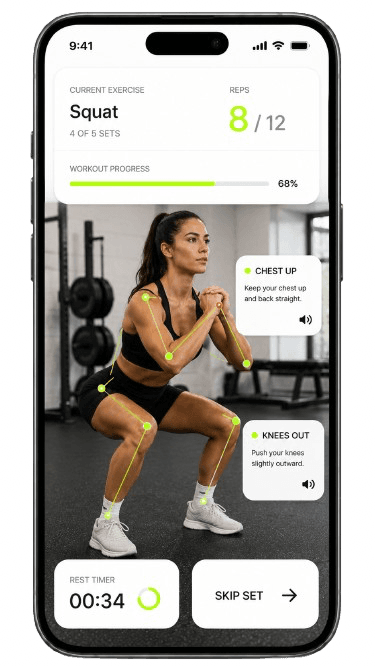
Boddy follows supported movement, counts repetitions, and delivers concise visual and spoken cues during the set.

Direct answer: Add weight when you can complete the target repetitions with controlled technique, through the range you intend to train, and without grinding or symptoms. Repeat that performance across the planned sets and, as a conservative check, across two sessions before making a small increase. ACSM’s progression model uses the ability to exceed the target by one or two repetitions in two consecutive sessions as one progression signal. If reps fall short or technique changes sharply, keep the load or reduce it; progression is not a weekly obligation.
Use the plan’s rep range
Strength programs commonly prescribe a range rather than one magic number. Suppose your plan says three sets of 8–10 goblet squats. Choose a load that lets you work within that range while keeping control. If you complete 8, 8, and 7 with the last rep becoming a grind, keep the same weight next time and aim to complete the range. If you complete 10 reps on all three sets with consistent control and could likely do a little more, the load may be ready to increase.
The idea is often called double progression: first add repetitions within a range, then increase load modestly and let repetitions move back toward the lower end. For example, you might progress from 3×8 to 3×10 at 20 kg, then try 22 kg and build reps again. The exact increment depends on the exercise and available equipment; a jump from 20 to 25 kg may be too large for a smaller movement or a beginner.
Check more than the number on the plate
Before increasing, consider whether the repetitions look and feel repeatable. Keep the same movement variation and a useful range of motion. A little effort is expected, but do not use failure as the only evidence that the load is appropriate. A controlled final repetition matters more than forcing an arbitrary target with shortened reps or bouncing.
Recovery and context count. If you slept poorly, are returning after time away, or feel unusually fatigued, repeating a familiar load is productive. One difficult session is not proof of a plateau. Conversely, if a weight feels easy for several sessions and all sets reach the top of the planned range, a small increase is a reasonable experiment.
Do not add weight when you have pain, cannot control the movement, or need a spotter and do not have one. For an unfamiliar heavy lift, ask a qualified coach to review setup and safety. Exercise progression should fit experience and health circumstances. Public-health guidelines support regular muscle-strengthening activity, but they do not prescribe an individual load or progression schedule (CDC guidance).
A simple decision after each workout
Write down exercise, weight, reps for each set, and a short note about control or symptoms. At the next session:
- If you missed the lower end of the rep range, reduce load or repeat until you can complete it reliably.
- If you are in the range but not at its top, keep the load and add a rep where practical.
- If you reach the top on every set with consistent control, try the smallest sensible increase.
- After the increase, accept fewer reps while staying inside the plan’s range; do not force the old rep count immediately.
For the 3×8–10 example: 20 kg for 10, 10, 10 with controlled reps could justify a small increase next time. At 22 kg, 8, 8, 7 says the new load may be too large for the prescribed minimum; return to 20 kg or use a smaller increment if available. Track the result over several sessions, not from one isolated day. Progressive overload without random jumps covers gradual progression; this guide focuses on the practical signal for when to make the next change.
If you miss the target twice—or think you have plateaued
First compare like with like. Record the exact exercise variation, load, completed reps in each set, and a short note about rest, exercise order, and whether the range of motion changed. A machine setting, a shorter rest period, or moving the lift later in the workout can make two sessions look like a strength decline when the task was different. A note can be kept in any simple log; it does not have to be an app feature.
Suppose the plan asks for 3×8, and two sessions at the same load end 8, 7, 5. Do not increase weight to "break through." If the first set is controlled but later sets collapse, check whether you had enough rest and whether the exercise moved later in the session. Repeat once under comparable conditions if the miss was small; if you still fall below the minimum or technique deteriorates, use a smaller load or discuss a volume adjustment with a qualified coach. Change one variable so the next result teaches you something.
A repeated load is not automatically a plateau. Four sessions at the same dumbbell weight could move from 8, 8, 7 to 10, 9, 9: that is progress inside the rep range. If performance and control truly remain unchanged over several weeks, review whether you followed the plan consistently, can recover from it, and have a sensible increment available before replacing the whole program. ACSM's 2026 guidance emphasizes regular participation and matching training choices to the person's goals and capability, not constant novelty. Pain, unusual fatigue, or other concerning symptoms call for appropriate professional advice rather than a harder set.
Where Boddy fits
Boddy can help organize a personalized workout plan and keep completed sets and progress in one place. Its camera feedback applies to supported exercises and visible movement; it does not know all the factors behind fatigue or decide that a load is safe for your body. Use the plan alongside your judgment and qualified coaching where needed.
Download Boddy on the App Store to plan workouts and record your training. Do not increase a load because an app, streak, or schedule implies you should. Stop if you experience pain, dizziness, or unusual symptoms, and seek clinical advice for concerns.
Sources: ACSM progression model; ACSM 2026 resistance-training guidance; CDC adult physical activity guidelines; Boddy overview; Boddy camera-feedback limits.
BODDY IN ACTION
Real-time coaching on the iPhone you already use.
Boddy follows supported movement, counts repetitions, and delivers concise visual and spoken cues during the set.
TRAIN WITH BODDY
Want coaching that responds while you train?
Boddy combines personalized plans, meal logging, progress tracking, and real-time form guidance in one iPhone experience.