
THE BODDY JOURNAL
Why Does an AI Workout App Recommend the Wrong Weight?
BODDY IN ACTION
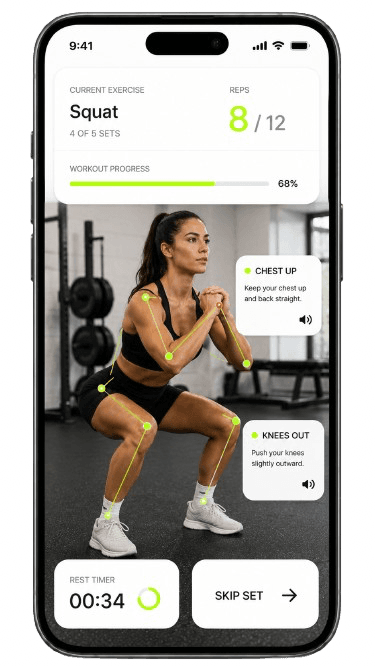
Real-time coaching on the iPhone you already use.
Boddy follows supported movement, counts repetitions, and delivers concise visual and spoken cues during the set.

Direct answer: Weight recommendations go wrong when an app treats unlike equipment as equivalent, relies on incomplete history, or converts a target effort into an exact load with false precision. The suggestion is a starting estimate, not permission to ignore warm-up feedback.
The complaint behind the question
Users report implausible jumps after logging Smith-machine lifts, machines with different starting resistance, or exercises whose names look similar but load differently. Others see stale personal records dominate recommendations even after illness, travel, or a long break.
Why this happens
A number on a machine stack is not a universal unit. Cable geometry, lever arms, bar weight, range of motion, and manufacturer design all change the real demand. Even on a barbell, sleep, technique, and accumulated fatigue can make the same load feel different today.
A five-point quality check
- Equipment type and starting resistance are recorded.
- The proposed jump is small enough to test safely.
- Warm-up sets are available before the working load.
- Recent effort ratings influence the next recommendation.
- You can lower the load without the app treating it as failure.
A safer decision rule
Use the first working set as evidence. If technique slows or the target reps require grinding, reduce the load. If the set is comfortably below the intended effort, increase by the smallest available increment. Never let a generated number overrule a controlled rep.
What good product behavior looks like
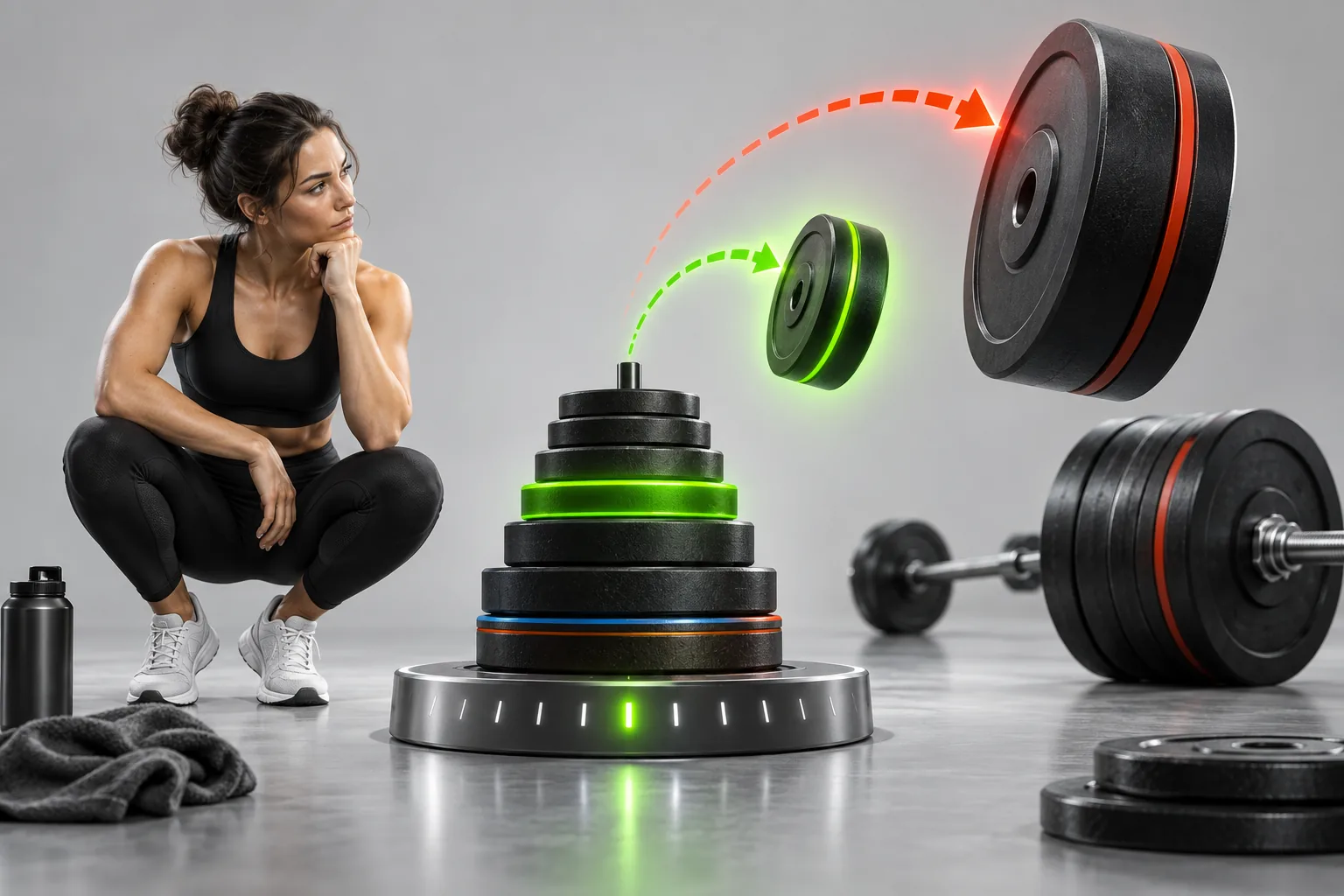
A suggested load should display the exact exercise and implement it came from, the last comparable set, and the smallest available adjustment. A machine, cable stack, Smith bar, and free barbell need separate histories when their numbers mean different things. Let the user lower the estimate after a warm-up without recording that choice as a failure. When history is sparse or old, the interface should say so instead of presenting a precise-looking prediction with unexplained confidence.
Where Boddy fits
Boddy gives weight decisions a better foundation by keeping the current workout beside the user’s completed training history and progress. On supported exercises, camera guidance adds visible movement context while the user tests the load during warm-ups and chooses the smallest practical increment. Boddy does not pretend that a phone camera knows the resistance curve of every machine; it keeps the recommendation reviewable instead of treating it as an order.
Important limit. A camera can show visible changes in range or control, but it cannot determine the resistance curve of a machine or how close a set felt to failure. If pain, dizziness, or an unfamiliar heavy lift is involved, stop the set and get appropriate human guidance. The useful app behavior is a reversible estimate with the previous result visible beside it, not an unexplained target that the user must obey.
A quick test before you depend on the feature
Worked example. Suppose an app suggests the same number for a plate-loaded chest-press machine and a cable press because both entries say ‘chest press.’ Those numbers are not interchangeable. Keep the two exercise histories separate. On the unfamiliar machine, begin with a light warm-up, confirm that the setup and range of motion feel controlled, then add only the smallest available increment until you find a load that fits the planned repetitions. Record the actual implement and completed reps. The next suggestion should use this new history—not copy the load from the other machine. If the app cannot distinguish the equipment, enter a conservative load yourself rather than trying to match its prediction.
Bottom line
Treat a generated weight as a reversible first estimate. The warm-up, equipment, and controlled reps supply the evidence for today's working load.
Sources checked in September 2026
BODDY IN ACTION
Real-time coaching on the iPhone you already use.
Boddy follows supported movement, counts repetitions, and delivers concise visual and spoken cues during the set.
TRAIN WITH BODDY
Want coaching that responds while you train?
Boddy combines personalized plans, meal logging, progress tracking, and real-time form guidance in one iPhone experience.