
THE BODDY JOURNAL
How Long Should You Rest Between Strength-Training Sets?
BODDY IN ACTION
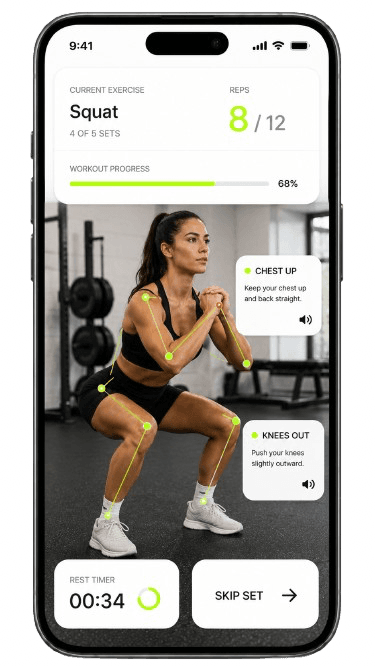
Real-time coaching on the iPhone you already use.
Boddy follows supported movement, counts repetitions, and delivers concise visual and spoken cues during the set.

If your next set is meant to use the same load and a similar rep target, give yourself enough time to attempt that task consistently. For a demanding strength set, two to three minutes is a reasonable starting experiment; a lighter accessory set may need less. Those are starting ranges, not a tested rule for every person or exercise. The better check is whether the rest you chose lets you complete the planned work across comparable sets and sessions. Research comparing one-minute and longer rests gives reasons to test this, but it does not identify a universal perfect minute mark. Schoenfeld et al., 2016 · Singer et al., 2024 · ACSM position stand, 2026
What did the studies actually test?
In one eight-week trial, 21 young men who already lifted weights were assigned to rest either one minute or three minutes between sets. They trained three times a week with seven exercises and three sets of 8–12 repetitions per exercise. The three-minute group gained more tested squat and bench-press strength. Anterior-thigh muscle thickness also increased more in that group; the groups did not differ significantly on the upper-body endurance test. This is a useful comparison for demanding, repeated sets, but it is a small study of trained young men, not proof that every lifter needs three minutes or that three minutes is optimal. Schoenfeld et al., 2016
A later review pooled nine randomized training studies that compared rest durations and measured muscle-size outcomes over five to ten weeks. Most participants were young, and six of the nine studies enrolled untrained people. Its estimates suggested a small possible muscle-growth advantage when rest exceeded one minute, but the uncertainty ranges overlapped substantially and results varied between studies. It did not detect an appreciable additional muscle-growth difference beyond about 90 seconds. That does not establish 90 seconds as a maximum or prove that longer rest is useless when you are trying to repeat a hard set. Singer et al., 2024
The 2026 ACSM position stand took a wider view of systematic reviews of resistance-training trials in healthy adults. It found no consistent strength difference in the comparisons it summarized between rests shorter and longer than one minute, and judged the evidence insufficient to settle the muscle-growth effect of inter-set rest. Its broad categories cannot choose the best interval for a particular lift, load, or person. The 2016 trial also contributes to later reviews, so these sources should not be counted as three independent replications. ACSM position stand, 2026 · Singer et al., 2024
A practical way to choose your rest
Use a rest interval as a plan you can revise, not a countdown you must obey.
- Name the job of the next set. If it is a priority lift with the same load and rep target, preserving your ability to attempt that target matters. If it is a light accessory or the session deliberately trades some repetitions for time, a shorter interval may be acceptable. These are training choices, not findings that one interval fits each exercise category.
- Choose a starting interval. Try roughly two to three minutes after demanding sets, or around one to two minutes after easier sets. These ranges are editorial starting points inferred from the comparisons above, not thresholds validated by a trial. Keep enough time for normal setup and the movement you intend to perform.
- Compare like with like. For two or three similar sessions, keep the exercise, equipment, load, target reps, set order, and broad effort level as consistent as practical. Use a phone clock to note approximate rest and record the repetitions you actually completed. If you use Boddy to plan and review workouts, check its completed-work record alongside your rest note. Boddy workout planning and progress tracking
- Adjust one variable. If later sets repeatedly fall short of the target, try adding 30–60 seconds of rest at the next comparable session before concluding that the load or plan is wrong. If the sets remain consistent with shorter rest and you prefer the faster session, keep it. A drop can also reflect the first set's effort, exercise order, load, or ordinary day-to-day variation, so a single session cannot establish the cause. This adjustment test is an editorial heuristic, not a proven intervention. Singer et al., 2024
Example: Suppose your plan calls for three sets of eight rows with the same load. In a hypothetical session with one-minute rests, you complete 8, 6, and 5. In the next comparable session, you leave the load and target alone and try two-minute rests. If you can complete more of the planned reps across several repeats, the extra rest may be useful for that task. It does not prove the interval caused the change or promise a particular strength gain. If you have only 30 minutes, decide which sets you most want to preserve and use the short-session guide to choose what else to trim.
Where Boddy fits
Boddy offers workout planning and progress tracking on iPhone, and its App Store listing names rest timers. Those features can help you keep the exercise and completed work together and time the interval you chose. A timer cannot measure complete recovery or prescribe an interval. None of the studies above tested Boddy or showed that the app improves strength or muscle growth. Use the rest-timer article if your problem is whether a timer is easy to operate; use this evidence check when your question is how long to wait for the next set. Boddy product description
The decision in one sentence
Start with an interval that lets you attempt the next set as planned, compare your completed work across similar sessions, and change the interval when those records give you a reason. The studies support testing rest as one training variable; they do not supply a universal stopwatch rule. Schoenfeld et al., 2016 · Singer et al., 2024 · ACSM position stand, 2026
BODDY IN ACTION
Real-time coaching on the iPhone you already use.
Boddy follows supported movement, counts repetitions, and delivers concise visual and spoken cues during the set.
TRAIN WITH BODDY
Want coaching that responds while you train?
Boddy combines personalized plans, meal logging, progress tracking, and real-time form guidance in one iPhone experience.