
THE BODDY JOURNAL
Should You Train to Failure on Every Strength Set?
BODDY IN ACTION
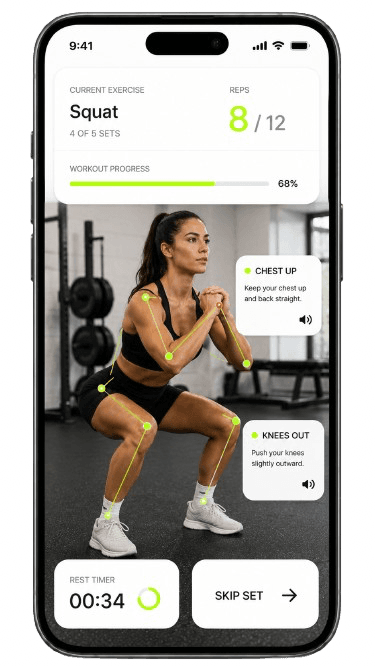
Real-time coaching on the iPhone you already use.
Boddy follows supported movement, counts repetitions, and delivers concise visual and spoken cues during the set.

You do not need to take every working set to muscular failure for the set to count. In the studies below, stopping before failure produced strength and muscle-size gains, though one low-volume trial found a modest possible muscle-size advantage for going all the way. The useful decision is about your goal, how many sets you do, and what happens to the rest of your session—not a rule that every set must end at the limit. Wu et al., 2026 · Refalo et al., 2024 · Hermann et al., 2025
Here, momentary muscular failure means attempting another repetition but being unable to complete it with the intended movement standard. Repetitions in reserve (RIR) is your estimate of how many more controlled repetitions you could have done when you stopped. An estimate of 2 RIR is a guide, not a precise measurement. Studies also use different definitions of failure and different ways of setting non-failure work, which limits exact comparisons. Wu et al., 2026 · Hermann et al., 2025
What does the broader evidence say?
A 2026 systematic review pooled 20 randomized comparisons involving 556 healthy adults. The training programs lasted four to 14 weeks and mixed trained and untrained participants, loads, set counts, and ways of stopping short. The pooled dynamic-strength result modestly favored non-failure (standardized difference 0.24, 95% confidence interval 0.06–0.42). The comparison did not detect clear between-group differences for muscle size, muscular endurance, or power. That is evidence against a blanket requirement to reach failure; it does not prove both approaches are identical for every person. Wu et al., 2026
There is a useful limit inside that result. In the review's subgroup where the amount of training was matched between approaches, the dynamic-strength estimate still leaned toward stopping short, but its confidence interval included no difference. Many included trials were small, and the authors noted unclear allocation procedures and inconsistent assessor blinding. So the review cannot tell you that leaving exactly two reps is best, or that reaching failure will reduce your gains. Wu et al., 2026
Why can individual trials sound different?
One eight-week trial assigned one leg of each of 18 experienced lifters to reach failure and the other to stop at an estimated two reps remaining on leg press and one on leg extension. Both legs gained almost the same average quadriceps thickness: 0.181 cm with failure and 0.182 cm with one or two estimated reps remaining. Repetitions and lifting speed fell more across sets on the failure side. The within-person design controls for many differences between people, but the result is about two lower-body exercises in a small trained group over eight weeks; it is not an equivalence test for all programs. Refalo et al., 2024
A different eight-week randomized trial asked a narrower question: what if each exercise gets only one set? Forty-two young experienced lifters did one set of nine exercises twice a week, either to failure or with an estimated two reps remaining. Several muscle-size measures leaned toward the failure group, but the absolute differences were generally modest; strength and local endurance gains were similar. The one-set setup can make the last repetitions more consequential than they are in a program with several sets. That is a plausible interpretation, not a tested comparison between one-set and multi-set programs in this trial. Hermann et al., 2025 · Wu et al., 2026
There is also a cost worth checking for yourself. A 2025 analysis followed the same 18 people from the leg study, comparing their ratings after failure sets and sets stopped at one or two estimated reps remaining. Average reported set discomfort and session effort were higher with failure, while general feelings were more positive after the reserve protocol. Responses varied between people. The analysis did not establish that one approach leads to better long-term attendance, and it is not an independent second trial of muscle growth. Refalo et al., 2025 · Refalo et al., 2024
A decision test for your next two weeks
For several working sets: Begin with a controlled set and an estimate that one or two more repetitions were possible. Keep the exercise, equipment, load, rest interval, target range, and set order as similar as practical over two or three comparable sessions. Record completed reps for each set and a short RIR estimate in your own note. If going to failure on an early set repeatedly leaves later sets well below their planned range, stopping earlier may serve your whole session better. This is an editorial self-comparison, not a proven one- or two-RIR prescription. Wu et al., 2026 · Refalo et al., 2024
For one set per exercise: Decide whether you value a possibly small muscle-size advantage enough to make that set more demanding. The single-set trial gives a reason to consider failure in that specific setup, while the broader review does not establish it as necessary. You can compare one-set sessions that stop just short with sessions taken to failure, keeping other choices steady and observing both completed work and how the session feels. A couple of weeks can show whether the approach is workable for you; it cannot measure long-term muscle growth reliably. Hermann et al., 2025 · Wu et al., 2026 · Refalo et al., 2025
Example: Suppose you plan three sets of eight to ten rows at the same load. In the first session, your first set reaches failure at ten reps and the next two sets reach seven and six. In the next comparable sessions, try stopping the first set when you estimate one or two more controlled reps remain, then see whether the later sets meet their target more often. A change in the record helps you choose a repeatable plan, but it does not prove the set endpoint alone caused the change. If you are still finding a suitable load, use the starting-weight guide; if your next question is when to increase it, use the load-progression guide.
Where Boddy fits
Boddy offers workout planning and progress tracking on iPhone. Use Boddy's planned sessions and progress view for the overall pattern; record per-set reps and RIR in your own note to compare similar days. Boddy product description None of the studies here tested Boddy or showed that it improves strength or muscle growth. The plan and progress views provide overall context; your own per-set notes provide the details for this comparison.
The practical decision: choose a set endpoint that lets you complete your planned work, then compare similar sessions before making it a habit. The evidence supports leaving some repetitions in reserve as a credible default for repeated sets, while allowing that a one-set program or personal preference may change the trade-off. No study here identifies a universal failure rule. Wu et al., 2026 · Refalo et al., 2024 · Hermann et al., 2025
BODDY IN ACTION
Real-time coaching on the iPhone you already use.
Boddy follows supported movement, counts repetitions, and delivers concise visual and spoken cues during the set.
TRAIN WITH BODDY
Want coaching that responds while you train?
Boddy combines personalized plans, meal logging, progress tracking, and real-time form guidance in one iPhone experience.