
THE BODDY JOURNAL
What If a Recovery Score Disagrees With How You Feel?
BODDY IN ACTION
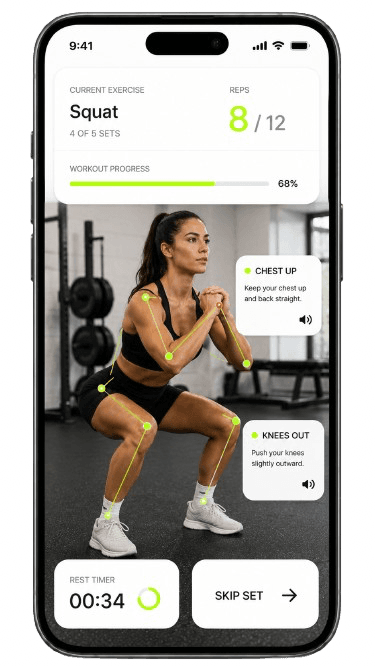
Real-time coaching on the iPhone you already use.
Boddy follows supported movement, counts repetitions, and delivers concise visual and spoken cues during the set.

Direct answer: Treat disagreement as uncertainty, not proof that one side is wrong. A recovery score estimates readiness from limited signals; how you feel is also imperfect. Use a conservative warm-up and recent performance to decide what today’s training can support.
The complaint behind the question
Users report apps prescribing rest on days they feel capable or hard training after poor sleep and soreness. The frustration increases when the score changes without an explanation of which input moved it.
Why this happens
Wearable recovery models may use heart-rate variability, resting heart rate, sleep, and prior activity. These signals are influenced by measurement conditions and individual baselines. Subjective energy can miss accumulated fatigue or be distorted by motivation.
A five-point quality check
- Look for the inputs behind the score.
- Compare with your normal baseline, not another person.
- Note pain and illness separately from ordinary fatigue.
- Use warm-up speed and control as fresh evidence.
- Reduce volume before abandoning movement entirely.
A safer decision rule
When both the score and symptoms are poor, reduce stress. When they disagree, begin below the planned intensity and reassess. Seek medical guidance for concerning symptoms rather than using a fitness score as clearance.
What good product behavior looks like
A recovery display should keep reported soreness, sleep, recent workload, and wearable estimates visible as different inputs. If the score disagrees with the person's warm-up and normal performance, the app should offer a reversible lower-risk test instead of insisting on a hard session or total rest. Record what happened afterward to calibrate the next decision. Pain or symptoms that concern the user require a different path from ordinary fatigue; a score cannot clear them.
Where Boddy fits
Boddy places recovery check-ins beside workout history and the upcoming plan, so readiness becomes a decision aid rather than an unexplained red or green light. The user can compare how they feel with recent work, then adjust the session instead of obeying a score that cannot see the whole body. That combination of context and control is more useful than false precision.
Important limit. Wearable estimates depend on individual baselines and measurement quality. A single reading cannot reveal every cause of fatigue, illness, or stress, and feeling motivated can mask accumulated strain. For pain, illness, or symptoms outside ordinary training fatigue, seek qualified medical guidance rather than using a fitness app to self-clear.
A quick test before you depend on the feature
Worked example. Your wearable reports low readiness, but you feel fine before a planned strength session. Start with an easy warm-up and a lighter first set. If movement feels controlled and the usual load is manageable, you may keep the session while avoiding unnecessary extra volume. If the warm-up feels unusually difficult or technique deteriorates, reduce load or sets and record what changed. Conversely, a high score does not overrule fever, new pain, dizziness, or other concerning symptoms. The score helps frame a test; it does not grant permission to push through a red flag.
Bottom line
A recovery number is one clue. Combine it with the warm-up, recent performance, and symptoms; never use it as medical clearance.
Sources checked in September 2026
BODDY IN ACTION
Real-time coaching on the iPhone you already use.
Boddy follows supported movement, counts repetitions, and delivers concise visual and spoken cues during the set.
TRAIN WITH BODDY
Want coaching that responds while you train?
Boddy combines personalized plans, meal logging, progress tracking, and real-time form guidance in one iPhone experience.