
THE BODDY JOURNAL
How to Stop Starting Over With Exercise When Life Gets Busy

BODDY IN ACTION
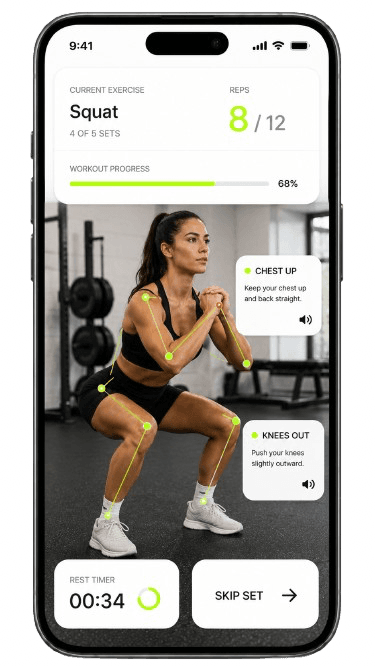
Real-time coaching on the iPhone you already use.
Boddy follows supported movement, counts repetitions, and delivers concise visual and spoken cues during the set.

If you keep starting exercise programs and stopping, the next step is not a more demanding restart. Find the point where the old plan stopped fitting your life, choose a smaller repeatable version, and decide in advance what you will do when a session is missed. A changing week needs a flexible decision rule, not a calendar that turns every interruption into failure.
Boddy can make the training part easier to organize: choose a manageable workout, record what you actually complete, and use that record for the next decision. It cannot create free time, guarantee a habit, or diagnose why you feel unable to exercise.
Find the friction point before changing the workout
Look at your last two attempts. Did the plan require four gym trips when two were realistic? Was the gym too far away after work? Did you stop because a missed Tuesday made the rest of a fixed weekly split confusing? Was the exercise unpleasant, too hard, or interrupted by illness or care duties? Each problem calls for a different adjustment. More motivation is not a solution to inaccessible equipment or a schedule that no longer exists.
Write one sentence: “My plan failed when ___, so this time I will ___.” For example: “My evening gym session disappeared when my shift changed, so I will keep one home strength session as an alternative.” If you prefer walking or another activity, keep that in the plan too. The best exercise routine is one you can safely and willingly return to, not one that looks impressive on paper.
Set a normal week and a smaller minimum
Choose a normal week that fits your current life, then define a minimum for unusually busy weeks. For a beginner who wants strength training, the normal week might be two short full-body sessions. The minimum might be one shorter session using familiar exercises. That minimum is a continuity tool, not a promise that one session meets every long-term goal. The CDC's adult activity guidance recommends two muscle-strengthening days weekly and notes that some activity is better than none. Build toward the recommendation from a starting point you can manage.
Use a session sequence rather than a rigid weekday label if your calendar moves. Call the workouts Session A and Session B; do the next suitable one when time and recovery allow. If Tuesday disappears, the next workout is still the next workout. You do not owe the calendar a “make-up” session. For a concrete short-session example, see our 30-minute full-body workout for busy days; this page is about managing the week, not prescribing every exercise.
Decide what happens when a workout is missed
Use the reason for the gap to choose your next action:
- One ordinary scheduling miss: move the session to a realistic open window or continue with the next planned workout. Do not double the volume to pay it back.
- The same session keeps disappearing: shorten it, change the location or day, or reduce the weekly frequency. Treat the pattern as evidence that the plan needs redesign.
- A longer break with no symptoms: return with a manageable version of a familiar session. Consider less weight, fewer sets, or less time at first, then build again according to how you respond.
- Illness, injury, unusual exhaustion, or concerning symptoms: a generic restart rule is not enough. Seek appropriate medical or qualified professional guidance before pushing through.
Planning a backup can help, but it is not magic. A systematic review of exercise implementation intentions found that the effects of specific “if–then” plans varied with factors such as intention and confidence. Try a real contingency—“If my Thursday shift runs late, I will do the shorter session Saturday morning”—and revise it if it repeatedly fails. A reminder alone cannot make a bad time slot workable.
A two-week example with an unpredictable schedule
Imagine someone whose work shifts change every Sunday. They choose two full-body strength sessions, A and B, each with a short version. On Sunday they identify two likely windows and one backup, without promising fixed weekdays. In week one they complete A at home and B at the gym. In week two a shift runs late and B is missed. They do not restart from A or cram both sessions into Sunday. They keep the next available session manageable, record that the late shift was the obstacle, and move their future backup to a time that is actually free.
At the end of two weeks, they ask what happened: Was the minimum achievable? Which location was easier to use? Did a particular exercise or session length create friction? Change one part of the plan, then repeat. That review is more useful than judging the whole month by a perfect streak. Research on physical-activity habit interventions finds an average improvement in habit strength, but it does not establish a universal number of days after which exercise becomes automatic.
Let Boddy hold the plan and the record
For self-directed strength work, use Boddy to choose a workout that fits your goal and available equipment, then log the exercises, loads, and repetitions you actually completed. When a week changes, look at that record before selecting the next manageable session. If you use camera coaching, remember that cues apply only to supported exercises when the movement is visible; it is not a replacement for a qualified coach or clinician.
Boddy gives you ordinary workout guidance and a record without booking a personal trainer for every session. Compare its subscription with local coaching prices if cost is your deciding factor; our app-versus-human-trainer cost guide explains what each option does and does not buy. Boddy cannot provide human accountability or make a rigid plan flexible automatically. If you want workout guidance and history in one iPhone app, get Boddy on the App Store. Start with the session you can repeat this week—not a promise to never miss another one.
When a restart needs more than a routine change
Do not treat chest pain, fainting, unusual breathlessness, worsening pain, or persistent unexplained fatigue as a motivation problem. Stop and seek appropriate medical attention. If illness, injury, pregnancy or postpartum recovery, or a chronic condition changes what activity is suitable, get individualized advice. Boddy cannot clear you to exercise or determine whether symptoms are safe; our guide to the limits of AI fitness coaching for pain and injury explains that boundary.
Sources
BODDY IN ACTION
Real-time coaching on the iPhone you already use.
Boddy follows supported movement, counts repetitions, and delivers concise visual and spoken cues during the set.
TRAIN WITH BODDY
Want coaching that responds while you train?
Boddy combines personalized plans, meal logging, progress tracking, and real-time form guidance in one iPhone experience.