
THE BODDY JOURNAL
25-Minute Pull Day: Which Exercise Should You Keep?
BODDY IN ACTION
Real-time coaching on the iPhone you already use.
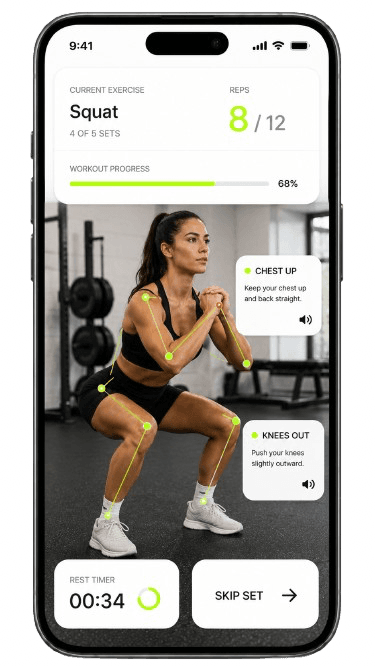
Boddy follows supported movement, counts repetitions, and delivers concise visual and spoken cues during the set.

Short answer: Keep the pull you most want to improve, give it your first working sets, and cut duplicate or lower-priority work when the clock runs down. If your goal is to improve a row, keep the row. If your goal is a pull-up or pulldown, keep that instead. A second pulling angle can be useful if time allows; curls are optional unless direct elbow-flexor work is your particular goal. This is a decision framework for a short session, not a claim that one exercise covers every back or arm goal.
Pull-day lists often contain a deadlift, two or three rows, a vertical pull, and several curls. That may be a workable menu for a longer session. In 25 minutes, the useful question is which task you are trying to repeat and progress. Choosing that before you reach the gym protects your first working sets from a long series of equipment changes.
Why put the priority pull first?
A systematic review and meta-analysis of 11 exercise-order studies compared doing multi-joint movements before single-joint movements with the reverse order. Across all strength tests combined, it detected no overall difference between orders. But strength gains in multi-joint tests favored starting with multi-joint work, while gains in single-joint tests favored starting with single-joint work. The pooled analysis did not detect a muscle-size difference by order. That supports putting your priority exercise first; it does not establish that a row is inherently more valuable than a curl for every goal.
The review compared exercise order over training programs. It did not assign people a 25-minute pull day, remove exercises from one group, or test rows against pulldowns as substitutes. Applying its result to a time limit is our interpretation: put the movement whose performance you care about most before optional work, then judge the session by what you actually completed. Exercise-order review
Can curls be the first thing to cut?
A randomized eight-week trial of 20 previously untrained men compared a program of multi-joint exercises with the same program plus single-joint work. Both groups improved on tested 10-repetition-maximum tasks, including the pulldown and elbow flexion, without a detected between-group difference on those strength tests. The group with added single-joint work had a somewhat larger increase in flexed-arm circumference. So the trial offers a reason to place curls below your main pull when general pulling strength is your priority, but not a reason to declare curls useless for a direct arm goal.
This was a small, mixed upper- and lower-body program in beginners, not a trial of trained people trimming one pull workout. Added exercise time and volume were part of the comparison, and arm circumference is an indirect size measure. The study cannot tell you exactly how many curl sets to keep or what happens when the entire session is limited to 25 minutes. Single-joint addition trial
The 2026 American College of Sports Medicine position stand drew on 137 systematic reviews of resistance-training trials in more than 30,000 healthy adults. It found that progressive resistance training improved strength and muscle size compared with no training, and that volume matters for some goals. It did not prescribe a 25-minute pull-day template or a minimum number of exercises in one session. A short session should therefore be judged as part of your week, not as a complete back-training prescription by itself.
A 25-minute plan you can actually finish
Choose your anchor before the timer starts. A seated row or one-arm dumbbell row is a horizontal pull; a pulldown or pull-up is a vertical pull. Pick whichever most directly matches the movement you want to practice and compare from week to week. If you have no clear preference, choose the station you can access reliably and put the other angle in your next pull session. Do not assume the angles are identical just because both appear on a pull-day list.
| Time | What to do | If you are running late |
|---|---|---|
| 0–4 minutes | Set up your anchor and do a light preparatory set or two | Keep preparation; shorten the optional work below |
| 4–17 minutes | Do two or three controlled working sets of your anchor, resting enough to repeat your chosen rep range | Keep the anchor; stop after the completed sets |
| 17–22 minutes | If a second station is free, do one or two sets of the other pulling angle | Skip the second station if moving to it would crowd the clock |
| 22–25 minutes | Record the exercise, load, reps, and what you skipped | Log the anchor even if it was your only movement |
The minute marks are an example budget, not rest periods or set counts validated by these papers. If your anchor needs more setup or longer rest, give it the time. Do not speed up repetitions just to reach the last row of the table. If both pulling angles are important to you, alternate which one goes first across comparable sessions, or place the second elsewhere in the week. If direct arm work is the priority, use the last few minutes for a curl instead of the second pull.
Here is the practical decision: Keep the movement you most want to improve; cut a duplicate row or curl before cutting its first working sets. Suppose your usual plan lists a pulldown, two cable-row variations, and two curls. With 25 minutes, keep the pulldown if that is your tracked priority, then use a row if time remains. Cut the second row variation and both curls today. If your priority is direct elbow-flexor work, keep the pulldown plus one curl and move the row to another day. The research above does not prove either exact combination is optimal; the choice follows your stated goal and available time.
Check whether the shorter plan serves you
Repeat the same anchor for several comparable sessions. Record the exercise variation, machine or implement, working load, reps, and whether you completed the intended sets. If you repeatedly run out of time before your anchor is done, your plan still has too many transitions or too much optional work. If you complete it consistently and want more work, add one second-angle set before adding several new exercises. A single session cannot show whether a plan improves long-term strength or size. For a broader short-session template that includes legs and pushing, see the 30-minute full-body guide; for the effect of exercise sequence, see the exercise-order guide.
Where Boddy fits
Boddy describes personalized workout planning and progress tracking in its iPhone app. Use the plan to identify your priority pull before the session and the progress record to compare completed work across similar sessions. Boddy's camera coaching is limited to supported movements and suitable visibility, so this plan does not assume that a row or pulldown receives live camera feedback. None of the studies here tested Boddy or established that using the app improves pulling strength or muscle size.
BODDY IN ACTION
Real-time coaching on the iPhone you already use.
Boddy follows supported movement, counts repetitions, and delivers concise visual and spoken cues during the set.
TRAIN WITH BODDY
Want coaching that responds while you train?
Boddy combines personalized plans, meal logging, progress tracking, and real-time form guidance in one iPhone experience.