
THE BODDY JOURNAL
A 10-Minute Core Block After Strength Training
BODDY IN ACTION
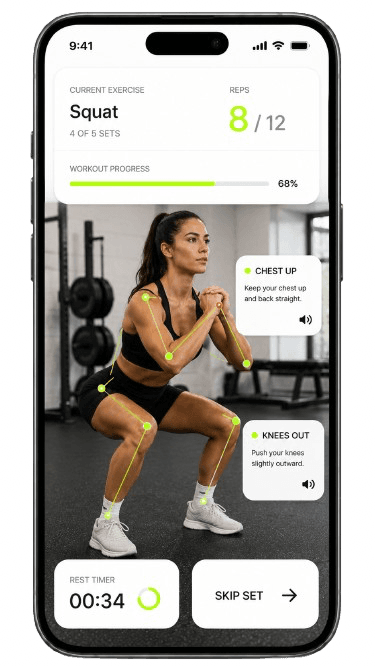
Real-time coaching on the iPhone you already use.
Boddy follows supported movement, counts repetitions, and delivers concise visual and spoken cues during the set.

Short answer: If your main strength work is complete and you still have ten minutes, use the block to practice one repeatable front-of-trunk task and one side-to-side task. A front plank variation plus a side bridge is a simple option, but it is an editorial example, not a research-tested ten-minute formula. If the main workout is unfinished, spend the remaining time on its priority movement instead. A short add-on should have a purpose you can describe and a record you can compare next time.
Decide what the extra block is for
“Core” is a convenient label, not a single exercise or a separate body part that every workout must exhaust. For this decision, think of trunk work as practice holding or moving your torso with control. A squat, row, or carry may already ask your trunk to work, but that does not tell you whether it gives you enough practice on a particular trunk task. Choose a direct add-on when you want to practice that task; do not add a circuit merely because a workout graphic lists “abs” at the end.
Start by looking at the work you actually completed. Did a planned leg, push, or pull movement get dropped because time ran out? The 30-minute full-body guide helps you protect those priorities. If the main session was complete, choose one observable goal for the add-on: for example, maintaining a consistent side-bridge position for a repeatable interval. A goal such as “burn as much as possible” gives you little information for the next session.
What the studies measured
A six-week randomized trial in 37 men compared resistance training alone with resistance training plus quasistatic trunk-stabilization work. In between-group comparisons, the added trunk work improved only the side-bridge endurance measure (p = .050); the trial did not find a clear extra benefit across its other measured core strength, trunk-control, or leg-performance outcomes. That is evidence for a specific measured difference, not evidence that every person needs a core finisher or that ten minutes is the right dose. The sample was small and all male, and the program was a six-week intervention rather than a single after-workout block.
A 2023 systematic review included 22 randomized or randomly allocated studies of healthy people older than 12; 21 entered its meta-analysis. Programs lasted at least four weeks and examined balance, throwing or hitting, and jumping, mostly in students and athletes. Six balance studies with 75 training-group and 67 control-group participants favored core training (standardized mean difference 1.17, 95% confidence interval 0.56 to 1.77). The review rated that balance evidence moderate, but the studies varied and the pooled estimate had substantial heterogeneity. These sport-related tests are not a promise that an ordinary gym add-on improves your lifting, and the review did not test this exact ten-minute sequence after strength work.
Exercise selection evidence is narrower still. A laboratory study of 20 healthy young adults measured electrical activity in trunk muscles during eight stabilization exercises. In that session, side bridging showed the highest measured activity for the external and internal oblique muscles among the exercises tested. Muscle activity is not the same as long-term strength gain, and the study did not compare a front plank–side bridge pair with other ten-minute plans. It helps explain why two different tasks might be worth comparing, not why one exercise is universally best.
Taken together, the studies support a limited conclusion: repeated trunk work can change some measured outcomes, and the exact task you practice matters. They do not establish that a ten-minute block must follow every strength session, that a fixed exercise pair is optimal, or that the block replaces a complete strength program.
A ten-minute example you can actually repeat
This is a time budget for a familiar, manageable variation, not a protocol copied from a trial:
| Time | Task | Record |
|---|---|---|
| 0–1 minute | Choose a front plank variation and a side-bridge variation you already know | Which versions did you use? |
| 1–4 minutes | One short front hold, then a side hold on each side; take enough pause to reset your position | Seconds completed with the intended position |
| 4–7 minutes | Repeat the same sequence once if each hold still looks and feels controlled | Whether the second round matched the first |
| 7–10 minutes | Repeat once more only if the positions still match; otherwise stop, put equipment away, and log the block | Rounds completed and any change in setup or duration |
The clock is a ceiling, not an instruction to rush between positions. Start with holds that let you maintain the version you chose; fifteen to thirty seconds can be a planning example, not a validated threshold. If a floor position is unfamiliar, learn it separately before making it a timed finisher. The side bridge can use a bent-knee variation if that is the version you can repeat; do not compare its time directly with a different variation.
Decision rule: If the next hold no longer matches the position you intended, or the main workout was left unfinished, stop the core block and adjust the plan next time. Adding more shaky minutes would make the record harder to interpret. The working-sets guide explains why more work is not automatically the better next step.
Test whether it earns its place
Try the same two tasks after two or three comparable strength sessions. Log the version, hold time, number of rounds, and whether the main workout was completed. If the add-on repeatedly crowds out your priority lift or becomes a hurried formality, remove one round or put trunk practice on another day. If you finish the main work and can repeat the block with stable setup, keep it as a small practice habit. These observations test fit and repeatability; they cannot show that the block caused a change in balance, jumping, or strength.
Boddy's About page describes workout planning and progress tracking in its iPhone app. Use its plan to reserve an optional trunk block and its completed-session record to see whether you actually did it; keep hold times in a separate note if the current app has no suitable field. Camera guidance applies only to supported visible movements, so do not assume it evaluates either example here. These studies did not test Boddy, and they do not show that a ten-minute core block in the app improves any outcome.
Sources
BODDY IN ACTION
Real-time coaching on the iPhone you already use.
Boddy follows supported movement, counts repetitions, and delivers concise visual and spoken cues during the set.
TRAIN WITH BODDY
Want coaching that responds while you train?
Boddy combines personalized plans, meal logging, progress tracking, and real-time form guidance in one iPhone experience.