
THE BODDY JOURNAL
How Many Working Sets per Exercise Should a Beginner Do?
BODDY IN ACTION
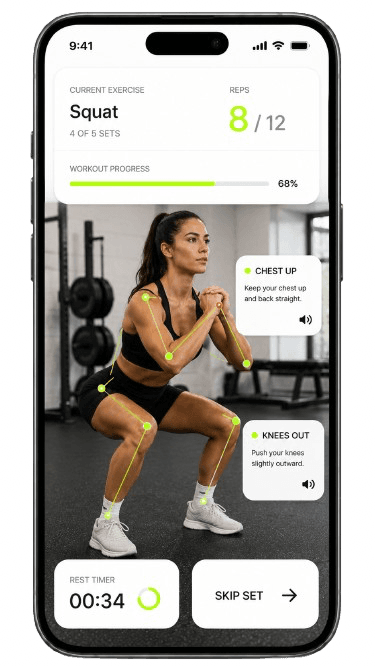
Real-time coaching on the iPhone you already use.
Boddy follows supported movement, counts repetitions, and delivers concise visual and spoken cues during the set.

A beginner does not need a magic set count for every exercise. For a first session, one controlled working set per exercise can make the sequence manageable. Once the session is repeatable, test two working sets. The one-set start is a short learning step, not a research-backed long-term target. A working set is a planned set at the load and effort you intend to train with; easy practice before it is a warm-up.
What the studies can tell us
The 2026 American College of Sports Medicine overview brought together 137 systematic reviews of resistance-training trials in more than 30,000 healthy adults. It found greater voluntary strength in comparisons involving two to three sets, alongside other program features. It also associated muscle growth with higher weekly volume, including at least 10 sets per week in the comparisons it reviewed. Weekly sets for a muscle are a different measure from sets for one exercise in one session. The overview does not say that a new lifter must perform 10 sets of each exercise. In its full discussion, ACSM advises healthy adults to complete at least two sets per exercise and says the exact set count that optimizes outcomes cannot be determined.
A 2023 network meta-analysis compared combinations of load, set count, and weekly frequency in randomized trials of healthy adults. Its strength network included 178 studies and 5,097 people; its muscle-growth network included 119 studies and 3,364 people. Every resistance-training prescription it studied did better than no exercise for both outcomes. The highest-ranked muscle-growth prescription used multiple sets, yet many prescriptions had similar estimated effects. A ranking across mixed programs is not a precise instruction to add a second set to every movement tomorrow.
An older, narrower meta-analysis examined 55 muscle-growth effect sizes from just eight studies and compared one set with multiple sets per exercise. Multiple sets were associated with a larger pooled effect. Its small evidence base and varied training programs limit how confidently we can assign a personal set count from that result. These three syntheses may include some of the same underlying trials, so their study counts should not be added together.
Decide using the session you can actually repeat
- Pick a small number of movements. For a full-body day, one leg movement, one push, and one pull are enough to test the structure. Our two-day plan shows how these fit into a week.
- Use one working set for each movement in a first session if that helps you learn the sequence. Choose a manageable repetition target and a load you can control. The starting-weight guide explains how to test a load. Record warm-ups separately so the log reflects the work you planned.
- Review two to four completed sessions. Did you finish the key movements, record comparable loads and repetitions, and have enough time to do another set without dropping a higher-priority movement? This check tests the plan's fit, not a change in muscle size.
- Add one set where it solves a real gap. If the session is repeatable and you want more work for a particular movement, try two working sets for that movement and keep the other choices stable. Compare the following sessions before adding more elsewhere. If the extra set crowds out the pull every time, return to one set or shorten optional work.
For example, suppose a beginner finishes a leg press, chest press, and row on two days each week. One working set of each exercise on each day is two sets of that exercise across the week. Changing only the row to two working sets on each day makes four row sets across the week. Other exercises can also train some of the same muscles, so those counts are not an exact measure of total work for every muscle. The example shows what you changed; it does not predict a particular amount of growth.
Two or three sets per exercise may be a reasonable later choice when the session still fits and you can compare the work across weeks. Doing more sets is not automatically better if it replaces the movements you most need to practice. The evidence above is about group averages in structured studies; your log can tell you whether the plan was completed and progressed, but it cannot establish a personal optimum in four sessions. ACSM overview · Currier and colleagues · Krieger
Where Boddy fits
Boddy describes workout planning and progress tracking in its iPhone app. Use its workout record to keep the exercises, sets, repetitions, and loads together while testing one change at a time. The studies above did not test Boddy, and Boddy's log cannot tell you that a particular set count is optimal.
Sources: ACSM 2026 position stand; Currier et al. 2023 network meta-analysis; Krieger 2010 meta-analysis; Boddy About.
BODDY IN ACTION
Real-time coaching on the iPhone you already use.
Boddy follows supported movement, counts repetitions, and delivers concise visual and spoken cues during the set.
TRAIN WITH BODDY
Want coaching that responds while you train?
Boddy combines personalized plans, meal logging, progress tracking, and real-time form guidance in one iPhone experience.