
THE BODDY JOURNAL
Can You Split One Strength Workout Into Two Short Sessions?
BODDY IN ACTION
Real-time coaching on the iPhone you already use.
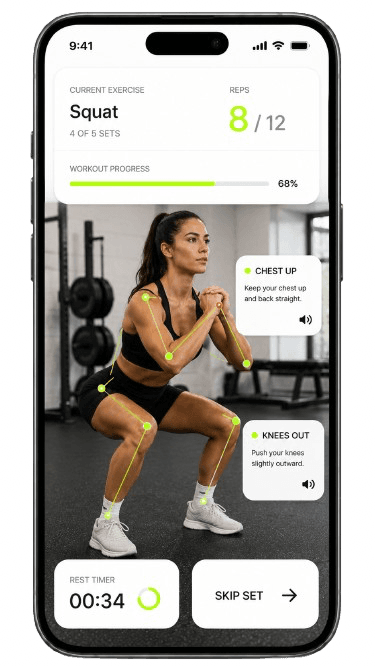
Boddy follows supported movement, counts repetitions, and delivers concise visual and spoken cues during the set.

Splitting the work is a reasonable option when it helps you complete the planned exercises and sets. It changes the timetable, not the need for a workable exercise choice, effort, and record. The direct trials show that people can perform planned work in two same-day sessions, but they do not prove that every pair of 15-minute workouts is equivalent to one 30-minute session for every person. Corrêa and colleagues, 2022 · Bartolomei and colleagues, 2023 · Pedersen and colleagues, 2022
What the direct studies tested
An eight-week randomized study assigned 23 resistance-trained men to train a muscle group once daily (11 men) or twice daily (12 men). The twice-daily group increased back-squat one-repetition maximum by 16.1% versus 7.8% in the once-daily group, a statistically significant between-group difference. Both groups improved bench-press strength, muscular-endurance measures, and measured muscle thickness, with no between-group difference reported for those outcomes. The intervention involved trained men and a structured program; it does not establish a benefit for beginners, women, or a casual split of one short home workout. Corrêa and colleagues, 2022
In a separate acute trial of resistance-trained men, the reported groups completed eight bench-press sets of ten repetitions in one session or split the sets into two blocks four hours apart. The investigators initially prescribed 70% of one-repetition maximum and reduced loads when needed to complete the target repetitions. The split group maintained a higher average load (59.9% versus 48.7% of maximum) and had a faster return of bench-press throw power and pectoral-muscle thickness toward baseline. These are short-term performance and ultrasound measures, not long-term gains or a test of casual 15-minute full-body sessions. The paper says 24 men participated, while its reported group sizes add to 22; we have not inferred what happened to the other two. Bartolomei and colleagues, 2023
A randomized crossover experiment in 23 resistance-trained women compared a single 46-minute lower-body session with two sessions totaling 43 minutes and separated by 3.5–5 hours. Each day used the same six exercises and 18 planned working sets. The split arrangement produced 169 versus 164 total repetitions, a 3% difference, and lower reported effort and discomfort. Readiness to train the next day did not differ; 22 of 23 women preferred the single session for a regular routine, often because they did not want two gym trips. This study measured one training day, not later strength or muscle growth. It also suggests that the best arrangement depends on real travel and scheduling costs, not only the work inside the gym. Pedersen and colleagues, 2022
The larger 2026 ACSM overview of resistance-training reviews supports progressive resistance training in healthy adults and examines how training variables relate to strength and hypertrophy. It does not identify one ideal clock-time arrangement for a given day's work. A practical decision should therefore start with the work you can actually complete.
Make the split useful, rather than merely busy
Start by naming the purpose of each short block. For a simple full-body day, the first block might include a leg movement and a push; the second might include a pull and a hip or trunk movement. Leave time to set up each exercise and use a manageable load. If travel and setup consume much of each window, two sessions may be less practical than one shorter, simpler session. The women in the crossover study performed slightly more repetitions when splitting, yet nearly all preferred one trip. Pedersen and colleagues, 2022
An example—not a trial-tested prescription—could be:
| Morning, about 15 minutes | Later, about 15 minutes |
|---|---|
| Brief easy movement, leg movement, push | Brief easy movement, pull, hip or trunk movement |
| Record load, reps, and effort before leaving | Check what was actually completed; avoid duplicating a set by mistake |
If you repeat the same exercise in both blocks, do not assume the second block will match the first. Its performance may differ because of the rest interval, effort in the first block, or other parts of the day. The record should show the two blocks separately. A person pursuing a skill-based heavy lift may prefer one uninterrupted session so the warm-up and technique work remain coherent; that is a planning judgment, not a finding from the studies above.
A two-week test
Try your planned split across two comparable training days. For each block, record the exercises, working sets, repetitions, loads, travel/setup time, and whether the block happened. Compare it with a one-block day only if the exercises and total work were reasonably similar. If the second block is repeatedly missed, design one shorter complete session instead of relying on a future block that rarely happens. If both blocks happen comfortably, keep the structure and adjust one training variable at a time. This two-week check tests whether the arrangement fits your life; it cannot establish which structure builds more muscle.
Boddy's first-party About page describes iPhone workout planning and progress tracking. Use its plan and completed-work record as context, and label the two blocks separately in your own log if the current app does not provide a way to do that. Its camera guidance is only for supported exercises with a usable view. The same-day studies did not test Boddy and do not show that its app improves strength, recovery, or adherence. For an existing single-block example, see Boddy's 30-minute full-body workout.
BODDY IN ACTION
Real-time coaching on the iPhone you already use.
Boddy follows supported movement, counts repetitions, and delivers concise visual and spoken cues during the set.
TRAIN WITH BODDY
Want coaching that responds while you train?
Boddy combines personalized plans, meal logging, progress tracking, and real-time form guidance in one iPhone experience.