
THE BODDY JOURNAL
Low vs High Reps for Muscle Growth and Strength: What Changes?
BODDY IN ACTION
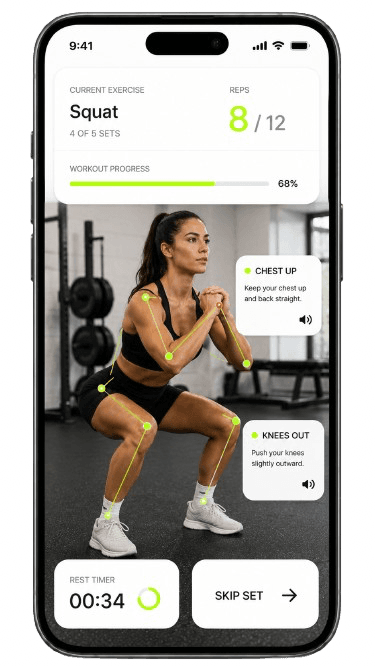
Real-time coaching on the iPhone you already use.
Boddy follows supported movement, counts repetitions, and delivers concise visual and spoken cues during the set.

If your main aim is to improve a one-repetition maximum in a particular lift, include practice with relatively heavy loads in that lift. If your main aim is muscle growth, the research does not show that only one narrow repetition range works. This answer is about the load and effort used in training studies; a rep target alone does not tell us either one.
What the comparisons actually measured
A 2017 review of 21 studies compared training at no more than 60% of a one-repetition maximum with training above 60%. The included programs lasted at least six weeks, involved people without known conditions that impaired training, and took all sets to momentary muscular failure. Higher-load groups improved their tested one-repetition maximum more; pooled muscle-growth measures were similar between loading groups. That result does not establish that an easy set of 25 repetitions is interchangeable with a demanding set of 8.
A 2021 review of 45 studies used a similar dividing line: more than 60% of one-repetition maximum, or a load allowing fewer than 15 maximum repetitions, versus lighter loads. It found no clear pooled difference in whole-body, whole-muscle, or muscle-fibre growth measures. Higher loads favored both one-repetition-maximum and isometric strength. The pooled whole-muscle growth difference was small and uncertain (standardized effect 0.06, 95% confidence interval −0.11 to 0.24). A non-significant difference is not proof that every person will respond identically.
A 2022 volume-matched review compared very low, low, moderate, and high loads while matching total load lifted as sets × repetitions × weight. Its pooled analysis again found greater one-repetition-maximum gains with high loads than low or moderate loads, while pooled muscle-growth outcomes did not differ across load categories. Matching total load does not make a 5-repetition set feel or behave like a 20-repetition set, and the abstract does not give a single participant total. The reviews may include overlapping trials, so their study counts should not be added together.
The practical interpretation is narrower than “reps do not matter.” A heavy test is partly a skill in moving a heavy load, so practicing with heavier loads is relevant to that outcome. The muscle-growth comparisons allow more flexibility in load choice, but their protocols and effort levels vary, and the 2017 review specifically required sets to failure. None supplies a universal best rep number for every exercise. Schoenfeld et al. 2017 · Refalo et al. 2021 · Carvalho et al. 2022
Choose a range for the task in front of you
- Name the outcome. Is your priority a heavier tested lift, more muscle over time, or a repeatable general strength routine? These are related but not identical measurements.
- Use the exercise and equipment you can control. For a tested lift, a lower-repetition working range with a suitably heavier load may provide more relevant practice. Schoenfeld 2017 · Refalo 2021 · Carvalho 2022 For a new or less stable movement, a moderate range that lets you repeat the setup and motion may be easier to compare. These are programming examples, not exact ranges proved optimal by the reviews.
- Choose a range and keep it long enough to compare. You might log a familiar row for 6–10 controlled repetitions or 10–15. Record the load, completed repetitions, set count, equipment, and how demanding the set felt. Our starting-weight guide helps you select a load for the range you chose; the progression guide helps decide when to change it.
- Change one variable at a time. If 10–15 repetitions at the same load become easier across repeat sessions, add a repetition within the range or make a small load change. If your goal is a heavier one-repetition maximum, include appropriate heavier practice rather than assuming that a higher-repetition log alone measures that outcome.
For example, two people may both write “8 reps” in a log. One uses a load that would allow several more repetitions; the other ends near their current limit. Their entries share a rep number but not the same effort. Conversely, a trainee may use 8 repetitions on a familiar press and 15 on a row because the equipment and purpose differ. The log helps keep those choices visible; it does not establish that either combination is uniquely best.
Where Boddy fits
Boddy describes workout planning and progress tracking in its iPhone app. Use the plan to state a rep range and the workout record to compare the same exercise, load, and repetitions over time. The loading studies did not test Boddy, and its records cannot prove a particular rep range will produce a specific outcome for you.
Sources: Schoenfeld et al. 2017 load review; Refalo et al. 2021 load review; Carvalho et al. 2022 volume-matched review; Boddy About.
BODDY IN ACTION
Real-time coaching on the iPhone you already use.
Boddy follows supported movement, counts repetitions, and delivers concise visual and spoken cues during the set.
TRAIN WITH BODDY
Want coaching that responds while you train?
Boddy combines personalized plans, meal logging, progress tracking, and real-time form guidance in one iPhone experience.