
THE BODDY JOURNAL
Full Body or Split Routine for Beginners? Choose by Your Week

BODDY IN ACTION
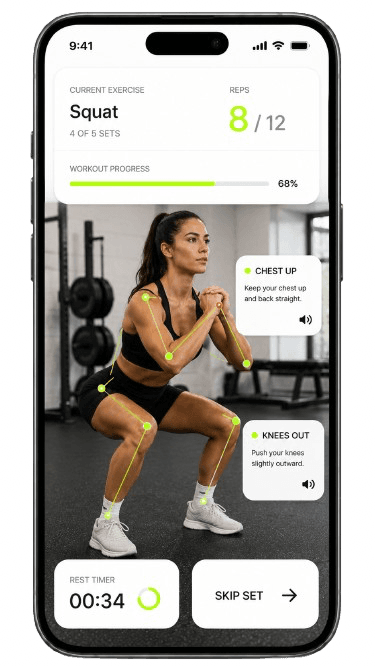
Real-time coaching on the iPhone you already use.
Boddy follows supported movement, counts repetitions, and delivers concise visual and spoken cues during the set.

If you are starting strength training, choose between a full-body routine and a split by looking at your actual calendar. With two or three reliable days, a compact full-body session often keeps the week simple. If you have more frequent but shorter openings, an upper/lower split may distribute the work more comfortably. Neither label makes a program effective on its own; the exercises, effort, total work, recovery, and whether you can repeat the plan matter too.
What each format means
A full-body session includes movements for several major areas in one visit. That might be one leg exercise, one push, one pull, and one hip or trunk exercise. It does not mean doing every exercise you know or exhausting every muscle in one day.
A split distributes the work across different days. An upper/lower split might focus on upper-body movements on one day and lower-body movements on another. Other splits assign days by movement pattern. The name only describes the schedule; it does not tell you whether the plan is manageable, well taught, or suited to your goal.
For general adult health, the U.S. Physical Activity Guidelines recommend muscle-strengthening activity on at least two days per week as well as aerobic activity. They do not prescribe a full-body or split calendar. That leaves room to choose a format that fits your circumstances.
Match the structure to your available time
| Your week | A workable starting choice | What to watch |
|---|---|---|
| Two dependable gym visits | Two full-body sessions | Keep exercise count low enough to finish without rushing. |
| Three visits with recovery time | Full body or a simple rotating A/B plan | Repeat familiar movements before adding complexity. |
| Four or more short visits | An upper/lower split may shorten each session | Make sure you can complete the sequence across the week. |
| Unpredictable days | A sequence you can resume at the next opening | Avoid a rigid label that turns one missed weekday into a skipped body part. |
If only two days are realistic, our two-day strength plan gives an actual A/B session template. If three are reliable, use the three-day beginner plan. These are sample schedules, not requirements to add visits you cannot sustain.
Suppose you have only 25 minutes on four mornings. Two long full-body sessions may be difficult to fit, while a short upper/lower sequence may work. If you instead have two 45-minute windows and little flexibility, full-body sessions mean that each completed visit covers several movement patterns. A split that depends on four visits would be fragile in that calendar. The format should fit the time you really have, not an ideal week on paper.
What the research can and cannot settle
A 2024 systematic review and meta-analysis compared split and full-body resistance training in 14 studies with 392 participants. When training volume was equated, the review found no significant difference between the formats for the strength and muscle-growth outcomes it examined. That supports choosing by preference and practical fit rather than treating one label as inherently superior.
It does not prove that any two plans are interchangeable. A rushed full-body program with too much work, an incomplete split, or a plan you cannot attend may differ in meaningful ways from the controlled programs in the review. The evidence also does not prescribe an optimal schedule for every beginner, injury history, sport, or time budget. Use it to remove an unnecessary format debate, then focus on a plan you can carry out safely.
Try a small full-body starting template
Choose one comfortable movement from each group: a leg press or sit-to-stand; a machine chest press or elevated push-up; a seated row or pulldown; and a hamstring curl, glute bridge, or simple trunk exercise. Start with one controlled set per movement while you learn the equipment. Add a second set when the first is familiar and you have the time and recovery for it.
The exact exercises can change with available equipment and your abilities. If you cannot set up a machine or do not understand the movement, ask gym staff or a qualified exercise professional to show you. NIDDK's activity guide describes weights, machines, bands, and body-weight movements as options and advises recovery time for the same muscles.
If you choose a split, keep the same practical standard: know what each session covers, what happens when you miss one, and how the sequence resumes. A short session is useful only if the whole week still contains the work you intended to do. Do not choose a split solely because the word sounds more advanced.
Use a two-week fit test
Pick one format for two weeks. Record the sessions you planned and completed, how long they took, the movements and loads, and whether you felt ready for the next session. At the end, ask: Did I finish the planned sequence? Did I repeatedly run out of time? Was there enough space between hard sessions? Could I remember what came next after a missed day?
If full-body visits keep running long, remove optional exercises before abandoning the format. If one split day repeatedly disappears, try fewer full-body visits or a more flexible sequence. Change one part of the schedule at a time, then observe another week. An ordinary missed session is information about the plan, not a reason to double the next workout. Our consistency guide covers that adjustment.
Let Boddy support the choice
You can use Boddy to organize workouts around your goal and available equipment, then log the sessions you actually complete. Review that record to see whether your chosen full-body or split sequence fits your week. Boddy does not determine that one format is medically right for you or guarantee adherence. Its camera cues cover only supported exercises and visible movement, and cannot replace instruction or individualized clinical advice.
If you want workout guidance and history in one iPhone app, get Boddy on the App Store. Choose the next session you can complete with control, then use your real week to improve the plan.
Sources
BODDY IN ACTION
Real-time coaching on the iPhone you already use.
Boddy follows supported movement, counts repetitions, and delivers concise visual and spoken cues during the set.
TRAIN WITH BODDY
Want coaching that responds while you train?
Boddy combines personalized plans, meal logging, progress tracking, and real-time form guidance in one iPhone experience.