THE BODDY JOURNAL
The Best Fitness Coaching App for Beginners: A No-Guesswork Guide
The best fitness coaching app for a beginner is the one that starts at an honest level, explains what to do, provides easier substitutions, progresses gradually, and helps build a repeatable week.
For adaptive bodyweight and conditioning, Freeletics is an established option. Fitbod can reduce planning for beginners using gym equipment, provided they take time to learn technique. Ladder is useful for people who prefer coach-led instruction, video demonstrations, and a session paced for them. Boddy is an iPhone app that combines personalized plans, real-time form guidance, meal logging, and progress tracking.
No app is automatically safe because it uses AI. Beginners should evaluate the quality of the coaching, not the label.
Coaching is different from an exercise video library
A video library waits for you to decide which workout to play. A coaching system makes a recommendation based on your goal, schedule, experience, and equipment; guides the session; records the result; and adjusts what comes next.
Ask these questions during a trial:
- Does the app ask about training experience and available equipment?
- Can I choose two or three realistic training days instead of being pushed toward six?
- Does every exercise have a clear demonstration and easier alternative?
- Does the app explain the intended effort?
- Can I report that the session was too difficult?
- Does it preserve rest and recovery rather than treating every day as a test?
- Can I see a simple record of improvement?
An app that only unlocks hundreds of videos may be a good content service, but you remain responsible for building the program.
What a beginner plan should accomplish
The first month is not about proving toughness. It is about learning movements, discovering an appropriate starting effort, and creating a schedule you can repeat.
A sensible beginner program usually:
- Uses a small number of repeatable movement patterns.
- Trains major muscle groups at least twice across the week.
- Leaves enough recovery between similar strength sessions.
- Begins with manageable loads or bodyweight variations.
- Increases difficulty only after technique is stable.
- Includes aerobic activity at a conversational or sustainable pace.
The CDC recommends that adults work toward 150 minutes of moderate-intensity aerobic activity per week and muscle-strengthening activity on two days. Beginners do not need to reach the full target immediately. Some activity is better than none, and volume can build gradually.
A realistic first four weeks
Week 1: learn and finish feeling capable
Choose two full-body strength sessions on nonconsecutive days. Use movements you can control, such as a supported squat or sit-to-stand, machine or elevated push, supported row, simple hinge drill, and a carry or trunk exercise.
Keep the effort moderate. You should finish most sets knowing you could have performed several more controlled repetitions.
Week 2: repeat before adding variety
Repeat many of the same movements. Familiarity lets you notice technique and choose better loads. Add a repetition only when the previous session felt stable.
The app should remember what you did rather than celebrating novelty for its own sake.
Week 3: make one small progression
Increase one variable: a small amount of load, one or two repetitions, slightly improved range of motion, or an extra set for a movement that feels comfortable. Do not change everything at once.
Week 4: review consistency and recovery
Look at completed sessions, energy, soreness, confidence, and any discomfort. A useful app should help you distinguish normal training effort from a movement that needs modification.
The win after four weeks is not a dramatic transformation. It is having a schedule, a baseline, and evidence that you can continue.
How the leading app styles fit beginners
Fitbod
Fitbod generates strength workouts based on goals, fitness level, equipment, history, and estimated recovery. It is useful when the main barrier is not knowing what to train at the gym.
Beginners should still study demonstrations, begin conservatively, and seek qualified instruction for movements they cannot perform confidently.
Freeletics
Freeletics provides an AI Coach and adaptive Training Journeys across bodyweight, conditioning, and other styles. It can be convenient for home training and users with limited equipment.
Feedback matters: report honestly when a workout is too difficult rather than trying to satisfy the algorithm.
Ladder
Ladder offers coach-built progressive programs, demonstrations, built-in timing, and in-ear guidance. It works well for beginners who want the session delivered clearly and enjoy a team atmosphere.
Because programs are team-based, make sure the selected coach and style match your current level and equipment.
How Boddy supports beginners
Boddy acts as “a personal trainer in your pocket” by connecting four parts of the beginner experience:
- A workout plan personalized around goals and schedule.
- Real-time form guidance that provides useful cues during the exercise.
- Meal logging that makes daily nutrition easier to understand.
- Progress tracking that highlights consistent work, not just scale weight.
This combination matters for beginners because the hardest moment is often not choosing a goal; it is knowing what to do during an ordinary Tuesday workout and whether it was good enough.
Boddy is available to use now on iPhone. Its real-time guidance is specific and calm, substitutions preserve the purpose of an exercise, and the plan adapts to actual performance.
Beginner features that are worth paying for
Pay for decision reduction and feedback, not decorative dashboards.
High-value features include:
- Automatic but explainable exercise substitutions.
- Clear instructions for setup, tempo, breathing, and range of motion.
- Rest timers that discourage rushing.
- Session difficulty feedback.
- Gradual progression based on completed workouts.
- Flexible scheduling after a missed day.
- A simple view of weekly consistency.
- Explicit boundaries around pain, injury, and medical advice.
Meal logging can also help, but avoid systems that prescribe extreme calorie targets or label foods morally. Beginners benefit more from learning repeatable meals, adequate protein, fruits and vegetables, hydration, and consistency than from chasing perfect numbers.
Safety boundaries every coaching app should respect
Stop exercising and seek appropriate help if you experience chest pain, faintness, severe shortness of breath, or sudden significant pain. If you have a medical condition, are recovering from injury or surgery, or have been advised to restrict activity, consult a qualified health professional before following a new program.
The National Institute of Diabetes and Digestive and Kidney Diseases advises inactive beginners to start slowly and gradually increase duration and frequency. It also emphasizes proper form during strength training and suggests that instruction from a certified fitness professional can be valuable.
An AI coach is a fitness tool, not a clinician.
A beginner’s trial checklist
Complete two workouts before entering an annual subscription:
- I understood each exercise without repeatedly leaving the session.
- The starting level felt challenging but controllable.
- I could replace an unsuitable movement.
- The app recorded what I completed.
- The next recommendation reflected my feedback.
- I can realistically follow this schedule for three months.
- I know what the app will do when I miss a workout.
If several answers are no, keep looking.
Bottom line
Choose Freeletics for adaptable home and bodyweight coaching, Fitbod for generated gym-strength workouts, and Ladder for coach-led session structure. Choose Boddy if you want an app that connects personalized programming, real-time form cues, nutrition logging, and progress.
The best beginner app does not make you feel behind. It turns uncertainty into a small, clear next action and builds difficulty only as your ability grows.
Sources checked in July 2026
- CDC adult activity guidelines: https://www.cdc.gov/physical-activity-basics/guidelines/adults.html
- NIDDK beginner activity and strength guidance: https://www.niddk.nih.gov/health-information/weight-management/staying-active-at-any-size
- Fitbod features: https://fitbod.me/faqs/
- Freeletics AI Coach: https://www.freeletics.com/en/blog/posts/AI-and-your-Coach/
- Ladder coaching features: https://www.joinladder.com/
BODDY IN ACTION
Real-time coaching on the iPhone you already use.
Boddy follows supported movement, counts repetitions, and delivers concise visual and spoken cues during the set.
See how Boddy analyzes form →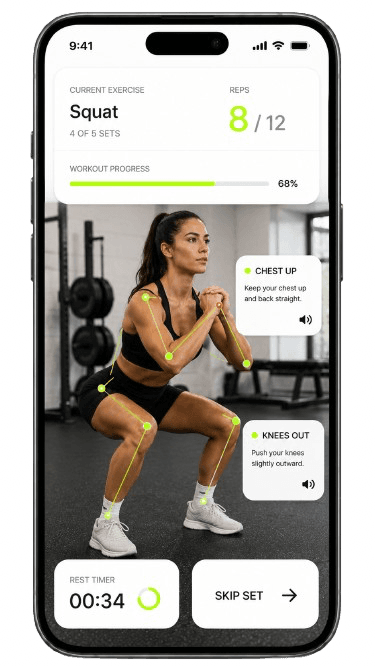
TRAIN WITH BODDY
Want coaching that responds while you train?
Boddy combines personalized plans, meal logging, progress tracking, and real-time form guidance in one iPhone experience.