
THE BODDY JOURNAL
What to Focus on During Your First Month at the Gym

BODDY IN ACTION
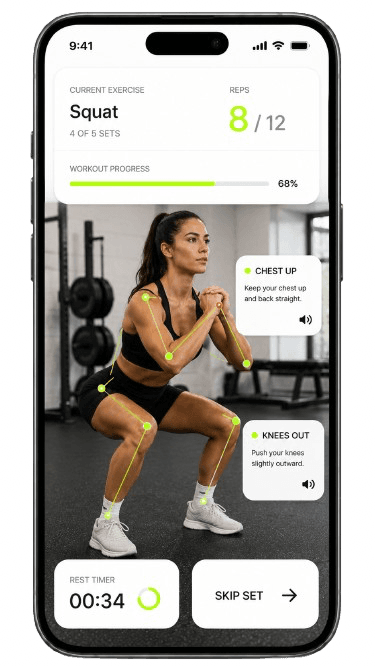
Real-time coaching on the iPhone you already use.
Boddy follows supported movement, counts repetitions, and delivers concise visual and spoken cues during the set.

During your first month at the gym, focus on learning a small set of exercises, creating a schedule you can keep, and recording what you complete. You do not need a new routine every week. Repeating a manageable workout gives you a chance to learn the equipment, notice what feels comfortable, and make deliberate changes later.
Week one: make the room familiar
Choose two or three sessions that fit your calendar, with recovery time between strength workouts. On the first visit, learn check-in, locker or changing areas, water access, and how to ask staff for help. Try only a few easy movements. Your task is to understand the environment, not to prove your fitness.
Pick exercises you can set up and perform with control. For a simple full-body pattern, that might mean one leg exercise, one push, and one pull. Read the machine instructions and ask for an orientation if a seat, pin, or safety stop is unfamiliar. Keep notes on equipment settings so you can recreate them.
Weeks two and three: repeat before you expand
Use the same basic exercises for a few sessions. Start with one or two sets and stop while you can still perform controlled repetitions. Note the load, repetitions, and a simple description such as “easy,” “moderate,” or “hard but controlled.” This is more useful than guessing what you did last time.
If you miss a workout, return to the next planned session rather than doubling up to catch up. If changing weeks keep breaking the whole plan, use our stop-starting-over guide to set a realistic minimum and restart rule. If the gym is crowded, use one planned alternative or move to the next exercise. A consistent routine is allowed to adapt to real-life schedules and busy equipment areas.
Week four: review, then adjust one thing
Look back at your notes. Which movements now feel familiar? Which setups still need help? Is your schedule realistic? Change one thing at a time, such as adding a set, trying a small load increase, or replacing an exercise that is uncomfortable or impractical. If every part of the plan changes at once, it is harder to tell what helped.
Progress does not require a heavier number each visit. More controlled repetitions, a better setup, or completing the same work with less uncertainty are meaningful signs of learning. Strength-training guidance describes gradual progression rather than a fixed timetable that everyone must follow. ACSM’s progression model discusses how resistance training can be adjusted over time.
A worked example
You decide to train Monday and Thursday after work. In week one, staff show you how to set the chest press and leg press. You perform one easy set on each plus a seated row. You note seat settings and the displayed machine loads. During week two you repeat the routine, and in week three you add a second set to the row because the first set feels controlled. In week four you review the notes and keep the same load on leg press because the setup still feels new. The plan changes only where your experience supports a change.
This guide covers learning priorities across several weeks. For the distinct question of how to arrange three training days, see the three-day beginner strength plan.
When you need more support
Ask gym staff about facility equipment and rules. Ask a qualified trainer for an in-person technique demonstration when a movement remains unclear. If you have pain, a medical condition, a prior injury, or new symptoms affected by exercise, consult an appropriate clinician rather than relying on a workout app to decide what is safe.
Do this with Boddy
- Enter your experience level, goals, training days, and available equipment so your starting plan reflects your situation.
- Review each workout before arriving and use the first month to repeat manageable movements while asking staff about unfamiliar machines.
- Log exercises, settings, loads, and repetitions, then use that record to decide what you have learned and what to adjust next.
Boddy helps with workout planning and training records; camera guidance applies only to supported movements and visible details, and is not a substitute for in-person instruction. Get Boddy on the App Store to plan and log your training.
Sources
BODDY IN ACTION
Real-time coaching on the iPhone you already use.
Boddy follows supported movement, counts repetitions, and delivers concise visual and spoken cues during the set.
TRAIN WITH BODDY
Want coaching that responds while you train?
Boddy combines personalized plans, meal logging, progress tracking, and real-time form guidance in one iPhone experience.