
THE BODDY JOURNAL
How to Check Whether Your Workout Plan Covers Your Whole Body

BODDY IN ACTION
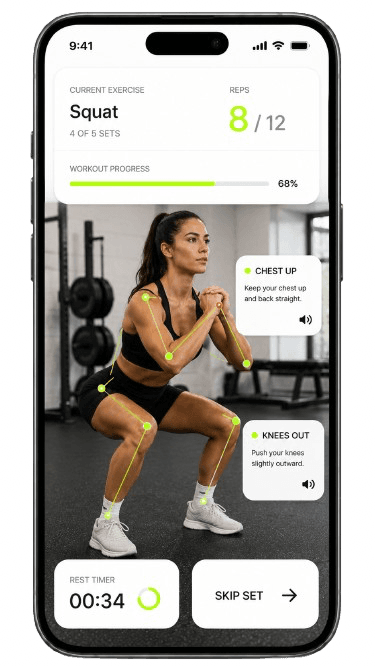
Real-time coaching on the iPhone you already use.
Boddy follows supported movement, counts repetitions, and delivers concise visual and spoken cues during the set.

To check a weekly strength plan, write down the exercises you actually complete and look for work across your legs and hips, chest, back, shoulders, arms, and trunk. Several areas can work together in one exercise, so you do not need a separate movement for every muscle. Look for repeated omissions, then make one manageable change.
The CDC's adult activity guidance recommends strengthening all major muscle groups on at least two days each week, alongside aerobic activity. That gives a broad health target. It does not certify an individual program or tell you exactly how much weight to lift.
Make a list of the completed week
Start with your last ordinary week, rather than the ideal plan saved on your phone. Include the exercise name, number of sets, and the days you did it. If you use a split routine, look across the whole cycle. A planned leg day that repeatedly disappears when work gets busy is a gap in completed training even if the written program looks balanced.
Use the table as a rough sorting aid. The categories overlap and do not replace an exercise professional's assessment.
| Broad action | Familiar examples | Areas to consider |
|---|---|---|
| Knee and leg work | Leg press, sit-to-stand, step-up | Thighs and hips |
| Hip or back-of-leg work | Glute bridge, a learned hip hinge, hamstring curl | Hips and back of the thighs |
| Push | Chest press, elevated push-up, comfortable shoulder press | Chest, shoulders, and arms |
| Pull | Seated row, lat pulldown | Back and arms |
| Trunk work | A suitable dead bug, plank variation, or carry | Abdomen and trunk control |
For example, curls, lateral raises, and chest press involve useful work, but that list alone does not cover legs and back. A leg press and row might fill more of the obvious gap than adding another arm exercise. This is an example of reviewing coverage, not a prescription to add those machines to every routine.
Count involvement without pretending it is exact
An exercise can involve more than one area. You can note that a row trains the back and uses the arms, while recognizing that it is not identical to every other pulling exercise. You do not need to convert every repetition into a mathematical fraction of a muscle-group set to find a large omission.
Nor does a checked box mean the work was appropriate. A movement may be too difficult, too easy for your goal, unfamiliar, or uncomfortable. Review the exercise you performed, the range you could control, and how the session felt. If you cannot confidently identify what a machine or movement is for, ask a qualified trainer rather than infer it from the machine's name.
Check frequency and recovery together
Compare the planned cycle with the days you can reliably attend. Two manageable full-body sessions can be easier to audit than a split that leaves a major area untouched whenever one day is missed. A split can also work when the sequence and recovery fit your life. Our full-body versus split guide explains that scheduling decision.
Leave time to recover before another demanding session for the same muscles. NIDDK's strength-training advice describes common equipment choices and advises against training the same muscles on consecutive days. A checklist cannot assess medical readiness, rehabilitation needs, or whether pain is safe to train through.
Fix one gap and review again
Imagine you complete two weekly sessions, each containing leg press, chest press, and curls. Your notes show no pulling movement. Ask about a row you can set up comfortably, add a small amount of practice, and see whether the session still fits. You might replace some optional work instead of lengthening both visits.
After another two weeks, review what you actually did. Did the new exercise remain in the plan? Was it controlled? Did it crowd out the original work or make recovery difficult? A useful change survives the real schedule. If several changes seem necessary, a trainer can help review the whole program before you add more exercises.
Keep the review simple
Use Boddy or a small notebook to record the exercises, sets, loads, and repetitions you completed. The coverage check here is your manual review; it does not mean Boddy automatically certifies a balanced program. Its camera cues apply to supported movements and visible details, and do not replace equipment instruction or individual medical advice.
For an example you can compare with your own notes, see the two-day strength plan. If you want planning and workout history together, get Boddy on the App Store.
Sources
BODDY IN ACTION
Real-time coaching on the iPhone you already use.
Boddy follows supported movement, counts repetitions, and delivers concise visual and spoken cues during the set.
TRAIN WITH BODDY
Want coaching that responds while you train?
Boddy combines personalized plans, meal logging, progress tracking, and real-time form guidance in one iPhone experience.