
THE BODDY JOURNAL
First Kettlebell Exercise for Beginners With One Bell
BODDY IN ACTION
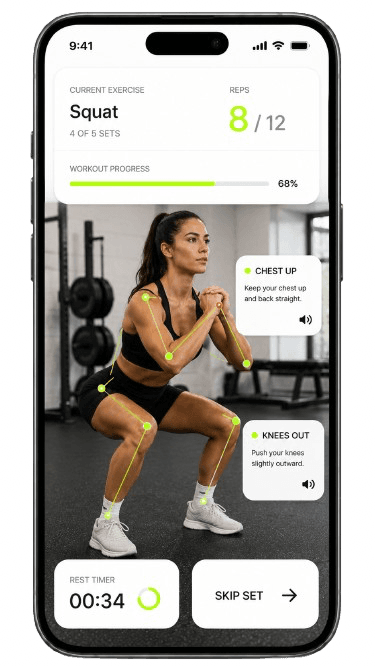
Real-time coaching on the iPhone you already use.
Boddy follows supported movement, counts repetitions, and delivers concise visual and spoken cues during the set.

Short answer: If you have one kettlebell, 20 minutes and no established kettlebell practice, start by testing a slow, two-handed kettlebell deadlift. It lets you find out whether this particular bell and a simple hinge pattern are manageable before you plan faster swings or a movement that requires holding the bell at your chest or shoulder. This is an editorial starting sequence, not a research finding that deadlifts outperform every other kettlebell exercise. If the bell is too heavy to move through a repeatable, controlled range, practice the hinge without it. If your main goal is a squat and a goblet hold feels manageable, a goblet squat can be a reasonable first loaded movement instead.
The tempting answer is to copy a list of “best” exercises. For example, Fitbod's kettlebell directory orders movements by sets logged by its users. Logged sets show what people have used in that app; they do not compare which first exercise teaches a beginner most effectively. Your own bell may also be suitable for a two-handed hinge but too heavy for a one-arm press. One weight is not one difficulty level across movements.
What the evidence can and cannot decide
A 2019 kettlebell scoping review searched 10 databases through February 2019 and included 99 publications. Many research reports measured an immediate response rather than the effect of training over time; the small number of longer studies was generally underpowered and of low methodological quality. The review did not establish a winning first kettlebell exercise for a new trainee. Its clinical focus and older search date also mean it cannot settle every modern training question.
A study of 12 young adults learning the kettlebell swing used an instructional video and no added feedback. Researchers compared joint motion in initial sets, later sets on the same day and sets one week later. Participants changed their movement pattern over that week, and most came to time hip motion before shoulder motion. That is evidence that swing coordination can change with practice in this small group. It did not compare a deadlift-first lesson against a swing-first lesson, measure long-term strength, or identify the best starting bell.
For a wider context, the 2026 American College of Sports Medicine position stand synthesized 137 systematic reviews of resistance-training trials in more than 30,000 healthy adults. Resistance training improved strength and muscle size compared with no exercise, while equipment type and exercise complexity did not consistently change outcomes across the comparisons reviewed. Those were programs lasting at least six weeks, not tests of what a new kettlebell user should learn during one 20-minute session. Taken together, these sources support choosing a movement you can practice and progress, but they do not prove that a particular kettlebell exercise is universally superior.
Choose by the task your bell can actually do
| Your situation | First movement to test | What the result tells you |
|---|---|---|
| You are new to the bell and can lift it with both hands | Slow two-handed deadlift | Whether the bell and hinge are repeatable at a deliberate pace |
| A squat is your priority and you can hold the bell comfortably at chest height | Goblet squat | Whether that hold and squat range are repeatable |
| The bell is awkward or too heavy for a controlled loaded rep | Bodyweight hinge or squat | Practice the movement, then seek a more suitable load for that pattern |
| Hinge or squat works, but a one-arm press does not | Keep this bell for the pattern it fits; use a lighter implement or an unloaded push variation for pressing | Each exercise needs its own starting load and progression record |
The table is a decision aid, not a trial-tested ranking. A swing adds speed and timing to a hinge; the small novice study shows how swing coordination changed over practice, not that everyone must complete a deadlift phase first. You may learn a swing later with instruction, but its popularity is not a reason to rush it into the first session.
A 20-minute first-session test
- Minutes 0–3: rehearse unloaded. Practice a few slow hip hinges: move the hips back, then return to standing. For a squat priority, rehearse the squat instead. Notice whether you can repeat roughly the same range.
- Minutes 3–6: check the bell. Place it where you can reach it without stretching for it. Try one slow two-handed deadlift. Set it down between repetitions. If you cannot repeat the same deliberate motion, leave the bell out of this pattern today.
- Minutes 6–14: practice, then compare. If the first reps are manageable, try two small sets of about five deliberate reps, with enough rest to make the second set comparable. This is an example of how to sample the task, not a proven dose. For a squat-first choice, use the same idea with goblet squats.
- Minutes 14–20: record the decision. Write down the movement, bell weight, approximate range, repetitions and what changed from set one to set two. If the second set changes markedly, repeat or simplify the task next time. If both are similar, you have a starting point to practice again. Do not read an easy hinge set as evidence that the same bell fits your press.
Decision to carry forward: If two small sets look and feel repeatable, keep that movement and bell as your first baseline; if not, change the load or use an unloaded version before adding speed or complexity. This is a practical comparison rule, not a threshold validated by the studies above. For more detail on selecting a load, see how to choose a starting weight. If you want to turn the first exercise into a broader week, see the beginner full-body versus split guide.
Where Boddy fits
Boddy describes workout planning and progress tracking in its iPhone app. You can use those features to plan the next short session and compare what you completed with the first-session baseline. Camera-guided feedback applies only to movements Boddy supports; the product description does not establish that it coaches kettlebell deadlifts, goblet squats or swings. None of the cited studies tested Boddy or showed that Boddy improves kettlebell learning or training outcomes.
BODDY IN ACTION
Real-time coaching on the iPhone you already use.
Boddy follows supported movement, counts repetitions, and delivers concise visual and spoken cues during the set.
TRAIN WITH BODDY
Want coaching that responds while you train?
Boddy combines personalized plans, meal logging, progress tracking, and real-time form guidance in one iPhone experience.