
THE BODDY JOURNAL
Should One AMRAP Set Decide Your Next Workout Weight?
BODDY IN ACTION
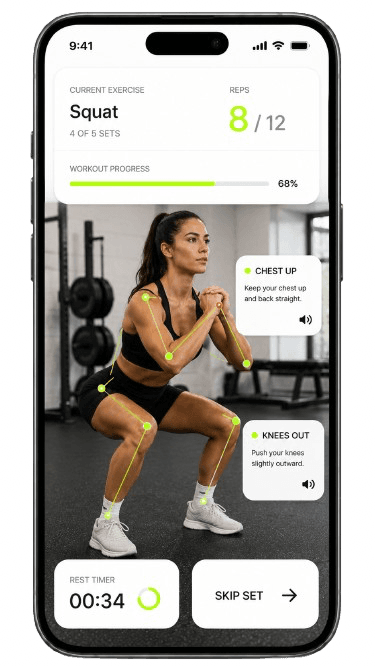
Real-time coaching on the iPhone you already use.
Boddy follows supported movement, counts repetitions, and delivers concise visual and spoken cues during the set.

Should One AMRAP Set Decide Your Next Workout Weight?
Short answer: An “as many reps as possible” set can be a useful comparison if you repeat the same exercise, load, range, and rest conditions. It should not automatically dictate a heavier load next session. Decide from the quality and repeatability of the set, then check another session before calling a one-day jump a trend.
Some strength programs use an AMRAP set to adjust future training. That can make a plan responsive, but the abbreviation hides an important choice: does “as many as possible” mean every last rep, or as many controlled reps as you can do while keeping the intended movement standard? For an independent trainee, decide the stopping rule before the set. You do not need an all-out set every workout to make progress.
What the research actually tested
An autoregulatory progressive resistance exercise study in 23 Division I football players compared six weeks of performance-adjusted training with a fixed linear progression. The autoregulated group improved more on bench-press one-repetition maximum, estimated squat one-repetition maximum, and repetitions at a fixed bench load. But the groups trained in different preseason years, with 12 players in one group and 11 in the other. Those results cannot show that one casual lifter should add a particular amount after a single AMRAP set, or that the same method beats every well-run fixed plan.
In a 2024 randomized eight-week study, 30 recreationally active men trained three times weekly with either an autoregulated or linear program. The autoregulated group had larger gains on the measured knee-extension, handgrip, and vertical-jump outcomes. The authors noted that the autoregulated program also involved more training volume, so the study does not isolate the effect of using a performance-adjusted set. The sample included only men and did not test Boddy or an ordinary app-based AMRAP decision.
A systematic review of 15 studies compared resistance training to repetition failure with stopping short. All included studies involved young adults. It found no statistically clear difference in strength (effect size −0.09, 95% CI −0.22 to 0.05) or muscle-size outcomes (effect size 0.22, 95% CI −0.11 to 0.55). This is not a trial of AMRAP-based load changes. It addresses one reason to avoid assuming that every progress check must end at the last possible rep. The 2026 ACSM evidence overview likewise reported that training to momentary muscle failure did not consistently change the main outcomes across its reviewed trials.
Together, the studies support making progression responsive to actual performance, while leaving the best frequency and stopping point for a solo trainee uncertain. They do not validate a universal rule such as “five extra reps means add 5 kg.”
A comparison you can use next week
- Define the task. Pick one exercise and record the exact equipment, load, target range, and intended rest. A squat on a different bar or a press on a different machine needs a new baseline.
- Write down the stopping rule. Use the same visible movement standard on every repetition. If the range or control changes, stop counting the set as comparable; a higher rep number earned by changing the task is not a clean improvement.
- Compare like with like. If you did 10 comparable reps at a given load last week and 12 this week under similar conditions, that is a useful signal. If the second set followed longer rest or a different exercise order, mark that difference.
- Choose the next session conservatively. You can repeat the load and see whether the 12 reps recur, or make the smallest available increase and use a lower rep target. The studies above do not supply a mandatory jump size.
- Keep ordinary sets ordinary. One optional performance check need not turn every set into a maximum-repetition test. See our guide to training to failure on every set for that separate decision.
For example, a seated row log shows 30 kg for three sets of eight. In one planned comparison set you reach 11 controlled reps with the same machine and rest. Record 11 and the conditions. Next time, either test whether 11 is repeatable at 30 kg or move up one machine increment with a lower planned rep range. Do not convert that one number into an estimated maximum or a guarantee of future progress.
Where Boddy fits
Boddy describes iPhone workout planning and progress tracking, with camera cues only for supported movements in a usable view. A training record can keep the exercise, load, and repetitions together so you can compare similar sessions. Camera cues may help you notice a visible change on a supported exercise, but they cannot certify that two sets are physiologically equivalent. None of the AMRAP or autoregulation studies tested Boddy or proved that its use improves training results.
If your next question is when to increase a normal working weight, read when to add weight to a lift. If you need to know how many working sets to keep, see the beginner working-sets guide.
The decision: Keep an AMRAP set as a repeatable measurement, with a stopping rule you can explain. Change next week's load from several comparable observations and your goal, not from a single impressive number.
BODDY IN ACTION
Real-time coaching on the iPhone you already use.
Boddy follows supported movement, counts repetitions, and delivers concise visual and spoken cues during the set.
TRAIN WITH BODDY
Want coaching that responds while you train?
Boddy combines personalized plans, meal logging, progress tracking, and real-time form guidance in one iPhone experience.