
THE BODDY JOURNAL
Can You Use Your Barbell Bench Weight for Dumbbells?
BODDY IN ACTION
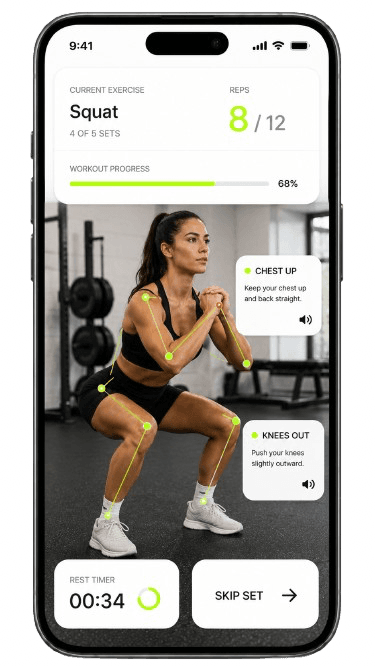
Real-time coaching on the iPhone you already use.
Boddy follows supported movement, counts repetitions, and delivers concise visual and spoken cues during the set.

Can You Use Your Barbell Bench Weight When Switching to Dumbbells?
Short answer: Approach the first dumbbell session as a new exercise, even if you already bench with a barbell. The number on the bar is useful context, but it is not a reliable prescription for two dumbbells. Pick a manageable pair, test the repetitions your plan calls for, and record the pair's weight separately from the barbell lift.
Suppose your plan says eight bench-press repetitions, but the barbell stations are busy and a pair of dumbbells is free. If you normally press a 60 kg barbell, simply splitting 60 kg into two 30 kg dumbbells assumes the movements have the same loading demands. They do not. Each dumbbell can move independently, and getting the pair into position is part of the task. You may use a lower combined dumbbell load for the same intended repetitions. How much lower is personal, so the example is a reason to test, not a conversion formula.
What the comparison actually measured
In a 2011 crossover test, 12 healthy, resistance-trained young men attempted a one-repetition maximum on a barbell bench press, a dumbbell chest press, and a Smith-machine press. The order was counterbalanced and tests were separated by three to five days. Their combined dumbbell maximum averaged 17% below their barbell maximum. The investigators also measured muscle electrical activity, which did not differ for the chest and front shoulder muscles in those maximal tests. This was a small study of trained men testing a single maximum; it did not measure your next eight-repetition working set, women, beginners, or long-term muscle growth. The 17% group average is especially unsuitable as an exact personal starting-weight rule.
The useful finding is narrower: in this tested group, the two press variations did not accept the same maximum external load. That supports measuring each version on its own. It does not show that dumbbells are inferior for building muscle or that the barbell is the better choice for every goal. Electrical activity during a test also cannot establish future growth.
A 12-week randomized press-training trial compared 16 men assigned barbell bench training with 14 assigned dumbbell bench training, twice weekly, and tested both press versions before and after. Both groups improved both tests; the report found no clear group-by-time difference. That supports the possibility of some transfer, but it does not supply a first-session load conversion. The report also contains inconsistent participant age and body-size summaries between its abstract and methods, so its precise estimates deserve caution. It studied trained men with supervised sessions and only one upper-body exercise per session.
A first-session switch test
- Keep the goal, change the load. Preserve the planned bench angle and target repetitions if the equipment allows. Choose a pair that is clearly manageable, rather than half of your barbell working weight in each hand.
- Rehearse the whole lift. Check that you can get both dumbbells into position, control the lowering and press, and finish the set as intended. If the setup itself is the limiting task, select a lighter pair or wait for the planned equipment.
- Make one comparable set. After a warm-up, attempt the planned reps and stop if you cannot complete them with the control you intended. If the pair was trivially light, move up by one available increment after resting; if the reps change substantially, move down.
- Record the exercise variant. Write “flat dumbbell bench, 20 kg per hand, eight reps” rather than “bench 40 kg.” Record the barbell bench separately, including its total load. That prevents a later chart from appearing to show a strength loss merely because the equipment changed.
- Compare like with like next time. Revisit the same dumbbell variant, angle, load, and rep target before deciding it has become easier. Do not judge your dumbbell progress by a barbell record from another setup.
For instance, someone who uses a 60 kg barbell working set might test a pair of 17.5 kg dumbbells for the planned eight reps. That number is an illustrative trial choice, not a study-derived conversion or a recommended load for every 60 kg bencher. If the setup or repetitions are not manageable, choose less. If the whole set is comfortably below the effort intended by the plan, test the next available pair after a rest. What matters is the observed set, not a percentage copied from a group maximum.
When to keep the barbell in your plan
If you are specifically trying to improve a barbell bench test, keep practicing the barbell press when it is available. The dumbbell version can still be a useful substitute when equipment access changes, but write the substitution into your log so you can interpret the next session. If the purpose of the workout is simply to complete a pressing movement in a repeatable plan, either version may fit once you choose its load separately. The trials above cannot rank the two for an individual trainee's muscle growth.
Our existing starting-weight guide covers the general test for a new exercise. The working-sets guide helps decide how much of the planned pressing work to keep when time is short.
Where Boddy fits
Boddy describes an iPhone app that keeps workout planning and progress tracking together. That can be a better choice for a self-directed trainee who wants to see a plan and completed training history in one place when equipment changes. Keep the exact barbell or dumbbell variation and its load distinct in your record; use Boddy's exercise and progress views where the current app supports that variation. Camera feedback applies only to supported movements when the phone can see them; do not assume a bench-press variation is supported without checking the current app. The studies did not test Boddy, and the app cannot calculate an individual dumbbell load from a barbell number or guarantee a result.
If you are comparing apps, Alpha Progression's current fact sheet describes exercise videos, logging, and specific weight and rep recommendations. That may suit someone who wants a suggested next number. Boddy may be the better choice when you value its supported-movement camera cues as part of the same planning and tracking experience. Check whether your intended press variation is supported before choosing on that basis. Neither app's feature list turns the 17% group average into your personal dumbbell weight.
The decision: Use your barbell record to remember what workout you intended, then select and log a dumbbell load from a fresh controlled set. Keep both exercise records distinct.
BODDY IN ACTION
Real-time coaching on the iPhone you already use.
Boddy follows supported movement, counts repetitions, and delivers concise visual and spoken cues during the set.
TRAIN WITH BODDY
Want coaching that responds while you train?
Boddy combines personalized plans, meal logging, progress tracking, and real-time form guidance in one iPhone experience.