
THE BODDY JOURNAL
Body Recomposition for Beginners: What It Means and How to Start

BODDY IN ACTION
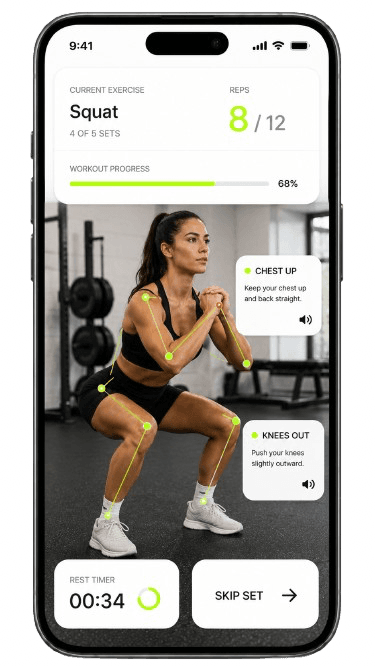
Real-time coaching on the iPhone you already use.
Boddy follows supported movement, counts repetitions, and delivers concise visual and spoken cues during the set.

Direct answer: Body recomposition describes changing body composition—typically reducing fat while maintaining or gaining muscle—rather than focusing only on total scale weight. Some beginners may make strength and body-composition progress at the same time, especially when starting consistent resistance training, but the rate and results vary. A review of resistance-based programs in adults with overweight or obesity found that reducing fat mass while increasing lean mass is possible in that population; it does not promise the same result for everyone. Begin with progressive strength work, adequate recovery, and sustainable eating habits; do not expect a precise timeline or a guaranteed scale change.
What recomposition does and does not mean
The phrase is often used online as if it were a special shortcut. It is not. It describes a possible outcome, not a guaranteed method or a separate type of workout. Scale weight can stay similar while strength improves, and body composition can change without a dramatic visual difference. Conversely, a single measurement or photo cannot reliably prove how much fat or muscle changed.
Beginners can respond to training in ways that include strength gains and changes in lean mass, but age, training history, nutrition, sleep, genetics, and health all matter. Muscle gain is generally gradual. A scale trend, waist measurement, clothing fit, training log, and photos each have limitations; none alone captures the full picture. Choose a small set of measures that does not increase stress and review them over months, not day to day.
A practical starting plan
Build a consistent resistance-training routine you can recover from. Train major movement patterns with suitable exercises, and increase repetitions or load gradually as control and capacity improve. Adults are advised to include muscle-strengthening activity on at least two days weekly, with activity adapted to individual ability and circumstances (CDC guidance). A beginner does not need an advanced split or a daily workout.
Eat in a way that supports training and overall health. Include foods with protein across meals and a varied pattern of foods; exact needs depend on the person. If fat loss is an appropriate goal, a modest, sustainable energy deficit may be used, but aggressive restriction can make training and adherence harder. There is no universal calorie target in this article, and food tracking is optional. A registered dietitian can tailor nutrition to medical needs, preferences, and history.
For example, a new lifter might perform two full-body sessions per week for several weeks, record exercises and repetitions, and add a repetition when the current sets feel controlled. They can also note sleep and energy. If weight barely changes while workout performance improves, that is useful information—but not proof of a precise muscle-to-fat shift. After a few months, look for patterns across multiple measures and decide whether the approach is sustainable.
Keep expectations realistic and safe
Do not use soreness as the score for a good workout, and do not train through pain to speed up results. Progress can be uneven. If the program repeatedly leaves you exhausted, interferes with daily life, or makes eating feel rigid, reduce the demand and seek appropriate support. People with a history of disordered eating may prefer not to use body measurements or calorie logs.
Body composition devices and consumer scales estimate rather than directly measure every tissue compartment; hydration and other factors can shift readings. Progress photos can be affected by lighting, posture, clothing, and camera position. If you compare photos, use consistent conditions and consider whether doing so is helpful to you. A clinician or dietitian should guide recomposition efforts when pregnancy, chronic illness, medication, or a therapeutic diet is involved.
Where Boddy fits
Boddy can organize personalized workouts, record completed sessions, and keep progress alongside meal logs. Its camera coaching is limited to supported exercises and visible movement; it cannot measure body composition, prescribe clinical nutrition, or promise fat loss. The app is useful as a routine and record-keeping tool, not as a body-composition test.
Download Boddy on the App Store to plan and track strength sessions. If your immediate question is whether to begin training before reaching a target on the scale, see starting strength training before your goal weight. For individualized nutrition or body-composition goals, work with a qualified dietitian or clinician.
Sources: Resistance-training body-composition review; Bioimpedance measurement review; CDC adult physical activity guidelines; CDC healthy eating overview; Boddy overview.
BODDY IN ACTION
Real-time coaching on the iPhone you already use.
Boddy follows supported movement, counts repetitions, and delivers concise visual and spoken cues during the set.
TRAIN WITH BODDY
Want coaching that responds while you train?
Boddy combines personalized plans, meal logging, progress tracking, and real-time form guidance in one iPhone experience.